Iran lawmaker cites fear of unrest for ongoing internet shutdown


Iranian lawmaker Amirhossein Sabeti said authorities are keeping international internet access restricted during the war due to fears it could be used to organize unrest.
“If the internet is fully reopened, some mercenaries, who are also armed, may organize gatherings through these networks,” he said.
Sabeti also referred to the national uprising on Jan. 8 and 9, during which security forces killed thousands of protesters, saying similar events could happen again if restrictions are lifted.
He said the shutdown was ordered by the Supreme National Security Council and would remain in place as long as war conditions persist.





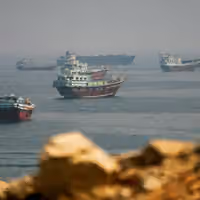
An Iranian proposal rejected so far by US President Donald Trump would reopen shipping in the Strait of Hormuz and delay nuclear talks, a senior Iranian official told Reuters.
The official said the plan would end the war and see Iran reopen the strait while the United States lifts its blockade, with negotiations on Tehran’s nuclear program moved to a later stage.
“Under this framework, negotiations over the more complicated nuclear issue have been moved to the final stage to create a more conducive atmosphere,” the official said.
Trump said on Friday he was not satisfied with the proposal. “They’re asking for things that I can’t agree to,” he told reporters at the White House.
The proposal comes four weeks after the United States and Israel paused strikes on Iran, with no agreement yet to end a conflict that has disrupted global energy supplies.
Iran’s rial weakened to around 1.83 million per US dollar in the open market on Saturday, extending a downward trend in the currency.
The euro traded around 2.15 million rials and the pound rose above 2.49 million rials, while gold prices also surged, with the so-called Emami coin - an official Iranian gold coin minted by the central bank - reaching about 2.07 billion rials.
The currency’s decline comes amid continued strain from the war and uncertainty over talks with the United States.
A US naval blockade in the Gulf of Oman has disrupted Iran’s oil exports, cutting billions of dollars in revenue and adding to pressure on the rial, while inflation and currency volatility continue to erode purchasing power.
Iran’s leadership is hardening its stance on the Strait of Hormuz, framing the waterway as a strategic and non-negotiable asset amid rising tensions and US pressure.
Statements have intensified following a message for National Persian Gulf Day attributed to Supreme Leader Mojtaba Khamenei.
In the message, he described the strait as a “strategic asset” and outlined a vision for the region’s future as “a future without America,” emphasizing the importance of “Iranian management of the strait.”
Parliament speaker Mohammad Bagher Ghalibaf signaled the shift most clearly, linking current policy to both strategic doctrine and historical precedent.
“Today as well, by exercising management over the Strait of Hormuz, Iran will ensure that it and its neighbors enjoy the valuable prospect of a future free from the presence and interference of America,” he wrote on X.
Yousef Pezeshkian, an advisor and son of Iran’s president, outlined possible scenarios for the war’s outcome, saying Iran has suffered damage but gained in global standing.
“Iran has been harmed economically due to infrastructure damage and in management capacity due to the loss of its best forces, but in terms of credibility and global position it has so far benefited,” he wrote in a post on his Telegram channel.
He said the war, which began with US and Israeli strikes on February 28, has produced mixed outcomes, while its final outcome remains uncertain.
Pezeshkian urged people to prepare for different scenarios. “We should prepare ourselves for the worst-case scenario… so we are not caught off guard,” he wrote, adding that people should also “live in the present” and not tie their well-being to uncertain future events.
He said planning for both negative and positive outcomes could help society better cope with the uncertainty of the conflict.
The Canadian opposition has accused the government of bypassing its own rules after Iran International reported that an IRGC-linked Iranian football official was granted special permission to enter the country despite being inadmissible.
Iran International’s reporting was followed by political backlash in Ottawa, international coverage and Mehdi Taj being turned back within hours of landing in Canada.
Speaking to Iran International’s Eye for Iran, Melissa Lantsman, deputy leader of Canada’s Conservative Party, said the case raised serious questions about who approved Mehdi Taj’s entry and why.
“We need to know who did it, when it happened, how it happened, why it happened, and why it’s never going to happen again,” Lantsman said.
Taj, president of Iran’s football federation, had been expected to travel to Vancouver for the FIFA Congress on April 30 at the Vancouver Convention Center.
Iran International previously reported that Taj was issued a Temporary Resident Permit, or TRP, a tool that allows Canadian authorities to admit a person who would otherwise be barred under immigration law.
Canada listed the IRGC as a terrorist entity in 2024, making people linked to the force inadmissible. Taj has longstanding ties to the Islamic Republic’s security establishment and previously served as an intelligence commander in the IRGC in Isfahan.
Lantsman said the permit showed that the issue was not simply a screening failure.
“Somebody actively made this decision to circumvent our own rules,” she said.
“I can’t believe that I work in a place with a minister who would issue a terrorist a permit.”
Taj was able to board a flight to Canada and land in Vancouver. He was sent back within hours, after Iran International’s reporting on the case had already become public.
That sequence has become central to the political fallout in Ottawa. Critics say the government acted only after the case drew public attention, while ministers have declined to discuss details, citing privacy rules.
Lantsman rejected that explanation in the podcast interview.
“We don’t give privacy to terrorists,” she said. “There is no privacy to people who are inadmissible to our country.”


The issue quickly reached Parliament.
Opposition MPs pressed ministers to explain how a person barred under Canada’s own rules received permission to enter the country.
At Thursday’s meeting of the Standing Committee on Public Safety and National Security in Ottawa, Conservative MP Frank Caputo asked Immigration Minister Lena Diab how a person deemed inadmissible had been granted entry.
Caputo said “the rule of law demands transparency” and asked “who gave him a visa,” saying Iran International’s reporting had brought the case to public attention.
Prime Minister Mark Carney declined to comment on Taj’s case, citing privacy laws, but defended the government’s position on the IRGC.
“Members of the [Iranian] Revolutionary Guard rightly have been prohibited from entering this country and they will not enter this country,” he said.
Foreign Affairs Minister Anita Anand suggested the permit may have been granted and later revoked, saying her understanding was that “there is a revocation of the permission” and that “it was unintentional.”
Lantsman said that response only deepened the need for answers.
“If they unintentionally gave him a permit, then we need to know how that happened and why it happened,” she said. “And if the unintentionality of it was about the revocation, that’s even worse.”
The controversy has turned a single immigration decision into a broader political test of Canada’s handling of officials tied to the Islamic Republic.
Although Canada has formally banned the IRGC, Temporary Resident Permits allow authorities to override inadmissibility in certain cases. Taj’s case has raised questions about how such exceptions are approved and what safeguards exist when national security concerns are involved.
The controversy also comes as anger continues over the Islamic Republic’s crackdown on protests in January, with the IRGC at the center of the state response. Rights groups and Iranian activists have described the violence as among the deadliest episodes in modern Iranian history.
At least three Iranian footballers have been killed during the unrest. Ali Karimi, Iran’s former national team captain, has criticized FIFA’s silence and called on the organization to condemn the killing of athletes and speak out against the crackdown.
Lantsman said the opposition has submitted formal questions in Parliament and would continue pressing the government for details.
“This cannot happen,” she said. “We’re going to continue to keep the pressure on.”
The case has also drawn wider attention beyond Canada. The New York Times, USA Today, Agence France-Presse and The Canadian Press have covered the incident, citing Iran International’s reporting.
For Lantsman, the central issue remains who approved the permit and why.
“Somebody in Canada, somebody very high up in the ministry, decides that it’s in public interest of Canada to have this person here,” she said.
The government has yet to publicly identify who authorized the permit, why it was issued, or what measures are being taken to prevent a similar case.