• العربية
  • فارسی
Brand
  • Iran Insight
  • Politics
  • Economy
  • Analysis
  • Special Report
  • Opinion
  • Podcast
  • Iran Insight
  • Politics
  • Economy
  • Analysis
  • Special Report
  • Opinion
  • Podcast
  • Theme
  • Language
    • العربية
    • فارسی
  • Iran Insight
  • Politics
  • Economy
  • Analysis
  • Special Report
  • Opinion
  • Podcast
All rights reserved for Volant Media UK Limited
volant media logo

Iran war has been 'terminated’, White House tells Congressional leaders

May 1, 2026, 20:25 GMT+1

President Donald Trump told congressional leaders on Friday that US hostilities with Iran “have terminated,” as his administration faces growing bipartisan pressure to seek authorization for the conflict after it passed the 60-day mark.

In letters to House Speaker Mike Johnson and Senate President Pro Tempore Chuck Grassley, Trump argued that the fighting had ended because the United States and Iran have observed a ceasefire since April 7.

“On April 7, 2026, I ordered a 2-week ceasefire. The ceasefire has since been extended. There has been no exchange of fire between United States Forces and Iran since April 7, 2026. The hostilities that began on February 28, 2026 have terminated,” Trump wrote.

The letters put in writing a claim War Secretary Pete Hegseth made during a Senate hearing on Thursday, as lawmakers questioned whether the administration must seek congressional approval under war powers rules.

Trump said the threat Iran poses to the United States and its military “remains significant,” but added that he would continue to direct US forces “consistent with my responsibilities and pursuant to my constitutional authority to conduct United States foreign relations” as president and commander in chief.

Most Viewed

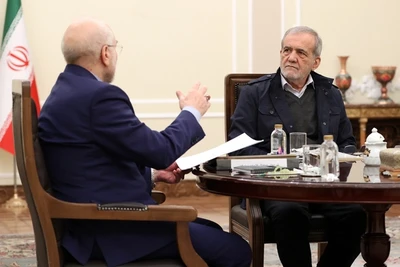
Pezeshkian, Ghalibaf seek Araghchi’s ouster over 'subservience' to Guards
1
EXCLUSIVE

Pezeshkian, Ghalibaf seek Araghchi’s ouster over 'subservience' to Guards

2
INSIGHT

Economics may decide outcome of Iran-US standoff

3
INSIGHT

How the Taliban tilted toward Iran during wartime tensions

4

US forms new coalition to secure Hormuz, asks partners to join

5
VOICES FROM IRAN

Iranians denounce tiered internet plan as discriminatory and corrupt

Banner
Banner

Spotlight

  • Iran faces internal instability fears as US blockade tests regime loyalists
    INSIGHT

    Iran faces internal instability fears as US blockade tests regime loyalists

  • Economics may decide outcome of Iran-US standoff
    INSIGHT

    Economics may decide outcome of Iran-US standoff

  • Ottawa on defensive after Iran football chief linked to IRGC entered Canada
    EXCLUSIVE

    Ottawa on defensive after Iran football chief linked to IRGC entered Canada

  • Soaring prices push medicine beyond Iranians' reach

    Soaring prices push medicine beyond Iranians' reach

  • Even state media sounds alarm as Iran’s economy sinks
    INSIGHT

    Even state media sounds alarm as Iran’s economy sinks

  • Tehran is pricing out its daughters
    TEHRAN INSIDER

    Tehran is pricing out its daughters

•
•
•

More Stories

Iran faces internal instability fears as US blockade tests regime loyalists

May 1, 2026, 19:33 GMT+1
•
Maryam Sinaiee

Rising prices for essential goods, inflation above 73%, and a surging dollar amid a fragile “no war, no peace” environment, US naval pressure, and political divisions have heightened concerns among some officials about internal instability.

Iran’s Parliament Speaker Mohammad Bagher Ghalibaf warned in a radio message on Wednesday that the United States had entered a new phase of the war to weaken Iran from within, or even make it collapse, through economic pressure, media campaigns, and a naval blockade.

Ghalibaf’s warning reflected a broader concern among political observers inside Iran that a prolonged naval blockade could impose escalating costs and, over time, prove more damaging than a direct military conflict.

Economic dissatisfaction is increasingly visible across media and social networks. Even before the recent conflict, rising economic pressures—reflected in the sharp increase in the dollar—had already driven days of protests and an exceptionally bloody crackdown in cities across the country. Those pressures have since intensified.

International affairs analyst Ali Bigdeli described the social climate in an interview with Khabar Online: “People are in an exhausting situation. At the societal level, signs of fatigue and restlessness are completely evident.”

He warned that a US naval blockade could be more dangerous than war itself and argued that authorities should move quickly toward negotiations with Washington, showing flexibility—even if that means temporarily halting parts of Iran’s nuclear program. “Ultimately, if no concessions are given to the United States, more complex internal social and political consequences may arise,” he added.

One reader commented: “I constantly have the feeling that people might pour into the streets soon—because of rising prices, internet shutdowns, and unemployment. Send this article to Mr. Ghalibaf so they move faster on reaching a deal; otherwise, things could turn.”

Risk of losing core supporters

Among government supporters, the current ceasefire period is described as a “war of resilience.” However, some warn that worsening economic conditions could erode the loyalty of core supporters—often referred to by conservatives as “The Street”—who backed the Islamic Republic during the conflict, while undecided “gray” segments of society may shift toward opposition.

Conservative figure Ali Gholhaki wrote that the war has entered a new phase, pointing to sharp increases in car prices, surging housing costs despite security risks, and rising currency and gold prices as signs of negative developments:

“The economic phase of the war is an essential part of the war itself. A new plan must be devised before the ‘street’ is lost!”

A user on X expressed similar concerns: “These days my fear is that the patience of the gray class will run out and, God forbid, we may experience another street conflict—even with revolutionary supporters present.”

Post-war economy under pressure

The fears are being amplified by a series of post-ceasefire indicators showing pressure spreading from prices and currency markets to employment.

According to the Statistical Center of Iran, the consumer price index rose 5% in Farvardin (March–April) compared to the previous month, reaching 73.5% year-on-year—over five percentage points higher than figures reported by the Central Bank of Iran earlier this week.

After a period of relative stability with the dollar below 1,600,000 rials, the exchange rate in the informal market rose to around 1,820,000 rials on April 30. While fears of renewed conflict played a role, rising inflation is also a key driver, analysts say.

Unemployment has surged sharply. A deputy labor minister said the 40-day war left 2 million people jobless. However, labor activist Hamid Haj Esmaeili estimates that including informal sectors and digital platforms, the real figure could be between 3 and 4 million.

The war has also disproportionately affected women’s employment. Zahra Behrouz Azar recently stated that nearly one-third of unemployment insurance claims filed over the past 40 days were submitted by women. Given their lower participation in formal employment, she described the figure as significant, noting it indicates a higher rate of women exiting the labor market—many of whom are heads of households.

According to new estimates by the International Monetary Fund, Iran’s economy is expected to contract by 6.1% due to the war, potentially leading to further unemployment and deepening poverty.

Expanding poverty and social risks

As inflation and unemployment rise, more Iranians are falling below the absolute poverty line. The head of Iran’s Welfare Organization reported in January that the population living in absolute poverty has doubled since 2018, reaching 44% (around 35 million people), with an additional 4 million experiencing extreme poverty.

Economic analyst Majid Goudarzi warned that if current trends continue, Iran could face “a combination of widespread unemployment, declining purchasing power, and rising poverty that will be very difficult to manage.”

Man arrested for using Starlink dies after beating by Iran security forces

May 1, 2026, 19:11 GMT+1

Hesam Alaeddin, a 40-year-old man detained in Tehran over his alleged use of Starlink satellite internet equipment to bypass the digital blackout, died after being severely beaten by government agents, a source familiar with the matter told Iran International.

Alaeddin was violently arrested and, after dozens of days, his family was told to collect his body, the source said.

He had gone to a hospital to follow up on the condition of his brother, Hamid Alaeddin, who had been shot during protests. Some of Hesam Alaeddin’s electronic devices were seized there.

A week later, when he went to retrieve the devices and follow up on the matter, he was arrested and taken to his home for questioning and a search, according to the source.

He was severely beaten at his home with various objects and died there, but authorities concealed his death and treated him as if he were still a living detainee.

Hesam Alaeddin was a relative of Ahmad Alaeddin, one of the owners of Tehran’s famous Alaeddin shopping center.

Trump says not satisfied with Iran's latest proposal

May 1, 2026, 17:26 GMT+1

US President Donald Trump says he is not satisfied about Iran's latest proposal, which was delivered via Pakistani mediators on Friday.

"We just had a conversation with Iran. Let's see what happens, but I would say that I'm not happy... They've got to come up with the right deal. At this moment, I'm not satisfied with what they're offering," he told reporters.

He praised Pakistan's mediation efforts, saying negotiations by phone were continuing.

"They've made strides, but I'm not ​sure if they ever get there," Trump said. "They're asking for things that I can't agree to."

US sanctions Iranian exchange houses involved in oil revenue transfers

May 1, 2026, 17:00 GMT+1

The US Treasury Department sanctioned three Iranian currency exchange houses and a network of associated front companies on Friday, saying they help the Islamic Republic convert oil revenues and sustain its war effort.

The Treasury’s Office of Foreign Assets Control said the designations target Opal Exchange, Radin Exchange and Tahayyori Guarantee Society, also known as Arz Iran Exchange, along with their owners and associates.

“Iran is the head of the snake for global terrorism, and under President Trump’s leadership, Treasury is moving aggressively, through Economic Fury, to sever the Iranian military’s financial lifelines,” Treasury Secretary Scott Bessent said.

“We will relentlessly target the regime’s ability to generate, move, and repatriate funds, and pursue anyone enabling Tehran’s attempts to evade sanctions,” he added.

The Treasury said Iranian exchange houses facilitate billions of dollars in foreign currency transactions each year and play a critical role because Tehran primarily settles its oil sales in Chinese yuan. The department said the exchange houses help convert those revenues into currencies more usable by Iran’s military, partners and proxies.

OFAC said Iran’s shadow banking networks handle tens of billions of dollars in trade annually, much of it linked to overseas oil and petrochemical sales.

The sanctioned individuals include Pedram Pirouzan, Hossein Mohammad Rezaei, Masoud Mohammad Rezaei, Nasser Ghasemi Rad and Ehsan Tahayyori.

The Treasury said Pirouzan and Ghasemi Rad used citizenship from Dominica and Saint Kitts and Nevis, respectively, to obscure their Iranian ties while setting up foreign front companies and bank accounts.

OFAC also designated a series of front companies, including entities registered in jurisdictions such as the United Arab Emirates and elsewhere, saying they helped Iranian exchange houses conduct transactions worth hundreds of millions of dollars on behalf of sanctioned Iranian persons.

Since February 2025, OFAC has sanctioned more than 1,000 Iran-related individuals, vessels and aircraft as part of the campaign, the Treasury said.

Iran still has ‘many things’ to do in revenge, Tehran cleric says

May 1, 2026, 16:53 GMT+1

“The enemy should know that we will not let them go and will avenge Khamenei and every single person killed,” Tehran’s Friday prayer leader Mohammad-Javad Haj Ali-Akbari said.

“We have still not taken revenge for Qassem Soleimani, and we have many things to do,” he said during his sermon in Tehran.

He also praised Iran’s negotiating team, led by Parliament Speaker Mohammad Bagher Ghalibaf, and Foreign Minister Abbas Araghchi, saying they had rejected the enemy’s demands.

“We thank the negotiating team and its head, Mr. Ghalibaf, and the foreign minister for rejecting the enemy,” Haj Ali-Akbari said. “If Haj Bagher manages to fire at the heart of Satan with his missile of diplomacy, all the better. Otherwise, Seyed Majid (Mousavi) will fire at the heart of Satan with his launcher and real missile,” he said, referring to the IRGC aerospace commander.