Iran warns of 'unprecedented' response to US naval blockade - State media
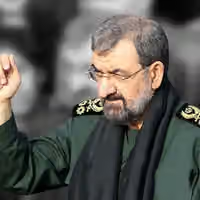
A senior Iranian security source warned that continued US naval actions around the Strait of Hormuz could face a “practical and unprecedented” military response, Press TV reported on Wednesday, citing a “high-ranking security source”.
The source said Iran’s armed forces, operating under the Khatam al-Anbiya Headquarters, believed patience had limits and could act if Washington maintained what it described as a naval blockade.
The source added that restraint so far had been aimed at allowing diplomacy to continue, but warned that a different response could follow if Iran’s conditions were not met, according to the report.
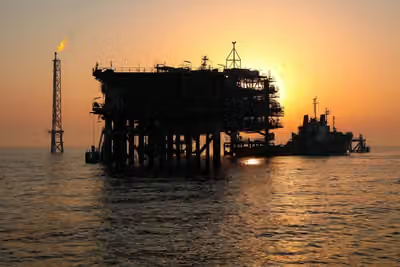
A 29-year-old Iranian supertanker appeared at Kharg Island after years off the radar, suggesting Tehran may be using retired vessels to keep loading oil as storage space runs out, Bloomberg reported on Wednesday.
The Nasha, an Iran-flagged very large crude carrier built in 1997, was docked Sunday at Kharg Island, Iran’s largest oil export terminal, according to the report, which cited satellite images also reviewed by United Against Nuclear Iran.
British Prime Minister Keir Starmer said on Wednesday the stabbing of two people outside a synagogue in London was “deeply concerning” and backed a police investigation into the incident.
“It is deeply concerning to everyone in this house,” Starmer told lawmakers, adding that authorities must be clear in their determination to address such offenses.
Two people were stabbed outside a synagogue in Golders Green, London, on Wednesday, and a suspect was arrested, emergency responders said.
Shomrim, a Jewish community patrol group, said its volunteers detained a man seen running with a knife before police arrived, used a Taser and took him into custody.
The victims were being treated by the Hatzola ambulance service, it said.
The US dollar passed 1.81 million rials on Iran’s open market on Wednesday, rising nearly 8% in a single day as the country’s economic crisis worsened under the strain of maritime blockade, stalled diplomacy and mounting pressure on households.
The euro and pound also rose sharply, passing 2.11 million rials and 2.44 million rials respectively.
Gold prices also climbed, with the benchmark Emami coin rising about 6.5% to 2.08 billion rials, reflecting the role of gold as a common store of value for Iranians trying to protect savings from the rial’s decline.
The surge comes as the US blockade of Iranian ports and the Strait of Hormuz remains in place despite President Donald Trump’s extension of a temporary ceasefire with Tehran earlier this month.
Uncertainty over talks between the United States and the Islamic Republic, Tehran’s insistence on continuing its nuclear and missile programs and support for regional proxy groups, and the broader “neither war nor peace” situation have pushed Iran’s economy into deeper instability.
On April 28, Trump said the Islamic Republic had informed Washington it was in a “state of collapse” and wanted the Strait of Hormuz blockade lifted.
The Wall Street Journal later reported, citing US officials, that Trump had instructed aides to prepare for a prolonged maritime blockade of Iran.
Women look at the gold shop display in Tehran Bazaar, amid a ceasefire between US and Iran, in Tehran, Iran, April 21, 2026.
Cost of living crisis
The currency jump follows weeks of worsening economic conditions inside Iran.
On February 25, the final working day before the war began, the dollar stood at 1.65 million rials, while the euro was 1.95 million rials and the pound 2.24 million rials on the open market.
Messages sent to Iran International in recent days point to a rapidly worsening cost-of-living crisis, with viewers reporting mass layoffs, sharp increases in basic goods, medicine shortages, food insecurity and inability to pay rent.
The internet blackout, now stretching into its third month, has added to the pressure by cutting off online work, e-commerce and freelance income for millions of Iranians.
One doctor told Iran International that many patients could no longer afford their medicines, citing seizure medication whose price had more than tripled even though some patients need two or three packs each month.
A former worker at the Marvdasht petrochemical complex in Fars province said he had been laid off two months ago and had reduced his household’s food consumption to one meal a day.
“I have an elderly mother and I am ashamed before her,” he said. “We have reduced our food consumption to one meal a day, and even that is barely manageable. I have not paid rent either. The situation is terrible.”
On Tuesday, Mohsen Zanganeh, a member of parliament’s planning and budget committee, said in a post on X that during a meeting on Iran’s postwar economic situation, one participant warned that the country was nearing “economic collapse.”
German Chancellor Friedrich Merz said on Wednesday his relationship with US President Donald Trump remained good, after Trump criticized him over comments on the war in Iran.
“From my perspective, my personal relationship with the US President remains good,” Merz said, adding he had expressed doubts from the start about the war in Iran.
Trump said in a social media post on Tuesday that Merz did not know what he was talking about after the German leader voiced criticism of the conflict.