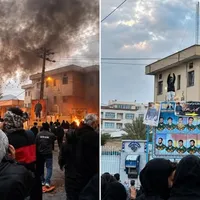
The United States and Iran are not as far apart as they appear despite failing to hold a second round of talks in Pakistan, CNN reported on Tuesday, citing sources familiar with the mediation process.
The sources said intense diplomacy was continuing behind the scenes, with talks centered on a staged process.
The first part of a potential deal would focus on returning to the pre-war status quo and reopening the Strait of Hormuz without restrictions or tolls, CNN reported.
Iran’s nuclear program would be addressed later, though US President Donald Trump has said any deal must require Tehran to give up near bomb-grade uranium and end enrichment, demands Iran has rejected, according to the report.
Mediators are pressing both sides to reach an agreement, with the next few days seen as crucial, the sources said.
Iran’s near-total shutdown of the global internet reached 60 days on Tuesday, worsening economic losses and social restrictions as authorities move toward selective access for some users and businesses.
The disruption began on February 28, when connectivity dropped to a fraction of normal levels, according to internet monitor NetBlocks, and has since stretched beyond 1,400 hours with most users still cut off from global networks.
“Exactly two months ago … Iran was thrown into digital darkness,” NetBlocks said, adding that the blackout persists despite limited access for privileged users.
Economic toll runs into billions
The prolonged shutdown has transformed internet access into a central economic constraint, with losses mounting daily across multiple sectors.
Estimates from Iran’s Chamber of Commerce put direct daily losses at $30 million to $40 million, rising to as much as $70 million to $80 million when indirect damage is included.
Communications Minister Sattar Hashemi said the disruption threatens the livelihoods of around 10 million people, pointing to the limited resilience of small and medium-sized businesses.
Zahra Behrouz-Azar, the vice president for women’s affairs, said women have been disproportionately affected, with many home-based businesses collapsing under the restrictions.
“The situation has been imposed like a war, and the damages should not be denied,” Behrouz-Azar said.
Export industries have also struggled to maintain international ties. Mohsen Ehtesham, the head of the National Saffron Council, said exporters had been unable to communicate with overseas clients or verify deliveries.
“Exporters … did not have direct contact with international customers, and could not even confirm whether goods had reached them,” Ehtesham said.
He added the disruption had weakened Iran’s position in global markets and created openings for competitors such as Afghanistan to rebrand Iranian saffron.
Beyond the economic toll, the blackout has disrupted daily life and created a two-tier digital reality, with limited access granted to select groups while most Iranians remain cut off.
For younger Iranians, internet access is closely tied to education, identity and social life, making the prolonged shutdown especially disruptive.
The divide has become more visible as officials and connected groups retain access to platforms blocked for ordinary users, while much of the population remains limited to a heavily restricted domestic network.
Human rights groups say such shutdowns restrict access to information, make abuses harder to document and leave crises with less public scrutiny.
Authorities have sought to manage the fallout by advancing a plan known as “Internet Pro,” which would restore global access for selected businesses and institutions while most users remain restricted.
Under the proposal, approved by the Supreme National Security Council, commercial entities and later industrial sectors would receive connectivity, with officials presenting the measure as a form of economic management.
Government spokesperson Fatemeh Mohajerani said the plan aims to preserve business operations during crisis conditions.
“Internet Pro has been approved … to preserve business connections under current conditions,” Mohajerani said, adding that access could change once authorities declare conditions normal.
The plan has drawn criticism for formalizing unequal access. Reports show some connections have been sold at high prices, prompting judiciary chief Gholamhossein Mohseni Ejei to order an investigation, describing the practice as discriminatory and potentially corrupt.
Civil society pushes back
Professional groups and users have rejected the proposal, describing it as institutionalizing digital inequality.
The Iranian Graphic Designers Guild said it would not submit a collective request for the service, calling it an insult and reaffirming the need for open and affordable access for all.
Public reaction has echoed that stance, with users criticizing the idea of restricting connectivity in an era where digital access underpins economic survival and social participation.
At the same time, authorities are accelerating development of domestic infrastructure aimed at reducing reliance on the global internet, a move critics view as enabling longer-term isolation.
The first liquefied natural gas shipment since the Iran war began two months ago appeared to have crossed the Strait of Hormuz and exited the Persian Gulf, Bloomberg reported on Tuesday.
The Mubaraz, which loaded LNG from Abu Dhabi National Oil Co.’s Das Island facility in the UAE around early March, was passing the southern tip of India, the report said, citing ship-tracking data.
The tanker had been idling inside the Persian Gulf before it stopped sending a signal around March 31, according to the report.
Iran’s ambassador to Pakistan on Tuesday thanked Pakistani officials for facilitating and arranging talks with the US, praising their diplomatic efforts.
Reza Amiri Moghadam expressed appreciation to Pakistan’s Deputy Prime Minister and Foreign Minister Muhammad Ishaq Dar and diplomats at Pakistan’s foreign ministry.
He said their work helped turn political will into practical arrangements needed for diplomacy.
“This is diplomacy in its truest sense, not merely words, but the quiet, persistent labor that makes dialogue possible and peace attainable,” he wrote on X.
Iran’s government spokeswoman said on Tuesday there was “no problem” in the country’s decision-making process, citing US President Donald Trump’s remarks about negotiations with Tehran.
Fatemeh Mohajerani referred to Trump’s social media posts, saying they may aim at “creating confusion and dispersing public opinion.”
She said decisions were made based on national interests and through the relevant institutions, citing what she called coordination among Iran’s branches of power.
“The president, as head of the Supreme National Security Council, is fully aware of matters,” Mohajerani said.
Iran’s digital darkness entered its 60th day on Tuesday, with the public largely cut off from the global internet, monitoring group NetBlocks said.
“Metrics show the blackout is now entering its 60th day after 1416 hours despite regime efforts to introduce tiered access for privileged groups,” it said in a post on X.