Trump hits out at Merz, says US doing ‘what others should have done’ on Iran


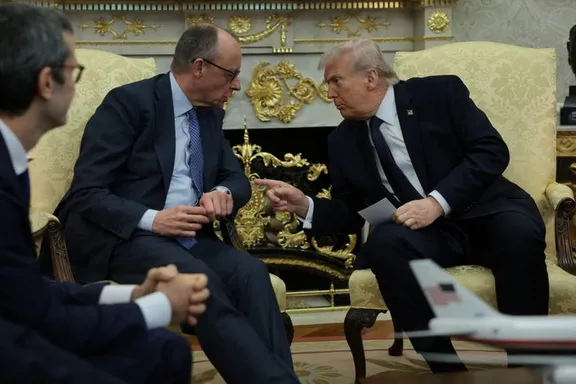
US President Donald Trump criticized German Chancellor Friedrich Merz over his remarks about Tehran, saying the German leader “thinks it’s OK for Iran to have a Nuclear Weapon”.
“He doesn’t know what he’s talking about!” Trump wrote in a post on Truth Social. “If Iran had a Nuclear Weapon, the whole World would be held hostage.”
“I am doing something with Iran, right now, that other Nations, or Presidents, should have done long ago,” he said, before linking his criticism to Germany’s broader situation: “No wonder Germany is doing so poorly, both Economically, and otherwise!”
Trump's remarks came after Merz said on Monday the US was being “humiliated” by Iran.


US forces on Tuesday boarded a commercial ship in the Arabian Sea suspected of attempting to violate the blockade on Iranian ports, before allowing it to continue after determining it was not bound for Iran, according to a statement from United States Central Command.
“Earlier today in the Arabian Sea, US Marines from the 31st Marine Expeditionary Unit boarded M/V Blue Star III… [and] released the vessel after conducting a search and confirming the ship’s voyage would not include an Iranian port call,” the statement said.
CENTCOM added that US forces “continue to operate and enforce the blockade across the Middle East,” noting that 39 vessels have so far been redirected to ensure compliance.
Israeli forces demolished two Hezbollah tunnels in southern Lebanon using hundreds of tons of explosives, triggering earthquake alerts across parts of northern Israel in an unusual aftermath of the operation.
According to Israeli military officials, the tunnels were built “to Iranian standards,” with Iran directly involved in their planning and funding.
In a statement, the Israel Defense Forces said its troops dismantled the tunnels in the Qantara area, adding that the network stretched roughly two kilometers in total and was destroyed using more than 450 tons of explosives.
The military said the tunnels contained over 30 rooms used for lodging and operational planning, as well as around 30 shafts.
Residents in northern Israel had been notified ahead of the blasts, but the scale of the detonation still triggered earthquake warning systems, according to initial reports.
As efforts continue to revive talks with the United States, Iranian lawmakers and state-linked outlets are increasingly calling for secrecy around negotiations.
The growing calls for secrecy may reflect an effort to control the narrative as divisions emerge at home over how far Iran should go in any negotiations.
Ahmad Bakhshayesh Ardestani, a member of parliament’s National Security and Foreign Policy Committee, told reporters on Monday that “not everything about the negotiations needs to be stated openly.”
He compared diplomacy to marriage negotiations, where each side conceals parts of its background until after an agreement is reached, insisting that secrecy does not contradict transparency with the public.
As efforts continue to revive talks with the United States, Iranian lawmakers and state-linked outlets are increasingly calling for secrecy around negotiations.
The growing calls for secrecy may reflect an effort to control the narrative as divisions emerge at home over how far Iran should go in any negotiations.
Ahmad Bakhshayesh Ardestani, a member of parliament’s National Security and Foreign Policy Committee, told reporters on Monday that “not everything about the negotiations needs to be stated openly.”
He compared diplomacy to marriage negotiations, where each side conceals parts of its background until after an agreement is reached, insisting that secrecy does not contradict transparency with the public.
Iran used similar tactics at least twice in recent history: during the release of American hostages in January 1981 after 444 days in captivity, and in August 1988 when it accepted the ceasefire that ended the eight-year war with Iraq.
On Tuesday, ultraconservative lawmaker Amir Hossein Sabeti, a prominent anti-US figure, called for “nuclear ambiguity,” arguing that the United States and Israel would have used nuclear weapons against Iran had they known the exact location of Iran’s enriched uranium stockpiles.
His remarks coincided with similar statements from other lawmakers urging officials not to speak publicly about Iran’s positions on the nuclear issue or the Strait of Hormuz—two of the central obstacles in diplomatic efforts to break the deadlock in Iran-US relations.
US President Donald Trump said on Tuesday that Tehran had told Washington it wanted the Strait of Hormuz reopened “as soon as possible,” suggesting efforts to revive talks may include discussions over shipping through the strategic waterway.
In a Truth Social post, Trump said Iran was in a “state of collapse” and was trying to resolve “their leadership situation,” though Tehran has not publicly commented on the claim.
In Tehran, conflicting public statements have underscored divisions within the political establishment over the talks.
Ultraconservative MP Ali Khezrian told state broadcaster that all doors of negotiation with the United States were shut down” adding that no messages were being exchanged through intermediaries.
Yet other lawmakers have acknowledged that talks are continuing, including Ardestani, who said, “we cannot stop negotiating … we have won the war, and we need to establish our victory in negotiations.”
Khezrian and Ardestani both said hardline cleric and lawmaker Mahmoud Nabavian—who accompanied the Iranian delegation to Islamabad during the first round of talks—was there only to brief parliament afterward.
Nabavian later said it had been “a mistake” to include the nuclear issue in the discussions.
In a report published on April 27, Khabar Online cited conservative commentator Mohammad Mohajeri criticizing lawmakers and some officials for making “uncalculated” statements on foreign-policy matters, including Iran’s position on the Strait of Hormuz.
According to the report, remarks about imposing taxes on shipping, proposing a “new legal regime” for the waterway, or using the term “closure of the strait” instead of “control” have raised concerns they could harm Iran’s national interests and create legal complications.
Khabar Online also warned lawmakers not to undermine the authority of the Supreme National Security Council, which coordinates national-security and foreign-policy positions.
The United Kingdom has summoned Iran’s ambassador to London over what it called “unacceptable and inflammatory” social media comments by the Iranian embassy, according to an official statement.
The Foreign, Commonwealth & Development Office said Middle East minister Hamish Falconer raised the issue directly with the envoy, stressing that the embassy “must cease any form of communications that could be interpreted as encouraging violence in the UK or internationally.”
The move comes after Iran’s embassy in London drew scrutiny for a social media post calling on “proud Iranian compatriots” in the UK to join a “Jan Fada” — or “sacrificing life” — campaign, urging supporters to show “solidarity, loyalty, and national zeal.”
The message, which included a line stating, “Let us all… give our bodies to be slain,” prompted concern among security experts and members of the Iranian diaspora, with critics warning it could be interpreted as encouraging violence despite the embassy’s claim that the initiative “does not promote any form of hostility.”
The British government's statement on Tuesday said that such actions were “completely unacceptable,” and reiterated that the UK government would continue to call out what it described as Iran’s “malign activities” on British soil, as well as its actions against regional allies and its own population.
London said safeguarding national security remains its top priority and that it would take all necessary steps to protect the public.