Iran police arrest person accused of ties with ‘hostile media’
Police in Iran’s southwestern province of Fars said on Tuesday they had identified and arrested a person in Sarvestan accused of cooperating with “hostile media.”
Police in Iran’s southwestern province of Fars said on Tuesday they had identified and arrested a person in Sarvestan accused of cooperating with “hostile media.”




The United States will not negotiate through the press and remains firm on its red lines in dealings with Iran, a White House spokeswoman said.
“The United States will not negotiate through the press — we have been clear about our red lines and the president will only make a deal that’s good for the American people and the world,” Olivia Wales said.
Her comments came as US officials reviewed Iran’s latest proposal related to reopening the Strait of Hormuz and ending the war, according to a New York Times report.
The report also cited US officials as saying that Iran’s leadership has not authorized its negotiators to make concessions on the country’s nuclear program, complicating efforts to reach a compromise or broader peace deal.
Iran’s foreign trade has suffered a sharp contraction in the first month of war with the United States and Israel, newly released customs data show, signaling a severe blow to the country’s already fragile economy.
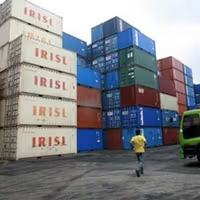
Figures from Iran’s customs administration show non-oil trade collapsed in the final month of the previous Iranian fiscal year (February 21–March 22), falling to just $6.4 billion—down 30% from the previous month and 50% from a year earlier.
The plunge coincided with military escalation that began on February 28, when US and Israel attacked Iran and Iran retaliated with strikes against Arab neighbours across the Persian Gulf.
The conflict disrupted shipping routes and strained regional trade links.
The fallout has been especially visible in trade with Iran’s main commercial partners. The United Arab Emirates, Iran’s second-largest trading partner, reportedly suspended trade with Tehran in early March.
Chinese customs data also point to a steep decline in bilateral trade. China’s non-oil trade with Iran fell to just $184 million in March, compared with more than $907 million in the same month last year—roughly one-fifth of its level a year earlier.
While Iranian customs data exclude crude oil exports, tanker-tracking data from Kpler indicate Iranian crude deliveries to Chinese ports averaged around 1.53 million barrels per day in March, about 15% lower than in March 2025, suggesting energy exports are also under pressure.
In total, Iran’s non-oil foreign trade during the last fiscal year stood at $109 billion, down 16% from the previous year. Imports accounted for 53% of the total, underscoring the economy’s reliance on foreign supplies at a time of escalating geopolitical disruption.
The outlook may worsen in the months ahead.
Following Israeli strikes on petrochemical facilities, Iran has banned petrochemical exports. On Monday, the Iran Trade Promotion Organization ordered a halt to exports of steel slabs and sheets until May 30 as the country’s steel industry came under pressure following US-Israeli strikes.
The secretary of Iran’s steel producers’ association said work was underway on an urgent plan to import steel slabs and hot-rolled sheets, underscoring the scale of the disruption.
At the same time, steel production facilities in Isfahan and Khuzestan—which account for roughly 70% of Iran’s steel output—have reportedly suffered major damage.
Together, petrochemicals and steel generate an estimated $18 billion to $20 billion in annual exports, accounting for more than one-third of Iran’s non-oil export revenues. Prolonged disruption in those sectors would hit government revenues, industrial output and access to foreign currency.
Additional pressure is also emerging at sea. In response to Iran’s move to block the Strait of Hormuz, the United States has begun enforcing a naval blockade on Iran, a development likely to further restrict both oil and non-oil trade.
With US-Iran diplomacy still deadlocked and sanctions relief appearing distant, the outlook could worsen further in the absence of a deal to ease pressure on trade and energy exports.
Taken together, the data suggest Iran may be facing not a temporary slowdown but the early stages of a historic external shock.
In Tehran, Abbas Araghchi’s whirlwind regional tour is being presented as evidence that Iran still has diplomatic options and regional leverage.
But behind the official narrative, even Iranian media and senior officials are beginning to acknowledge a harsher reality: talks with Washington are stalled, allies are limited and the country’s room to maneuver is narrowing.
The reformist daily Shargh wrote on Monday that the visits revealed “clear signs of a deadlock in negotiations with Washington.”
In an interview with ISNA, Araghchi himself acknowledged that “the first round of talks in Islamabad failed to reach its objectives,” blaming what he described as “the United States’ excessive demands.”
Read the full article here.
Iran’s unused onshore oil storage capacity may last 22 days or less at current production rates as the US blockade constrains exports, according to data cited by Kpler.
The shrinking storage window increases the risk that Tehran may soon be forced to make deeper production cuts.
Analysts warn prolonged cuts could damage reservoir pressure in mature oil fields and reduce long-term recovery rates.
Oil prices continued their steady rise on Tuesday, extending gains for a seventh straight session as diplomatic efforts to halt the conflict between the United States and Iran remained at a standstill.
Brent crude futures for June delivery rose 45 cents, or 0.4%, to $108.68 a barrel by midnight London time after surging 2.8% in the previous session.
US West Texas Intermediate crude for June delivery climbed 58 cents, or 0.6%, to $96.96 a barrel, building on a 2.1% gain in the prior trading day.