• العربية
  • فارسی
Brand
  • Iran Insight
  • Politics
  • Economy
  • Analysis
  • Special Report
  • Opinion
  • Podcast
  • Iran Insight
  • Politics
  • Economy
  • Analysis
  • Special Report
  • Opinion
  • Podcast
  • Theme
  • Language
    • العربية
    • فارسی
  • Iran Insight
  • Politics
  • Economy
  • Analysis
  • Special Report
  • Opinion
  • Podcast
All rights reserved for Volant Media UK Limited
volant media logo

Oil prices rise for seventh day as US-Iran diplomacy stalls

Apr 28, 2026, 03:45 GMT+1

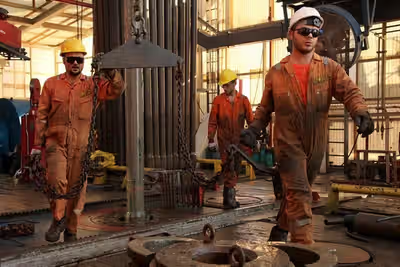
Oil prices continued their steady rise on Tuesday, extending gains for a seventh straight session as diplomatic efforts to halt the conflict between the United States and Iran remained at a standstill.

Brent crude futures for June delivery rose 45 cents, or 0.4%, to $108.68 a barrel by midnight London time after surging 2.8% in the previous session.

US West Texas Intermediate crude for June delivery climbed 58 cents, or 0.6%, to $96.96 a barrel, building on a 2.1% gain in the prior trading day.

Most Viewed

The hidden target in US war on Iran may be China
1
PODCAST

The hidden target in US war on Iran may be China

2
INSIGHT

Unity or fracture? Tehran battles Trump’s narrative of disarray

3

Is the US blockade working? It depends who you ask

4
EXCLUSIVE

New intelligence exposes IRGC-linked network targeting Israeli, Western sites

5
INSIGHT

Is Ghalibaf becoming Iran’s Khrushchev?

Banner
Banner

Spotlight

  • Iran’s foreign trade suffers wartime collapse
    ANALYSIS

    Iran’s foreign trade suffers wartime collapse

  • Did Araghchi’s tour signal leverage or isolation?
    INSIGHT

    Did Araghchi’s tour signal leverage or isolation?

  • Why a blockade would not halt Iran’s oil overnight
    ANALYSIS

    Why a blockade would not halt Iran’s oil overnight

  • Iran football chief with IRGC past to visit Canada for FIFA event
    EXCLUSIVE

    Iran football chief with IRGC past to visit Canada for FIFA event

  • New intelligence exposes IRGC-linked network targeting Israeli, Western sites
    EXCLUSIVE

    New intelligence exposes IRGC-linked network targeting Israeli, Western sites

  • Is Ghalibaf becoming Iran’s Khrushchev?
    INSIGHT

    Is Ghalibaf becoming Iran’s Khrushchev?

•
•
•

More Stories

Why a blockade would not halt Iran’s oil overnight

Apr 28, 2026, 03:23 GMT+1

Amid Iran’s closure of the Strait of Hormuz and the ensuing US blockade, an old energy fantasy has resurfaced that cutting off a country’s oil exports works like flipping a switch. But reality is less cinematic and far more uncomfortable.

If Iran faced a serious maritime blockade, its oil system would not collapse overnight. It would absorb the shock, adapt, and only gradually tighten under pressure.

That distinction between sudden failure and slow strain is not just technical. It is the difference between a crisis markets can price instantly and one that unfolds in uneasy stages.

As Washington says its blockade is tightening around Tehran, understanding that distinction matters.

Read the full article here.

Iran says 50 hospitals damaged by US-Israeli strikes

Apr 28, 2026, 03:14 GMT+1

Iran’s health minister says around 240 attacks on healthcare and treatment centers were recorded during the US-Israeli war on Iran.

Health Minister Mohammadreza Zafarghandi said 50 hospitals and nearly 50 emergency response bases were damaged in the attacks.

He said Iranian authorities have documented details of the strikes.

Did Araghchi’s tour signal leverage or isolation?

Apr 28, 2026, 03:01 GMT+1
•
Behrouz Turani

In Tehran, Abbas Araghchi’s whirlwind regional tour is being presented as evidence that Iran still has diplomatic options and regional leverage.

But behind the official narrative, even Iranian media and senior officials are beginning to acknowledge a harsher reality: talks with Washington are stalled, allies are limited and the country’s room to maneuver is narrowing.

The reformist daily Shargh wrote on Monday that the visits revealed “clear signs of a deadlock in negotiations with Washington.”

In an interview with ISNA, Araghchi himself acknowledged that “the first round of talks in Islamabad failed to reach its objectives,” blaming what he described as “the United States’ excessive demands.”

Media in Tehran have portrayed Araghchi’s visits to Pakistan, Oman and Russia as part of an effort to break the impasse with Washington through regional diplomacy.

But leaks in US media suggest Tehran’s message remains uncompromising: end the US blockade of the Strait of Hormuz as a precondition for immediate talks on Iran’s nuclear program.

That demand underscores the gap between Tehran’s public message of diplomacy and the harder line it may still be taking behind closed doors.

The idea that Tehran can quickly repair relations with neighboring states also appears optimistic. Regional capitals still vividly remember Iran’s recent strikes on the United Arab Emirates, Qatar, Kuwait, Bahrain and Saudi Arabia.

While Tehran insists diplomatic channels remain open, only a handful of neighbors appear willing—or able—to engage.

Oman, traditionally a trusted mediator, may have less incentive to play that role after Tehran’s recent actions and amid Washington’s hesitation. Russia, meanwhile, is increasingly viewed with suspicion inside Iran, where critics accuse Moscow of exploiting Tehran’s isolation without offering meaningful support.

Yet despite the impasse, signs of a possible diplomatic opening remain.

Pakistan’s active mediation has positioned Islamabad as an important hub for indirect US-Iran communication, suggesting both sides still see value in keeping channels open.

In Washington, President Donald Trump’s recent references to an “agreement in principle,” including possible limits on uranium enrichment in exchange for sanctions relief, suggest discussions may have moved from whether to talk toward what terms might be acceptable.

Economic pressure is also pushing both sides toward pragmatism.

In Iran, the economy is buckling under war, inflation and disruption to oil exports. In the United States, rising gasoline prices are creating domestic political pressure.

The so-called pragmatists in Tehran appear increasingly willing to pursue compromise to preserve stability. Hardliners, especially among a younger generation of officials, increasingly frame the conflict as existential and may see concessions as surrender.

If they conclude Washington’s ultimate goal is regime change rather than policy change, pressure could grow for nuclear escalation rather than restraint.

Washington’s insistence that Iran halt all uranium enrichment and remove previously enriched material remains a central sticking point. The Strait of Hormuz is another.

The United States has reportedly conditioned any pause in military action on the complete and safe reopening of the waterway. Any renewed Iranian interference with shipping could trigger immediate retaliation and collapse diplomacy.

Israeli strikes on Iranian nuclear or leadership targets—or retaliatory actions by Hezbollah or the Houthis—could drag both Tehran and Washington into a cycle neither fully controls.

For now, the immediate question is no longer whether Washington and Tehran are talking. It is whether either side is prepared to soften their demands before events overtake diplomacy.

And in Tehran, where the costs of war are rising by the day, that question is becoming harder to ignore.

Araghchi praises Iran-Russia ties after Putin talks

Apr 28, 2026, 02:59 GMT+1

Iranian Foreign Minister Abbas Araghchi praised Tehran’s relationship with Moscow following his visit to Russia and talks with President Vladimir Putin.

“Pleased to engage with Russia at the highest level as the region is in major flux,” Araghchi wrote on X.

“Recent events have evidenced the depth and strength of our strategic partnership,” he added. “As our relationship continues to grow, we are grateful for solidarity and welcome Russia’s support for diplomacy.”

Rubio casts Iran’s latest pitch as a tactic to 'buy time'

Apr 28, 2026, 02:23 GMT+1

US Secretary of State Marco Rubio said Iran’s nuclear ambitions remain the central issue in any negotiations, responding to Tehran’s latest reported proposal to postpone nuclear talks in exchange for ending the blockade and reopening the Strait of Hormuz.

“There’s no doubt in my mind that at some point in the future, if this radical clerical regime remains in charge in Iran, they will decide they want a nuclear weapon,” Rubio said in an interview with Fox News.

He said Iranian negotiators were likely trying to buy time and warned Washington must ensure that any agreement “definitively prevents them from sprinting towards a nuclear weapon at any point.”