• العربية
  • فارسی
Brand
  • Iran Insight
  • Politics
  • Economy
  • Analysis
  • Special Report
  • Opinion
  • Podcast
  • Iran Insight
  • Politics
  • Economy
  • Analysis
  • Special Report
  • Opinion
  • Podcast
  • Theme
  • Language
    • العربية
    • فارسی
  • Iran Insight
  • Politics
  • Economy
  • Analysis
  • Special Report
  • Opinion
  • Podcast
All rights reserved for Volant Media UK Limited
volant media logo

Pope firmly condemns Iran's killing of protesters after Trump criticism

Apr 23, 2026, 22:30 GMT+1

Pope Leo on Thursday strongly condemned Iran's killing of protesters, after US President Donald Trump criticized him for not doing so while speaking out against the US-Israeli war.

"I condemn all actions that are unjust. I condemn the taking of people's lives," the pope said when asked about reports that Iran has killed thousands of protestors.

Most Viewed

IRGC-linked media hints at threat to Persian Gulf undersea internet cables
1

IRGC-linked media hints at threat to Persian Gulf undersea internet cables

2

Iran Guards say two ships seized in Hormuz after ceasefire extension

3
EXCLUSIVE

Disputes within Iran leadership blocked negotiators’ trip to Islamabad

4
ANALYSIS

Internet Pro or Censor Pro? Iran rolls out a new service

5
INSIGHT

As Tehran digs in, ordinary Iranians pay the price

Banner
Banner

Spotlight

  • Tehran stocks head for reopening, but it risks triggering a new crisis
    ANALYSIS

    Tehran stocks head for reopening, but it risks triggering a new crisis

  • Power vacuum in Tehran emboldens hardliners
    INSIGHT

    Power vacuum in Tehran emboldens hardliners

  • Inflation spikes, basic goods slip out of reach for Iranians, citizens say
    VOICES FROM IRAN

    Inflation spikes, basic goods slip out of reach for Iranians, citizens say

  • Iran turns to citizenship and assets as tools of pressure beyond its borders

    Iran turns to citizenship and assets as tools of pressure beyond its borders

  • Who backs war now? Tehran flips the script
    INSIGHT

    Who backs war now? Tehran flips the script

  • As Tehran digs in, ordinary Iranians pay the price
    INSIGHT

    As Tehran digs in, ordinary Iranians pay the price

•
•
•

More Stories

US brokers three-week extension of Israel-Lebanon ceasefire

Apr 23, 2026, 22:25 GMT+1

The United States will extend the ceasefire between Israel and Lebanon by three weeks, President Donald Trump said on Thursday after hosting officials from both countries, adding Washington aims to support Lebanon in countering Hezbollah.

"The President of the United States, DONALD J. TRUMP, Vice President of the United States, JD Vance, Secretary of State, Marco Rubio, Ambassador to Israel, Mike Huckabee, and Ambassador to Lebanon, Michel Issa, met today with High Ranking Representatives of Israel and Lebanon in the Oval Office. The Meeting went very well! The United States is going to work with Lebanon in order to help it protect itself from Hezbollah," Trump posted on Truth Social.

"The Ceasefire between Israel and Lebanon will be extended by THREE WEEKS. I look forward in the near future to hosting the Prime Minister of Israel, Bibi Netanyahu, and the President of Lebanon, Joseph Aoun. It was a Great Honor to be a participant at this very Historic Meeting!" he added.

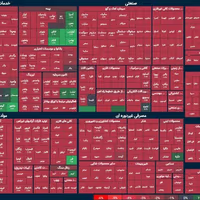
Tehran stocks head for reopening, but it risks triggering a new crisis

Apr 23, 2026, 22:00 GMT+1
•
Mohamad Machine-Chian

After nearly two months of closure, Tehran’s stock market is preparing a phased reopening, but deep structural flaws, lack of transparency and uncertainty over US negotiations threaten to turn the restart into a fresh crisis.

Trading has been suspended for two months. Ticker symbols remain closed, and millions of retail investors have been unable to move their assets.

The head of the Securities and Exchange Organization said the market would reopen within ten to twelve days in phases. In the first stage, only companies not directly damaged by the war will resume trading, while steel and petrochemical firms that suffered losses will remain closed.

Reopening a damaged petrochemical company whose production has halted and whose recovery costs and timeline are unclear would likely trigger a sharp price drop and create a volatile market signal. Yet the current approach of prolonged closure presents deeper structural concerns.

There are three conceivable scenarios for reopening the Tehran Stock Market.

  • War or economic collapse: can Iran withstand the pressure?

    War or economic collapse: can Iran withstand the pressure?

Scenario one: Comprehensive deal with US

The first scenario envisions a comprehensive agreement and broad sanctions relief. In an optimistic case, Iran reconnects to the global financial system, oil and petrochemical exports face fewer restrictions, and foreign investment gradually returns. Market reopening could then mark the beginning of long-delayed reforms: transition from price controls to market pricing, reduced financial repression in banking, and transparent government balance sheets.

Export-oriented sectors such as steel, petrochemicals, and copper would benefit from renewed access to global markets. Banks could reassess their balance sheets and shift toward genuine credit evaluation. Foreign investors, absent for nearly two decades, might gradually return.

However, without internal coordination and structural reform, even sanctions relief would not rescue the TEDPIX.

  • Dollar-pegged pizza in Tehran points to a different kind of regime change

    Dollar-pegged pizza in Tehran points to a different kind of regime change

Scenario two: Limited military and regional agreement

A more likely scenario involves a limited agreement focused on military and regional tensions. Hostilities ease, but sanctions remain largely intact and foreign investment prospects stay uncertain.

Under these conditions, reopening may trigger a new crisis. Major export-driven firms would initially remain untradeable. Downstream industries would face raw material shortages and price spikes. The automotive sector, already loss-making before the war, would struggle with supply chain disruptions and accumulated losses.

Meanwhile, limited foreign currency inflows could push the government toward inflationary financing to fund reconstruction and subsidies, either through money creation or borrowing from banks already dependent on regulatory forbearance. With high inflation ahead, questions arise about how listed firms can generate sufficient value to remain profitable, especially amid infrastructure damage and seasonal energy shortages.

Investors, having endured months of uncertainty without clear disclosure of portfolio losses, may view reopening as an exit opportunity. Investment funds facing redemption waves would be forced into selling queues, amplifying downward pressure. The market could reopen with a heavy backlog of sell orders, and each negative headline could trigger further declines.

Scenario three: Continued conflict and further escalation

If negotiations fail and conflict intensifies, prolonged closure would likely continue. In such a scenario, Tehran Stock Exchange, under its current management and policy framework, could effectively cease to function as a credible capital market.

Policymakers may believe closure prevents price collapse, but in practice, investor confidence collapses instead. Alternative investment channels gain prominence: foreign currency, gold, real estate, consumer goods, or capital flight to neighboring countries.

  • US tightens financial squeeze on Iran, warns banks over oil money flows

    US tightens financial squeeze on Iran, warns banks over oil money flows

Iran’s economy before and after the war

Even before the recent conflict, Iran’s economy faced a structural crisis. Industrial capacity was constrained by aging machinery, energy imbalances, and sanctions. Institutional trust was at its lowest level in four decades. Key industries — steel, petrochemicals, automotive, and banking — were either loss-making or dependent on hidden subsidies. War in such an environment acts as a crisis accelerator, pushing uncertainty beyond policymakers’ management capacity.

Tools available for reopening — tighter price limits, sales restrictions, targeted liquidity injections, and market-maker intervention — can at best distribute the shock and manage short-term risk. They cannot substitute for honest disclosure of losses, independent audit assessments, and credible reconstruction plans.

Reopening the Tehran Stock Exchange alone will not resolve broader economic challenges. In the best-case scenario, it could form part of a larger reform package aligned with political agreement and foreign capital inflows. In the other two scenarios, reopening may merely accelerate the crisis cycle.

The core question facing policymakers is political rather than technical: are they willing to accept the real market value of shareholders’ assets, or will they postpone the cost through opacity and suspension, only to face a larger reckoning later.

Trump says Iran's leaders are in turmoil, 'fighting like cats and dogs'

Apr 23, 2026, 21:05 GMT+1

US President Donald Trump told reporters that Iran's leaders are "fighting like cats and dogs on who's going to control because we've created a real mess for them."

"They want to make a deal. We have been speaking to them, but they don't even know who's leading the country. They're in turmoil. So we thought we'd give them a little chance to get some of their turmoil resolve," Trump said.

Trump says clock ticking for Iran, deal will be made only when good for US

Apr 23, 2026, 19:25 GMT+1

President Donald Trump said on Thursday time is running out for Iran and insisted any agreement would be reached only when it serves US interests, signaling no urgency from Washington to end the conflict.

In a post on Truth Social, Trump dismissed suggestions he is eager to conclude the war, saying, “I have all the time in the World, but Iran doesn’t — The clock is ticking!”

He argued Iran’s military capabilities have been severely degraded and that a US-led blockade remains firmly in place.

“Iran’s Navy is lying at the bottom of the Sea, their Air Force is demolished, their Anti Aircraft and Radar Weaponry is gone, their leaders are no longer with us, the Blockade is airtight and strong and, from there, it only gets worse — Time is not on their side!” Trump said.

He added that negotiations would proceed strictly on Washington’s terms.

“A Deal will only be made when it’s appropriate and good for the United States of America, our Allies and, in fact, the rest of the World.”

Iran says ‘10 A-bombs’ claim never raised in talks, calls it fabrication

Apr 23, 2026, 18:50 GMT+1

Iran’s foreign ministry spokesman said claims about Tehran seeking to build “10 nuclear bombs” were never raised in negotiations, dismissing them as projections by opposing parties.

Esmail Baghaei said Iran has not introduced any such figures in its diplomatic exchanges.

“The claim that Iran wants to build a nuclear bomb has never been raised by us; these narratives are more a projection by the other side, and even calculations about 10 bombs are products of their own analysis,” he said.