Trump says clock ticking for Iran, deal will be made only when good for US


President Donald Trump said on Thursday time is running out for Iran and insisted any agreement would be reached only when it serves US interests, signaling no urgency from Washington to end the conflict.
In a post on Truth Social, Trump dismissed suggestions he is eager to conclude the war, saying, “I have all the time in the World, but Iran doesn’t — The clock is ticking!”
He argued Iran’s military capabilities have been severely degraded and that a US-led blockade remains firmly in place.
“Iran’s Navy is lying at the bottom of the Sea, their Air Force is demolished, their Anti Aircraft and Radar Weaponry is gone, their leaders are no longer with us, the Blockade is airtight and strong and, from there, it only gets worse — Time is not on their side!” Trump said.
He added that negotiations would proceed strictly on Washington’s terms.
“A Deal will only be made when it’s appropriate and good for the United States of America, our Allies and, in fact, the rest of the World.”




Iran’s foreign ministry spokesman said claims about Tehran seeking to build “10 nuclear bombs” were never raised in negotiations, dismissing them as projections by opposing parties.
Esmail Baghaei said Iran has not introduced any such figures in its diplomatic exchanges.
“The claim that Iran wants to build a nuclear bomb has never been raised by us; these narratives are more a projection by the other side, and even calculations about 10 bombs are products of their own analysis,” he said.
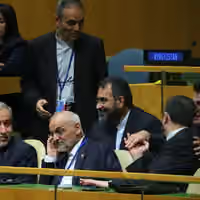
“There are no hardliners or moderates in Iran; we are all ‘Iranian’ and ‘revolutionary,’” Iranian President Masoud Pezeshkian said in a post on X, in an apparent response to remarks by Donald Trump about disarray in Iran's leadership.
“With the iron unity of the nation and the state, and full obedience to the Supreme Leader, we will make the criminal aggressor regret its actions,” Pezeshkian added.
The same remarks were posted by Parliament Speaker Mohammad Bagher Ghalibaf, Judiciary Chief Gholamhossein Mohseni Ejei, Foreign Minister Abbas Araghchi, and several other officials.
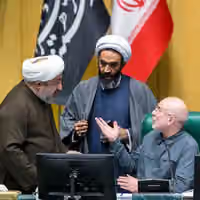
As debate over a ceasefire and renewed talks with the United States intensifies, the absence of a clear supreme arbiter in Tehran appears to be giving Iran’s hardliners more room to shape the narrative and to hinder any eventual agreement.
Under former Supreme Leader Ali Khamenei, ultraconservative factions were often allowed to rage in public, attack moderates and mobilize supporters in the streets. But when necessary, he could impose discipline.
Even on the 2015 nuclear deal, which he later criticized publicly, the system moved quickly once it was understood he had given at least tacit approval.
Then-speaker Ali Larijani famously pushed the JCPOA through parliament in a matter of minutes, effectively silencing opposition by invoking the Supreme Leader’s authority.
Today, who truly leads Iran—whether one man or a shifting collective—is anyone’s guess. What is clearer is that the political vacuum appears to be rewarding the loudest and most uncompromising voices.
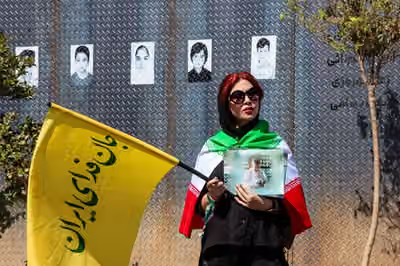
Iranian hardliners’ arguments for continuing the war with the United States have come to dominate state television, media reports and billboards across major squares in Tehran.
Many frame negotiations as a betrayal of “red lines,” accusing “accomplices of America and Israel,” “liberals” and those intimidated by Washington of undermining the country.
Those so-called red lines are often justified through selective interpretations of new leader Mojtaba Khamenei’s April 9 message, former Supreme Leader Ali Khamenei’s past speeches rejecting negotiations and claims by individual hardliners citing unnamed “reliable sources.”
One prominent example is ultraconservative MP Amir Hossein Sabeti of the Paydari Party, who has repeatedly warned that negotiators may be crossing the Supreme Leader’s red lines.
In a post on X, he claimed to have “the most definite information” that negotiating with the United States on the nuclear issue was prohibited and demanded that Speaker Mohammad Bagher Qalibaf and Foreign Minister Abbas Araghchi publicly deny reports of talks on suspending enrichment or diluting uranium.
He implied consequences if they did not.
State television has amplified such voices while giving nightly exposure to rallies calling for the war to continue until “final victory.”
The constant need to fill airtime has also elevated more extreme or theatrical voices, including members of the public eager for their moment on air.
Meanwhile, moderate voices arguing for negotiations appear to have lost even the limited channels they once had to plead their case to the country’s highest authority.
Iranian academic Sadeq Zibakalam, speaking to the reform-leaning Fararu website, questioned why some factions remain so insistent on continuing the war despite the economic devastation already inflicted.
“Do these gentlemen know what forty days of war has done to our economy, how many production units have run into trouble, and how many have laid off their workers?” he asked.
He said it was striking that hardline revolutionaries inside Iran, opposition groups seeking regime change and Israeli officials all appeared to share an interest in prolonging the conflict.
Views such as Zibakalam’s were once represented within inner circles of power by figures like former president Hassan Rouhani, who had direct access to Ali Khamenei, even if he rarely got his way.
President Masoud Pezeshkian has no such standing as the veteran Rouhani. And whatever limited influence he might have enjoyed under Khamenei Sr. appears to have diminished further under Khamenei Jr., who—even if in good health—remains almost certainly beyond the reach of civilian leaders.
In the absence of a clear authority to impose discipline or bless compromise, political competition in Tehran increasingly appears to favor the fiercest factions.
President Donald Trump endorsed a hardline opinion article arguing Washington does not need an agreement with Iran, including a call to target Iranian leaders resisting a deal.
Trump shared the column by former White House speechwriting director Marc Thiessen, published in The Washington Post, on Truth Social, writing: “Very true!”
In the article, Thiessen argued that Tehran has misinterpreted the ceasefire extension, believing Trump “wants a deal more than they do” and is reluctant to resume fighting.
Thiessen further argued that Iran “needs a deal more than Trump does,” citing the combined pressure of sustained military strikes and a US naval blockade that has “completely halted economic trade going into and out of Iran by sea.”
“If the Iranian regime is really ‘fractured’ between a faction that wants a deal and a faction that does not, there is a simple solution: Kill the faction that does not,” the article said.
Israel’s defense minister said on Thursday the country is prepared to resume military operations against Iran and is waiting for authorization from Washington, signaling readiness for both offensive and defensive action as targets have already been identified.
“Israel is prepared for the renewal of the war against Iran – the IDF is prepared for defense and attack and the targets are marked. We are waiting for a green light from the United States – first and foremost to complete the elimination of the Khamenei dynasty and return Iran to the Age of Darkness and Stone.”
He warned that any future assault would be significantly more severe.
“The attack this time will be different and deadly and will add devastating blows in the most painful places - which will shake and collapse its foundations,” Katz said.