• العربية
  • فارسی
Brand
  • Iran Insight
  • Politics
  • Economy
  • Analysis
  • Special Report
  • Opinion
  • Podcast
  • Iran Insight
  • Politics
  • Economy
  • Analysis
  • Special Report
  • Opinion
  • Podcast
  • Theme
  • Language
    • العربية
    • فارسی
  • Iran Insight
  • Politics
  • Economy
  • Analysis
  • Special Report
  • Opinion
  • Podcast
All rights reserved for Volant Media UK Limited
volant media logo

Video shows call for donations to build Khamenei mausoleum in Iran

Apr 22, 2026, 03:37 GMT+1

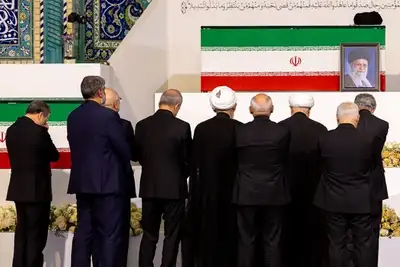
A video sent to Iran International shows a person describing a notice attributed to the Imam Khomeini Relief Committee requesting donations to fund a mausoleum for Iran’s Supreme Leader Ali Khamenei.

According to the account, the notice calls on citizens to contribute religious payments, including khums, zakat and charitable offerings, toward the project.

Most Viewed

Iran diplomacy wobbles as factions compete to avoid looking soft on US
1
INSIGHT

Iran diplomacy wobbles as factions compete to avoid looking soft on US

2
ANALYSIS

The politics of pink: how Iran uses cuteness to rebrand violence

3

Scam messages seek crypto for ships’ safe passage through Hormuz, firm warns

4
EXCLUSIVE

Family told missing teen was alive, then received his body 60 days later

5
TEHRAN INSIDER

The future has been switched off here

Banner
Banner

Spotlight

  • Diplomacy tolls at Hormuz as conflict returns to its doorstep
    OPINION

    Diplomacy tolls at Hormuz as conflict returns to its doorstep

  • Opposition to US talks grows in Tehran as ceasefire deadline nears
    INSIGHT

    Opposition to US talks grows in Tehran as ceasefire deadline nears

  • Tehran moderates see ‘no deal–no war’ limbo as worst outcome
    INSIGHT

    Tehran moderates see ‘no deal–no war’ limbo as worst outcome

  • The future has been switched off here
    TEHRAN INSIDER

    The future has been switched off here

  • Lights out, then gunfire: Witnesses recount Mashhad protest crackdown
    VOICES FROM IRAN

    Lights out, then gunfire: Witnesses recount Mashhad protest crackdown

  • Is Iran entering its Gorbachev moment?
    INSIGHT

    Is Iran entering its Gorbachev moment?

•
•
•

More Stories

Iran Revolutionary Guard holds missile displays in several cities

Apr 22, 2026, 02:54 GMT+1

Video published by Iranian state media showed the Islamic Revolutionary Guard Corps staging missile displays in multiple cities including Tehran, Kerman and Arak, alongside Hezbollah flags and anti-US and anti-Israel slogans.

According to reports received by Iran International, the displays took place shortly before US President Donald Trump announced an extension of the ceasefire.

Images showed missiles displayed in public urban areas near residential zones, with no visible safety measures or crowd protection in place, raising concerns over civilian safety.

Strikes on petrochemical hubs leave Iran short of plastics

Apr 22, 2026, 02:47 GMT+1
•
Dalga Khatinoglu

Iran is facing severe shortages of key petrochemical products after recent strikes on its main production hubs, according to two informed sources inside the country.

Earlier this month, Israel targeted facilities in Mahshahr and Asaluyeh, Iran’s two principal petrochemical centers, which together account for roughly three-quarters of the country’s output.

According to commercial sources who spoke on condition of anonymity, several petrochemical products have become acutely scarce, particularly polymer grades used in food packaging, plastics and basic manufacturing.

The shortages have forced authorities to explore emergency import options, even as logistical and geopolitical constraints complicate procurement.

The scale of disruption is still being assessed, but industry sources say the impact on domestic supply chains has been immediate.

Najmeh Jamshidi, editor-in-chief of Energy Press, previously reported, citing senior executives at petrochemical complexes, that restoring damaged units and associated infrastructure could take anywhere from six months to two years, depending on the extent of damage.

One source said Russia declined Iran’s request to supply certain polymers, citing a sharp rise in global petrochemical prices linked to disruptions in the Strait of Hormuz. According to the source, Moscow is prioritizing domestic supply to prevent further inflationary pressure in its own market.

Ilham Shaban, head of the Caspian Oil Studies Center, said Russia itself is facing constraints, as some of its petrochemical facilities have been damaged in Ukrainian attacks. This has further limited the country’s ability to meet external demand, particularly for higher-value polymer products.

Before the recent disruptions, Iran exported about 30 million tons of petrochemical products worth roughly $15 billion annually, with polymers accounting for around 12 percent of that volume.

In response to the supply shock, Iranian authorities have moved to ban exports of several petrochemical goods in an effort to stabilize the domestic market.

Another commercial source said Iran has approached Azerbaijan as a potential supplier of polymers, but the country’s limited production capacity makes it unable to significantly offset Iran’s shortfall.

Azerbaijan is also expected to prioritize maintaining its established export markets in Europe and Turkey.

Some of Iran’s Arab neighbours have the scale to potentially offset part of the supply gap. Saudi Arabia alone has about 19 million tons of annual polymer production capacity, while the United Arab Emirates and Qatar are also major exporters.

However, given Iran’s recent attacks on these countries during the conflict, they are unlikely to assist in covering Iran’s shortages.

At the same time, disruptions affecting shipping routes through the Strait of Hormuz over the past two months have pushed global polymer prices up by about 50 percent.

The combination of domestic supply disruptions and tightening international markets has deepened shortages, raising concerns about broader impacts on downstream industries and the availability of consumer goods.

Trump considered bombing Iran again - WSJ

Apr 22, 2026, 02:29 GMT+1

The Wall Street Journal reported on Tuesday that US President Donald Trump recently questioned aides about the possibility of bombing Iran again, before deciding to maintain sustained pressure on Tehran.

"Trump administration officials say they are prepared to wait. "Maximum pressure worked before, and it will work again," one senior US official said, referring to the first Trump term," the report said.

"Trump and his team split the difference: maintain pressure on Iran indefinitely until they make a concrete offer to the US after that, the president could gauge whether negotiations could proceed of if he would have to order a news wave of strikes on the Islamic Republic," the report added.

US Navy GARC drone deployed in Middle East operations against Iran

Apr 22, 2026, 02:24 GMT+1

The US Navy’s Global Autonomous Reconnaissance Craft (GARC), an unmanned surface drone, is being used in Middle East operations involving Iran as part of ongoing maritime security missions, National Interest reported on Tuesday.

the GARC is a small autonomous surface vessel designed for intelligence gathering, communications relay and combat support roles, and can also carry modular payloads for different mission sets.

It said the system has been deployed in the region in support of US military operations and has logged hundreds of hours of maritime patrol activity.

The report added that the drone is being used in operations involving Iranian maritime threats, including fast boats associated with the Islamic Revolutionary Guard Corps, which have long operated in the Persian Gulf region.

Iran 'terror premium' still drives oil prices, White House advisor says

Apr 22, 2026, 02:12 GMT+1

White House adviser Peter Navarro said on Tuesday geopolitical risks linked to Iran continue to impose a long-term “terror premium” on global oil prices, saying removing that risk could lower energy costs.

In a post on X, Navarro referred to a report released by his office last month arguing that Iran-related risks have inflated crude oil prices for decades.

The analysis estimated that concerns over disruptions in the Strait of Hormuz have added around $5 to $15 per barrel to global oil prices, as markets price in geopolitical risk.