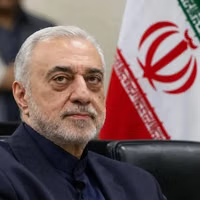
Iran's parliament speaker and chief negotiator Mohammad Bagher Ghalibaf argues with MPs in this prewar file photo
Apparent divisions over negotiations with the United States may have strengthened the most confrontational elements within Iran’s political landscape and facilitated the rise of new hardline actors.
Backed by the more uncompromising faction within the senior ranks of the Islamic Revolutionary Guard Corps (IRGC), these emerging hardliners have been testing their ability to disrupt talks that already face significant obstacles.
Within the IRGC itself, commanders appear to be split into at least two camps. One faction, associated with IRGC Commander Ahmad Vahidi and Supreme National Security Council (SNSC) Secretary Mohammad Bagher Zolghadr, is widely described by Iranian observers as favoring continuation of the conflict.
The opposing faction aligns more closely with former IRGC Air Force commander and current Majles Speaker Mohammad Bagher Ghalibaf. He is believed to retain influence within the IRGC’s aerospace branch and to maintain ties to the household of Iran’s slain leader Ali Khamenei, including his son Mojtaba.
Despite their rivalry, both factions share a core objective: ensuring the survival of the Islamic Republic. Their disagreement lies in the methods and strategic direction needed to achieve that goal.
Similar infighting existed before the latest war and under Ali Khamenei, but the absence of a figure with comparable authority appears to have widened the field to rival forces.
Among civilian political actors, many have attempted to distance themselves from the ultraconservative Paydari Party, which has been the loudest anti-American voice in Tehran for some time. Yet their ideological and personal links to Paydari figures remain evident.
Even Ghalibaf, now seen by many as the de facto leader of Iran’s “pragmatic” camp, has referred to these actors as a radical militia. He has also hinted at their connections to Paydari-aligned figures such as former nuclear negotiator Saeed Jalili and hardline lawmaker Amir Hossein Sabeti, both of whom journalists in Tehran accuse of enticing anti-talks rallies.
Over the weekend, an X account identifying itself as “Fans of Saeed Jalili” sharply criticized Ghalibaf and Foreign Minister Abbas Araghchi, accusing them of falsely suggesting that their more moderate positions toward Washington had been endorsed by Mojtaba Khamenei.
The account demanded that Mojtaba appear publicly—or at least release an audio or video message—to clarify his political intentions. The post was deleted within an hour, and Jalili later distanced himself from its content, though he did not deny links to the account.
Ghalibaf has also criticized calls to continue the war, referring to the large crowds of mostly young Iranians who have taken to the streets nightly to demand renewed attacks on the United States and Israel.
In an unprecedented televised address on Sunday, he told the nation that Iran “controls the battlefield,” but acknowledged that “the US and Israeli militaries are far stronger and more experienced than Iran’s.”
Meanwhile, several members of parliament—including Ali Khezrian, Hamid Rasai and Morteza Mahmoudi—have been reported to be encouraging efforts to unseat Ghalibaf as speaker and to push for the impeachment of Foreign Minister Abbas Araghchi.
Whether these pro-war factions are strong enough to derail the Islamabad talks remains uncertain. The deeper issue is that while Ali Khamenei often managed factional rivalries to maintain control, the emerging leadership—what President Trump has referred to as the “new regime in Iran”—has yet to demonstrate the same ability to balance competing forces.
Under Khamenei, domestic politics remained a relatively contained arena in which rival factions competed but ultimately operated within boundaries he enforced.
The new leadership now faces a far more volatile environment: major military powers are directly engaged in the region, and the Middle East remains perched on a geopolitical powder keg.
An illustration showing an ancient Iranian soldier and a Revolutionary Guard member holding a weapon together, displayed during a November 7 ceremony in Tehran where a statue of pre-Islamic Persian King Shapur I was unveiled.
Tehran’s unveiling of a towering statue depicting the Roman Emperor Valerian kneeling before pre-Islamic Persian King Shapur I has renewed criticism of the Islamic Republic’s appeal to nationalist sentiment following the June war with Israel.
For over forty years, the theocracy purged ancient Persian history from schoolbooks, replacing it with post-Islamic narratives. But after the 12-day conflict with Israel, officials have turned to the distant pre-Islamic past to rally a divided society.
From murals of ancient kings and soldiers to patriotic songs added to Shi’ite mourning ceremonies performed before Supreme Leader Ali Khamenei, Tehran now embraces imagery once deemed heretical by its own revolutionary ethos.
The statue unveiled in Tehran's Revolution Square
'Kneel before Iran' campaign
Tehran’s Revolution (Enghelab) Square was the scene of an unusual spectacle on Friday as officials unveiled a massive bronze statue depicting Roman Emperor Valerian kneeling in submission before Sassanid King Shapur I, commemorating Iran’s victory at the Battle of Edessa (260 AD).
The event was held under the slogan “Kneel before Iran,” part of what authorities describe as a campaign to project “national unity and historical pride” following the June war with Israel.
Tehran Mayor Alireza Zakani, a staunch ultraconservative, said on X: “Enmity with Great Iran can only end in kneeling before this historic nation.”
Municipal official Davood Goodarzi said the installation would be accompanied by visual displays depicting “other victories of Iranians over foreign aggressors,” including the defeat of British forces by local commander Rais-Ali Delvari, Mirza Kuchak Khan’s resistance against Russian troops, and Surena’s triumph over Rome at the Battle of Carrhae in 53 BCE.
The goal, Goodarzi said, is “strengthening concepts such as national dignity, social unity, and Iranian identity.”
The statue, he said, would remain temporarily at Revolution Square before being moved to a city gateway “where it will stand as the first emblem of Iran before diplomats and foreign visitors.”
Unveiled women were allowed to attend the unveiling ceremony—an uncommon scene at events organized by Tehran’s ultra-hardline municipality.
The turn to the pre-Islamic past
The sharp reversal also recalls remarks once made by Khamenei. In a 2011 speech, he asserted that “all the great military victories of this nation came after Islam,” dismissing pre-Islamic accounts as “things that are not documented.”
In 1987, he had said that prophets triumphed over kings such as Cyrus and that “nothing remains of these monarchs in history but names remembered with derision.”
Nevertheless, pro-government social media accounts have now gone so far as to circulate posters equating Khamenei himself with Shapur, showing him standing with a staff as Benjamin Netanyahu and Donald Trump kneel before him. The caption reads: “You will kneel before Iran.”
Image circulating by hardliners on social media
'Hypocrisy'
Pro-government figures have hailed the move as a patriotic success. Conservative political reporter Hossein Saremi posted: “Today’s grand Iranian gathering showed that people and the state share one essence: Iran itself. Nothing can take our homeland away.”
Others, however, called the spectacle “hypocrisy.” Journalist Gholamhossein Pashaei wrote on X: “Every year you close Pasargadae to stop people from celebrating Cyrus Day, yet you unveil Shapur’s statue in Enghelab Square with drums and fireworks during Fatimiyya (mourning period)!”
Dissident commentator Hamid Asafi called the ceremony “a perfect snapshot of the Islamic Republic’s contradictions.”
On Telegram he wrote: “A week ago they closed Cyrus’s tomb out of fear of the crowds, and now they glorify Shapur in the same breath. The Islamic Republic fears living history but poses for selfies with its corpse.”
He added: “They know people no longer respond to rosaries and sermons. That’s why they’ve brought history back to the stage—in a controlled costume. If they can’t erase the past, they’ll try to own it.”
The irony deepened as UNESCO formally recognized Cyrus’s Charter as one of the earliest human-rights documents.
President Masoud Pezeshkian wrote on X: “Iran, the cradle of dialogue, justice, and coexistence, can still inspire peace today.”
Users swiftly replied, questioning how such pride could coexist with a government that blocks access to Cyrus’s tomb each year to those wishing to visit it on his birthday.