• العربية
  • فارسی
Brand
  • Iran Insight
  • Politics
  • Economy
  • Analysis
  • Special Report
  • Opinion
  • Podcast
  • Iran Insight
  • Politics
  • Economy
  • Analysis
  • Special Report
  • Opinion
  • Podcast
  • Theme
  • Language
    • العربية
    • فارسی
  • Iran Insight
  • Politics
  • Economy
  • Analysis
  • Special Report
  • Opinion
  • Podcast
All rights reserved for Volant Media UK Limited
volant media logo
INSIGHT

Tehran moderates see ‘no deal–no war’ limbo as worst outcome

Behrouz Turani
Behrouz Turani

Iran International

Apr 21, 2026, 18:18 GMT+1
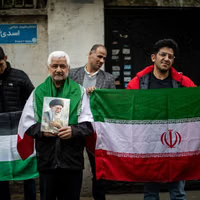
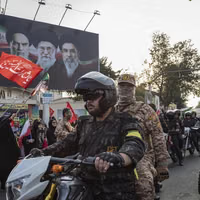
People walk past Iranian flags and a portrait of slain commanders in Tehran, Iran, April 20, 2026

Tehran’s commentariat is warning that the most troubling outcome of the current negotiations with Washington may be neither war nor peace, but a prolonged “no deal–no war” limbo.

With uncertainty surrounding the talks and the fragile ceasefire nearing its end, several outlets have begun outlining possible trajectories for the negotiations. While some reduce the situation to a simple binary of “deal or no deal,” others argue that the more likely outcome may lie somewhere in between.

Writing in the pro-government Etemad daily, columnist Babak Kazemi described three possible scenarios for the talks: a limited agreement on less contentious issues, a pause in negotiations due to irreconcilable differences, or a collapse of the process if either side insists on maximalist demands.

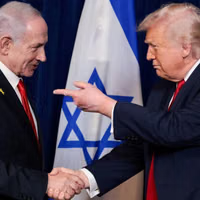
The dispute appears to center on several core issues, foremost among them Iran’s nuclear program. Tehran insists on its right to enrichment, while President Donald Trump has been pressing for “zero enrichment.”

Iran is also seeking full or at least partial lifting of US sanctions, along with guarantees that any agreement reached with the Trump administration would be honored by future US governments.

Kazemi suggested that the two sides’ experience with the 2015 nuclear agreement could serve as a foundation for progress, arguing that détente and mutual economic benefits could help stabilize the region.

He added that even if a comprehensive agreement proves out of reach, a limited deal could create space for broader negotiations later.

Other commentators are more pessimistic.

The reform-leaning Fararu website described Iran–US tensions as “complicated and multi-layered,” arguing that the two sides are neither heading toward full-scale conflict nor toward a durable agreement.

Instead, it portrayed the situation as a protracted game of attrition in which each side seeks to gain leverage before the crisis eventually reaches some form of resolution.

Former diplomat Jalal Sadatian echoed this view, saying neither Tehran nor Washington appears willing to start a war, yet neither sees a clear path to a sustainable agreement. He added that Israel’s role as a regional actor capable of escalating tensions further complicates the landscape.

Another veteran diplomat, Fereidoun Majlesi, offered an even bleaker assessment, telling Fararu that the United States is unlikely to accept anything short of Iran’s “surrender” and that the chances of reaching an agreement in Islamabad are extremely narrow.

Analysts writing on the Asr Iran website outlined several possible outcomes, arguing that the worst scenario would be the continuation of the current “no deal–no war” status quo.

The editorial warned that prolonged limbo would deepen economic instability and create a precarious security environment in which war could erupt at any moment, potentially giving Israel and the United States time and space to prepare for further attacks.

According to Asr Iran, even if wartime conditions temporarily foster social cohesion, the long-term strain would weaken the country’s internal resilience.

For that reason, the editorial called for a comprehensive and durable agreement that removes the pretext for future economic or military pressure and moves Tehran and Washington toward non-hostility and lasting peace.

Most Viewed

Ghalibaf defends Iran-US talks amid hardline backlash
1
INSIGHT

Ghalibaf defends Iran-US talks amid hardline backlash

2
INSIGHT

Iran diplomacy wobbles as factions compete to avoid looking soft on US

3
VOICES FROM IRAN

Bread shortages, soaring prices strain households in Iran, residents say

4
ANALYSIS

The politics of pink: how Iran uses cuteness to rebrand violence

5

Scam messages seek crypto for ships’ safe passage through Hormuz, firm warns

Banner
Banner

Spotlight

  • Opposition to US talks grows in Tehran as ceasefire deadline nears
    INSIGHT

    Opposition to US talks grows in Tehran as ceasefire deadline nears

  • Tehran moderates see ‘no deal–no war’ limbo as worst outcome
    INSIGHT

    Tehran moderates see ‘no deal–no war’ limbo as worst outcome

  • The future has been switched off here
    TEHRAN INSIDER

    The future has been switched off here

  • Lights out, then gunfire: Witnesses recount Mashhad protest crackdown
    VOICES FROM IRAN

    Lights out, then gunfire: Witnesses recount Mashhad protest crackdown

  • Family told missing teen was alive, then received his body 60 days later
    EXCLUSIVE

    Family told missing teen was alive, then received his body 60 days later

  • Is Iran entering its Gorbachev moment?
    INSIGHT

    Is Iran entering its Gorbachev moment?

•
•
•

More Stories

Is Iran entering its Gorbachev moment?

Apr 21, 2026, 04:48 GMT+1
•
Ashkan Safaei

The idea of an “Iranian Gorbachev” has surfaced before in the Islamic Republic, but this time the conditions may be different.

At the peak of the Reform Movement in the late 1990s, when Iranian president Mohammad Khatami promoted political openness and civil society, hardliners labeled him Iran’s Gorbachev.

Hardliners like Hossein Shariatmadari and Hassan Abbasi used the title to demonize him, while opposition groups clung to the hope that he might accelerate the regime's collapse—a feat they themselves had been unable to achieve.

In reality, neither Khatami nor his inner circle accepted such a role. They repeatedly stressed that their reforms were intended to strengthen the system, not dismantle it. The structure of power at the time also made a true "Gorbachev moment" nearly impossible.

Now-slain Supreme Leader Ali Khamenei controlled the pace of reform, restraining both reformists and hardliners and preventing the political system from tipping into crisis.

Iranian society in the late 1990s was also not prepared for a total rupture with the state. A significant portion of the population still believed reform was possible. The generation shaped by the 1979 revolution remained politically active and hopeful.

Three decades later, the situation appears markedly different. A new generation, deeply disillusioned with the system, appears to settle for nothing less than regime change.

Over the past three years the Islamic Republic has endured repeated foreign military strikes. Ali Khamenei, referred to by many officials as the “system,” has been removed from the scene. Mojtaba, his son, lacks the authority that allowed his father to hold competing factions together during moments of crisis.

It is in this environment that an individual—or individuals—may unintentionally become "Iran’s Gorbachev." One possible candidate is Mohammad Baqer Ghalibaf.

During the 40-day memorial of Ali Khamenei, Ghalibaf traveled to Islamabad to meet with the Vice President of the country that helped kill the Supreme Leader.

Signs suggest that the remnants of the regime, in a desperate attempt to remain in power, may be prepared to make concessions that strike at the ideological foundations of the Islamic Republic.

US President Donald Trump’s demands—surrendering enriched uranium, permanently ending enrichment, and disarming Hezbollah—strike at core elements of the Islamic Republic’s identity. Accepting them could alienate the ideological base that has long defended the system.

Even without an official agreement, hints of retreat have already triggered anger among loyalist forces. Aggressive reactions from accounts linked to ultrahardline figures, accusing officials of "sedition" and a "coup," suggest tremors within the regime’s core supporters.

When a Jalili-aligned account writes, “If these are the Leader's orders, release a video of him saying so,” it signals how deeply trust in the central authority has eroded.

Another example of frustration within the regime’s ideological base appeared in a tweet warning: “Alas for the public’s rage and disillusionment when they learn what has been agreed upon and what is yet to come.”

During the final years of the USSR, the policies of Glasnost (Openness) and Perestroika (Restructuring) distanced the Soviet system from its founding ideals. When transparency exposed the privileges of party elites, the ideological base lost faith. Many refused to defend the system when it needed them most. The "Evil Empire" collapsed with startling speed.

If those in power in Tehran abandon uranium enrichment and withdraw support from Hezbollah, there is no guarantee that their ideological base will mobilize in their defense—or shoot protesters as they did in January.

Without Ali Khamenei to frame such a retreat as "Heroic Flexibility," Ghalibaf and his allies, in their struggle to preserve the system, could inadvertently become the Gorbachevs of Iran.

Iran diplomacy wobbles as factions compete to avoid looking soft on US

Apr 21, 2026, 02:02 GMT+1
•
Behrouz Turani

Apparent divisions over negotiations with the United States may have strengthened the most confrontational elements within Iran’s political landscape and facilitated the rise of new hardline actors.

Backed by the more uncompromising faction within the senior ranks of the Islamic Revolutionary Guard Corps (IRGC), these emerging hardliners have been testing their ability to disrupt talks that already face significant obstacles.

Within the IRGC itself, commanders appear to be split into at least two camps. One faction, associated with IRGC Commander Ahmad Vahidi and Supreme National Security Council (SNSC) Secretary Mohammad Bagher Zolghadr, is widely described by Iranian observers as favoring continuation of the conflict.

The opposing faction aligns more closely with former IRGC Air Force commander and current Majles Speaker Mohammad Bagher Ghalibaf. He is believed to retain influence within the IRGC’s aerospace branch and to maintain ties to the household of Iran’s slain leader Ali Khamenei, including his son Mojtaba.

Despite their rivalry, both factions share a core objective: ensuring the survival of the Islamic Republic. Their disagreement lies in the methods and strategic direction needed to achieve that goal.

Similar infighting existed before the latest war and under Ali Khamenei, but the absence of a figure with comparable authority appears to have widened the field to rival forces.

Among civilian political actors, many have attempted to distance themselves from the ultraconservative Paydari Party, which has been the loudest anti-American voice in Tehran for some time. Yet their ideological and personal links to Paydari figures remain evident.

Even Ghalibaf, now seen by many as the de facto leader of Iran’s “pragmatic” camp, has referred to these actors as a radical militia. He has also hinted at their connections to Paydari-aligned figures such as former nuclear negotiator Saeed Jalili and hardline lawmaker Amir Hossein Sabeti, both of whom journalists in Tehran accuse of enticing anti-talks rallies.

Over the weekend, an X account identifying itself as “Fans of Saeed Jalili” sharply criticized Ghalibaf and Foreign Minister Abbas Araghchi, accusing them of falsely suggesting that their more moderate positions toward Washington had been endorsed by Mojtaba Khamenei.

The account demanded that Mojtaba appear publicly—or at least release an audio or video message—to clarify his political intentions. The post was deleted within an hour, and Jalili later distanced himself from its content, though he did not deny links to the account.

Ghalibaf has also criticized calls to continue the war, referring to the large crowds of mostly young Iranians who have taken to the streets nightly to demand renewed attacks on the United States and Israel.

In an unprecedented televised address on Sunday, he told the nation that Iran “controls the battlefield,” but acknowledged that “the US and Israeli militaries are far stronger and more experienced than Iran’s.”

Meanwhile, several members of parliament—including Ali Khezrian, Hamid Rasai and Morteza Mahmoudi—have been reported to be encouraging efforts to unseat Ghalibaf as speaker and to push for the impeachment of Foreign Minister Abbas Araghchi.

Whether these pro-war factions are strong enough to derail the Islamabad talks remains uncertain. The deeper issue is that while Ali Khamenei often managed factional rivalries to maintain control, the emerging leadership—what President Trump has referred to as the “new regime in Iran”—has yet to demonstrate the same ability to balance competing forces.

Under Khamenei, domestic politics remained a relatively contained arena in which rival factions competed but ultimately operated within boundaries he enforced.

The new leadership now faces a far more volatile environment: major military powers are directly engaged in the region, and the Middle East remains perched on a geopolitical powder keg.

The politics of pink: how Iran uses cuteness to rebrand violence

Apr 20, 2026, 23:47 GMT+1
•
Negar Mojtahedi

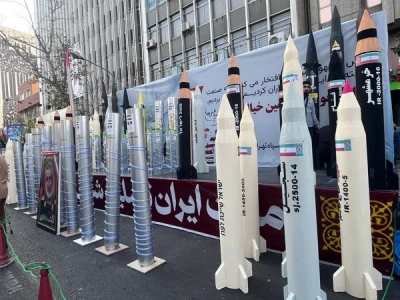
Pink missiles, pink drones and pink firearms. Women with uncovered hair—braids, ponytails, short bobs—stood beside weapons, waved flags and smiled for cameras in scenes broadcast across Iranian media. Tehran appears willing to try almost anything to preserve power.

Critics say the imagery forms part of a new Islamic Republic campaign that pairs missiles with fashion, war with pop culture and force with softness.

Liora Hendelman-Baavur, author of Creating the Modern Iranian Woman, told Iran International the visuals resemble Japan’s “kawaii” culture — imagery built around cuteness — but applied here to rockets and war.

“I think it is trying to make violence look cute,” Hendelman-Baavur said. “It is trying to appeal to the youth, to Gen Z.”

She said the campaign appears aimed at a generation that has filled streets, campuses and online spaces during years of unrest.

“We hear a lot of very aggressive and violent language coming from officials,” she said.

“And we also see it in many of the posters and murals being displayed in Iran. Violence and missiles — with red as the central color — are meant to show they are invincible and victorious. And on the other hand, we have this very light, pinkish, idyllic way of presenting a different reality … to demonstrate a whole different picture of what is really going on.”

A pink-painted missile bearing Persian script sits on display, turning a weapon of war into a piece of stylized propaganda.
100%
A pink-painted missile bearing Persian script sits on display, turning a weapon of war into a piece of stylized propaganda.

The result, she said, is two messages at once: murals, rockets and threats for one audience; pink colors, uncovered hair and festival scenes for another — a duality.

The campaign comes just over 100 days after one of the deadliest crackdowns in modern history, when at least 36,500 people were killed during the bloodiest days of the uprising on January 8 and 9 alone. The Islamic Republic continues to execute political dissidents linked to the January protests.

Any publicity — even negative — is good

For Iranian pop culture expert Siavash Rokni, the scenes are less about change than circulation.

He called the imagery a public relations stunt meant to fill feeds, group chats, broadcasts and headlines with new pictures after months of funeral processions, executions, arrests and mourning.

“With PR stunts, it doesn’t matter if it’s good or bad — what matters is that it circulates,” Rokni said.

He said many Iranians know the difference between staged images and daily life, but viewers abroad may not.

“What worries me isn’t Iranians — it’s people outside Iran who might see this and think everything is normal. That’s where it becomes dangerous.”

Others say the campaign also keeps state control over women at the center of public life. Even without hijab, women’s faces, hair and bodies remain tools in official messaging.

Retreat — for now — on Islamist ideology

It may also point to pressure inside the system itself.

Arash Azizi, author of What Iranians Want: Women, Life, Freedom, told Iran International the Islamic Republic was founded on the goal of building a uniformly Islamist society. If it now loosens one of its core social codes, he said, that carries meaning beyond style.

“They understand that they have to give up on this Islamist ideology,” Azizi said.

He also rejected claims that the war has produced a broad wave of new support for the state.

“There’s no evidence that tons of people were anti-regime before the war and are pro-regime now,” he said.

For now, the pink paint may soften the image, but it does not erase the prisons, the executions, the graves or the anger that still runs beneath the surface of Iran.

Iran says no decision yet on talks as Pakistan prepares to host US team

Apr 20, 2026, 12:05 GMT+1

Iran said on Monday it had not yet decided whether to join a second round of talks with the United States, even as Pakistan prepared to host a US delegation, with Tehran accusing Washington of violating the ceasefire and showing no real seriousness about diplomacy.

Foreign Ministry spokesperson Esmaeil Baghaei said Iran had no plan as of now for the next round of negotiations and said US actions had only deepened mistrust.

“As I am speaking to you now, we have no plan for the next round of negotiations,” he said.

Baghaei said Washington had undermined the process from the outset of the ceasefire.

He said the United States first tried to argue that Lebanon was not part of the truce, despite Pakistan’s mediator saying otherwise, and then continued what Iran describes as a naval blockade and other hostile actions in and around the Strait of Hormuz, including an attack on an Iranian commercial vessel.

He said such actions were clear ceasefire violations and that the blockade itself amounted to aggression under international law.

“Behavior and words are completely incompatible,” he said, adding that Iran would decide its next steps based only on national interests, not deadlines or ultimatums.

Baghaei said Iran had not started the war and had acted only in self-defense. He warned that if the United States or Israel launched any new attack, Iran’s armed forces would respond.

He also said Tehran could not forget what he called two US betrayals of diplomacy over the past year, saying Washington had twice attacked Iran during diplomatic processes.

“We cannot forget that twice America betrayed diplomacy,” he said.

Pakistan remains sole mediator

Baghaei said Pakistan remained Iran’s only formal mediator, though other countries were making efforts.

He said Iran was still reviewing the latest package conveyed through Pakistan after a US 15-point proposal, Iran’s 10-point response, discussions in Islamabad and further review during Pakistani army chief Asim Munir’s visit to Tehran.

He rejected suggestions that Iran had made a wholly new proposal, saying Tehran’s position had remained steady while the US side kept changing its demands.

“The American side keeps changing its demands, but we have remained steadfast,” he said.

He said some US demands were unacceptable and that repeated insistence on them would not change Iran’s position.

Baghaei also dismissed trust as a basis for negotiations with Washington.

“There is no trust,” he said.

Hormuz, Europe and red lines

Much of Baghaei’s remarks focused on the Strait of Hormuz. He said Iran’s actions there were lawful and defensive, arguing that before the US and Israeli attacks there had been no problem in the waterway.

“Before February 28, the Strait of Hormuz was safe and secure,” he said.

He said the international community should hold the United States and Israel responsible for the current insecurity, not Iran.

He added that Iranian authorities were still examining whether recent incidents involving Indian-linked ships had in fact been caused by Iranian forces.

Baghaei said as long as the current situation continued, it was unrealistic to speak of a full return to normal traffic through Hormuz. He said Iran had concluded that new rules or protocols would be needed to ensure safe passage in the future.

He also rejected European criticism, including comments from EU foreign policy chief Kaja Kallas, saying Europe could not invoke international law selectively.

“You cannot use international law as a convenient tool,” he said.

Baghaei said Iran would not negotiate over its defense capabilities and said the transfer of enriched uranium had never been an Iranian option in the talks.

On oil, he said Iran was using all available means to keep its oil industry functioning and maintain exports despite the blockade and wartime pressure.

War-hit homeowners feel abandoned as Iran’s reconstruction aid fades

Apr 20, 2026, 04:56 GMT+1
•
Behrouz Turani

The Iranian government has stepped back from earlier promises to compensate homeowners whose properties were destroyed in US-Israeli strikes, triggering anger among residents who expected the state to take responsibility for rebuilding.

Reports from Tehran suggest the government’s new reconstruction plan has created a deep sense of abandonment among citizens who assumed war-related destruction caused by a national conflict would be covered by the state.

On Thursday, the Iranian Labor News Agency (ILNA) quoted Tehran Province official Mohammad Sadeq Motamedian as saying that “nearly 40,000 residential units across Tehran Province have been damaged.”

Earlier, Donya-ye Eghtesad reported that the Ministry of Roads and Urban Development estimated roughly 45,000 residential and non-residential units were damaged during the March war but did not require demolition, while nearly 1,000 units needed full reconstruction.

Motamedian’s assessment has intensified debate over the true scale of destruction and the government’s approach to rebuilding.

In Tehran, Mayor Alireza Zakani had previously promised full reconstruction of ruined homes and restoration of damaged buildings, but there has been little clarity on how much progress has been made.

The government’s reconstruction strategy became more controversial after spokesperson Fatemeh Mohajerani said on April 15 that the administration would not provide direct financial assistance to rebuild destroyed homes.

Instead, she said the government would offer what officials call “floating density,” a system of additional building permits intended to encourage private developers to help reconstruct damaged housing.

Under the plan, builders could reconstruct damaged or destroyed homes in exchange for permission to add one or two additional floors to new buildings, which they would then be allowed to sell for profit.

Critics say the proposal is unrealistic. Density bonuses cannot compensate families who have lost their homes, especially at a time when construction costs are soaring.

For many displaced households, the absence of direct financial support raises serious questions about how reconstruction could realistically proceed.

Government bodies have also released widely differing figures about the scale of damage. Some officials have suggested only a few thousand homes were affected, while others have put the number in the tens of thousands.

Donya-ye Eghtesad noted that estimates range from about 1,000 homes requiring full reconstruction to tens of thousands with varying levels of damage, leaving residents uncertain about the true scale of destruction and the level of support they can expect.

The discrepancies have fueled speculation that the government may be downplaying the extent of war damage in order to limit financial obligations, reinforcing broader criticism of opaque communication during and after the conflict.