Iran said privately it would attend US talks, then pulled back - Axios
Iran had privately signalled on Monday that it would attend planned talks with the US, but said on Tuesday that it was not coming, Axios reporter said on X citing sources.
Iran had privately signalled on Monday that it would attend planned talks with the US, but said on Tuesday that it was not coming, Axios reporter said on X citing sources.



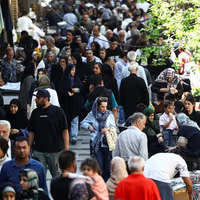
Mounting opposition to negotiations with Washington in Tehran is casting doubt over whether Iran will proceed with a new round of talks with the United States in Islamabad as the ceasefire deadline approaches.
Iranian officials and state media have increasingly emphasized a lack of interest in continuing negotiations. State television has claimed that a majority of Iranians oppose further talks, a narrative reinforced by coverage from Islamic Revolutionary Guard Corps (IRGC)-affiliated outlets including Fars News Agency and Tasnim News Agency.
Mohammad-Bagher Ghalibaf, who led Iran’s delegation in the first round of talks, struck a defiant tone earlier this week, saying Tehran would not accept negotiations “under the shadow of threats” and had spent the past two weeks preparing “to reveal new cards on the battlefield.”
Ali Abdollahi, commander of Iran's Khatam al-Anbia Central Headquarters, warned that Iranian forces are prepared to deliver an “immediate and decisive response” to any violation of agreements or commitments.
Abdollah Haji-Sadeghi, the Supreme Leader’s representative to the IRGC, said “there are no negotiations for now,” adding: “We will negotiate whenever the enemy accepts our conditions.”
On the US side, rhetoric has also hardened. President Donald Trump told CNBC on Tuesday that he does not intend to extend the ceasefire and that Washington is prepared for a military approach.
According to the Washington Post, Vice President J. D. Vance’s planned trip to Islamabad has been postponed.
Political activist Ali Gholhaki, considered close to Ghalibaf, argued that negotiations in Islamabad should only occur if the United States ends its naval blockade and moderates its nuclear demands.
Hardline commentator Foad Izadi was even more explicit, saying in an interview that entering negotiations now would be a mistake.
“We must raise the cost of this war to a significant level,” he said. “Wars ultimately end with negotiations, but they have not yet paid the expected price.”
Opposition to talks has also surfaced within Iran’s parliament. Vahid Ahmadi reaffirmed Iran’s right to uranium enrichment under the Nuclear Non-Proliferation Treaty, stating that enriched materials would “under no circumstances” be removed from the country.
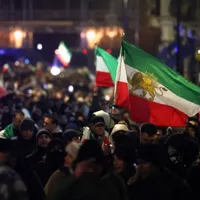
State television also aired footage of a pro-government rally where participants chanted “Death to compromisers.” A television host claimed that 87% of Iranians believe the war should continue—an assertion critics say cannot be independently verified.
Despite the hardline chorus, some voices have warned against abandoning diplomacy.
Prominent Sunni cleric Molavi Abdolhamid warned of dire consequences, writing: “The country’s skies are under enemy control, infrastructure is at risk of destruction, and the armed forces lack adequate air defense tools. In this deadlock, the only path to salvation is a ‘fair agreement.’”
He asked what hardliners would say before God and the nation if their actions lead to “the nation’s ruin.”
Prominent journalist Ahmad Zeidabadi also criticized state media claims about public opinion, arguing that they encourage parts of society to oppose negotiations.
“Iranians seek sustainable peace and security and the lifting of sanctions,” he wrote. “Any trade-off that guarantees these is justified for the overwhelming majority.”
Ali-Asghar Shafieian, media adviser to President Masoud Pezeshkian, similarly challenged claims of unanimous anti-negotiation sentiment, noting that participants in public rallies do not represent all citizens.
“Those of us attending nightly gatherings are not the entirety of the people,” he said.
The US Treasury on Tuesday imposed sanctions on 14 individuals, entities, and aircraft across Iran, Türkiye, and the United Arab Emirates for their alleged role in procuring and transporting weapons for Tehran.
A statement by the Treasury said the measures aim to disrupt Iran’s efforts to rebuild its ballistic missile program and expand its use of Shahed drones, which Washington says have been used against US interests and regional infrastructure.
The sanctions also target networks linked to Mahan Air, accused of transporting weapons and UAV systems, as well as companies involved in supplying missile propellant components.
Treasury Secretary Scott Bessent said the US would continue to “follow the money” and hold those enabling Iran’s military activities accountable, warning of further action.
Vice President JD Vance arrived at the White House for meetings on Tuesday afternoon as his plans to travel to Pakistan for Iran peace talks remained unclear, CNN reported, after the New York Times said earlier, citing a US official, that the trip had been put on hold.
CNN's report said Vance had been expected to depart for Islamabad in the morning, but that his plans had been paused as officials met to discuss the path forward.
Defense Secretary Pete Hegseth also arrived at the White House moments after Vance, while Secretary of State Marco Rubio was seen arriving at the West Wing entrance about 50 minutes earlier, CNN's report added.
Tehran’s commentariat is warning that the most troubling outcome of the current negotiations with Washington may be neither war nor peace, but a prolonged “no deal–no war” limbo.
With uncertainty surrounding the talks and the fragile ceasefire nearing its end, several outlets have begun outlining possible trajectories for the negotiations. While some reduce the situation to a simple binary of “deal or no deal,” others argue that the more likely outcome may lie somewhere in between.
Writing in the pro-government Etemad daily, columnist Babak Kazemi described three possible scenarios for the talks: a limited agreement on less contentious issues, a pause in negotiations due to irreconcilable differences, or a collapse of the process if either side insists on maximalist demands.
The dispute appears to center on several core issues, foremost among them Iran’s nuclear program. Tehran insists on its right to enrichment, while President Donald Trump has been pressing for “zero enrichment.”
Iran is also seeking full or at least partial lifting of US sanctions, along with guarantees that any agreement reached with the Trump administration would be honored by future US governments.
Kazemi suggested that the two sides’ experience with the 2015 nuclear agreement could serve as a foundation for progress, arguing that détente and mutual economic benefits could help stabilize the region.
He added that even if a comprehensive agreement proves out of reach, a limited deal could create space for broader negotiations later.
Other commentators are more pessimistic.
The reform-leaning Fararu website described Iran–US tensions as “complicated and multi-layered,” arguing that the two sides are neither heading toward full-scale conflict nor toward a durable agreement.
Instead, it portrayed the situation as a protracted game of attrition in which each side seeks to gain leverage before the crisis eventually reaches some form of resolution.
Former diplomat Jalal Sadatian echoed this view, saying neither Tehran nor Washington appears willing to start a war, yet neither sees a clear path to a sustainable agreement. He added that Israel’s role as a regional actor capable of escalating tensions further complicates the landscape.
Another veteran diplomat, Fereidoun Majlesi, offered an even bleaker assessment, telling Fararu that the United States is unlikely to accept anything short of Iran’s “surrender” and that the chances of reaching an agreement in Islamabad are extremely narrow.
Analysts writing on the Asr Iran website outlined several possible outcomes, arguing that the worst scenario would be the continuation of the current “no deal–no war” status quo.
The editorial warned that prolonged limbo would deepen economic instability and create a precarious security environment in which war could erupt at any moment, potentially giving Israel and the United States time and space to prepare for further attacks.
According to Asr Iran, even if wartime conditions temporarily foster social cohesion, the long-term strain would weaken the country’s internal resilience.
For that reason, the editorial called for a comprehensive and durable agreement that removes the pretext for future economic or military pressure and moves Tehran and Washington toward non-hostility and lasting peace.
In a “blatant violation” of the ceasefire, Lebanon's Hezbollah launched several rockets toward Israeli soldiers operating south of the Forward Defense Line in southern Lebanon, the Israeli military said on Tuesday, adding it struck the launcher in response.
"A short while ago, the Hezbollah terrorist organization launched several rockets toward IDF soldiers operating south of the Forward Defense Line, in the area of Rab Thalathin in southern Lebanon," the IDF said.
"In response, the IDF struck the launcher from which the rockets were launched."
"The launches constitute a blatant violation of the ceasefire agreement."