• العربية
  • فارسی
Brand
  • Iran Insight
  • Politics
  • Economy
  • Analysis
  • Special Report
  • Opinion
  • Podcast
  • Iran Insight
  • Politics
  • Economy
  • Analysis
  • Special Report
  • Opinion
  • Podcast
  • Theme
  • Language
    • العربية
    • فارسی
  • Iran Insight
  • Politics
  • Economy
  • Analysis
  • Special Report
  • Opinion
  • Podcast
All rights reserved for Volant Media UK Limited
volant media logo

IRGC commander warns Arab states to ‘say goodbye’ to oil if aiding attacks

Apr 21, 2026, 19:56 GMT+1Updated: 23:07 GMT+1

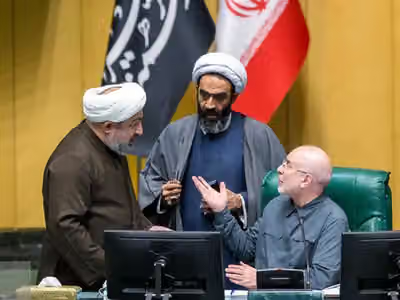
The commander of Iran’s Islamic Revolutionary Guard Corps aerospace force Seyed Majid Mousavi warned on Tuesday that Arab countries should “say goodbye” to oil production in the Middle East if their territory or facilities were used by Tehran's enemies to attack the country.

Most Viewed

IRGC-linked media hints at threat to Persian Gulf undersea internet cables
1

IRGC-linked media hints at threat to Persian Gulf undersea internet cables

2

Iran Guards say two ships seized in Hormuz after ceasefire extension

3
EXCLUSIVE

Strikes on petrochemical hubs leave Iran short of plastics

4
TEHRAN INSIDER

The future has been switched off here

5
INSIGHT

War or economic collapse: can Iran withstand the pressure?

Banner
Banner

Spotlight

  • Iran turns to citizenship and assets as tools of pressure beyond its borders

    Iran turns to citizenship and assets as tools of pressure beyond its borders

  • Inflation spikes, basic goods slip out of reach for Iranians, citizens say
    VOICES FROM IRAN

    Inflation spikes, basic goods slip out of reach for Iranians, citizens say

  • As Tehran digs in, ordinary Iranians pay the price
    INSIGHT

    As Tehran digs in, ordinary Iranians pay the price

  • Internet Pro or Censor Pro? Iran rolls out a new service
    ANALYSIS

    Internet Pro or Censor Pro? Iran rolls out a new service

  • Strikes on petrochemical hubs leave Iran short of plastics
    EXCLUSIVE

    Strikes on petrochemical hubs leave Iran short of plastics

  • Diplomacy tolls at Hormuz as conflict returns to its doorstep
    OPINION

    Diplomacy tolls at Hormuz as conflict returns to its doorstep

  • Opposition to US talks grows in Tehran as ceasefire deadline nears
    INSIGHT

    Opposition to US talks grows in Tehran as ceasefire deadline nears

•
•
•

More Stories

Vance Islamabad trip called off, but Trump could change mind - AP

Apr 21, 2026, 19:39 GMT+1

Vice President JD Vance’s trip to Islamabad for potential talks had been called off and put on hold, but President Donald Trump could change his mind at any moment, the Associated Press reported on Tuesday, citing a unnamed US official.

Trump’s special envoy Steve Witkoff and son-in-law Jared Kushner were expected in Washington on Tuesday afternoon for consultations on how to proceed, the official said, according to AP.

The official declined to predict what would happen if the current ceasefire expires without another meeting in Islamabad, but said Trump retains options short of restarting airstrikes, the report said.

Iran says US blockade of its ports is an 'act of war'

Apr 21, 2026, 19:24 GMT+1

Iran’s Foreign Minister Abbas Araghchi said on Tuesday that US blockade of Iranian ports was an act of war and a violation of the ceasefire.

“Blockading Iranian ports is an act of war and thus a violation of the ceasefire,” Araghchi said in a post on X.

“Striking a commercial vessel and taking its crew hostage is an even greater violation,” he added.

“Iran knows how to neutralize restrictions, how to defend its interests, and how to resist bullying,” Araghchi said.

Opposition to US talks grows in Tehran as ceasefire deadline nears

Apr 21, 2026, 19:21 GMT+1
•
Maryam Sinaiee

Mounting opposition to negotiations with Washington in Tehran is casting doubt over whether Iran will proceed with a new round of talks with the United States in Islamabad as the ceasefire deadline approaches.

Iranian officials and state media have increasingly emphasized a lack of interest in continuing negotiations. State television has claimed that a majority of Iranians oppose further talks, a narrative reinforced by coverage from Islamic Revolutionary Guard Corps (IRGC)-affiliated outlets including Fars News Agency and Tasnim News Agency.

Mohammad-Bagher Ghalibaf, who led Iran’s delegation in the first round of talks, struck a defiant tone earlier this week, saying Tehran would not accept negotiations “under the shadow of threats” and had spent the past two weeks preparing “to reveal new cards on the battlefield.”

Ali Abdollahi, commander of Iran's Khatam al-Anbia Central Headquarters, warned that Iranian forces are prepared to deliver an “immediate and decisive response” to any violation of agreements or commitments.

Abdollah Haji-Sadeghi, the Supreme Leader’s representative to the IRGC, said “there are no negotiations for now,” adding: “We will negotiate whenever the enemy accepts our conditions.”

On the US side, rhetoric has also hardened. President Donald Trump told CNBC on Tuesday that he does not intend to extend the ceasefire and that Washington is prepared for a military approach.

According to the Washington Post, Vice President J. D. Vance’s planned trip to Islamabad has been postponed.

Political activist Ali Gholhaki, considered close to Ghalibaf, argued that negotiations in Islamabad should only occur if the United States ends its naval blockade and moderates its nuclear demands.

Hardline commentator Foad Izadi was even more explicit, saying in an interview that entering negotiations now would be a mistake.

“We must raise the cost of this war to a significant level,” he said. “Wars ultimately end with negotiations, but they have not yet paid the expected price.”

Opposition to talks has also surfaced within Iran’s parliament. Vahid Ahmadi reaffirmed Iran’s right to uranium enrichment under the Nuclear Non-Proliferation Treaty, stating that enriched materials would “under no circumstances” be removed from the country.

State television also aired footage of a pro-government rally where participants chanted “Death to compromisers.” A television host claimed that 87% of Iranians believe the war should continue—an assertion critics say cannot be independently verified.

Despite the hardline chorus, some voices have warned against abandoning diplomacy.

Prominent Sunni cleric Molavi Abdolhamid warned of dire consequences, writing: “The country’s skies are under enemy control, infrastructure is at risk of destruction, and the armed forces lack adequate air defense tools. In this deadlock, the only path to salvation is a ‘fair agreement.’”

He asked what hardliners would say before God and the nation if their actions lead to “the nation’s ruin.”

Prominent journalist Ahmad Zeidabadi also criticized state media claims about public opinion, arguing that they encourage parts of society to oppose negotiations.

“Iranians seek sustainable peace and security and the lifting of sanctions,” he wrote. “Any trade-off that guarantees these is justified for the overwhelming majority.”

Ali-Asghar Shafieian, media adviser to President Masoud Pezeshkian, similarly challenged claims of unanimous anti-negotiation sentiment, noting that participants in public rallies do not represent all citizens.

“Those of us attending nightly gatherings are not the entirety of the people,” he said.

US imposes new sanctions targeting Iran's missile, drone networks

Apr 21, 2026, 19:03 GMT+1

The US Treasury on Tuesday imposed sanctions on 14 individuals, entities, and aircraft across Iran, Türkiye, and the United Arab Emirates for their alleged role in procuring and transporting weapons for Tehran.

A statement by the Treasury said the measures aim to disrupt Iran’s efforts to rebuild its ballistic missile program and expand its use of Shahed drones, which Washington says have been used against US interests and regional infrastructure.

The sanctions also target networks linked to Mahan Air, accused of transporting weapons and UAV systems, as well as companies involved in supplying missile propellant components.

Treasury Secretary Scott Bessent said the US would continue to “follow the money” and hold those enabling Iran’s military activities accountable, warning of further action.

Vance arrives at White House, Islamabad trip put on hold - reports

Apr 21, 2026, 18:26 GMT+1

Vice President JD Vance arrived at the White House for meetings on Tuesday afternoon as his plans to travel to Pakistan for Iran peace talks remained unclear, CNN reported, after the New York Times said earlier, citing a US official, that the trip had been put on hold.

CNN's report said Vance had been expected to depart for Islamabad in the morning, but that his plans had been paused as officials met to discuss the path forward.

Defense Secretary Pete Hegseth also arrived at the White House moments after Vance, while Secretary of State Marco Rubio was seen arriving at the West Wing entrance about 50 minutes earlier, CNN's report added.