Burial site of Khamenei not yet determined, religious foundation says


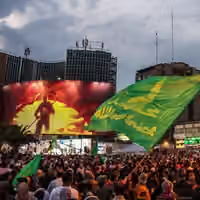
The burial site of slain Supreme Leader Ali Khamenei has not yet been determined, Astan Quds Razavi said on Saturday.
The religious foundation, which manages the Imam Reza Holy Shrine, said the exact location for burying the former Iranian leader in the northeastern city of Mashhad, had not been finalized.
Nearly two months after his death in US-Israeli airstrikes, Khamenei’s body has not yet been buried and there has been no official update on its status.






Turkey’s natural gas contract with Iran is due to expire in the coming months, but no negotiations are currently under way on an extension, Energy Minister Alparslan Bayraktar said on Saturday.
Bayraktar said the two countries could hold discussions on a possible extension, but none had started so far.
Speaking on the sidelines of a diplomacy forum in Antalya, he also said Ankara was seeking to diversify gas supplies, including Russian liquefied natural gas.
Iran said on Saturday that the Strait of Hormuz had returned to tight military control and would remain under strict oversight unless the United States ensured full freedom of navigation for vessels traveling to and from Iran.
Iran's Khatam al-Anbiya joint military command said Iran had restored the strait to its previous status, with the strategic waterway now under strict management and control by the armed forces.
“So long as the United States does not ensure full freedom of navigation for vessels traveling from Iran to destinations and from destinations to Iran, the situation in the Strait of Hormuz will remain under strict control and in its previous state,” the statement said.
Britain’s Foreign Secretary Yvette Cooper said on Saturday that the Strait of Hormuz had not yet returned to normal operations despite the ceasefire in the Iran war, and urged Tehran to allow global shipping to resume fully.
“We are at a critical diplomatic moment with a ceasefire now in place ... but we don't yet have normal passage through the strait,” Cooper told Reuters on the sidelines of a diplomacy forum in Antalya.
She said the truce needed to develop into a lasting peace and added that restoring shipping through the waterway was urgent for the global economy.
Iran’s internet blackout entered its 50th day on Saturday, with the country cut off from the global internet for seven weeks, NetBlocks said.
“Metrics show the measure, unprecedented for a connected society, continues to the detriment of most Iranians' livelihoods and human rights,” the internet monitoring group said.
NetBlocks said the disruption had lasted more than 1,176 hours and continued to affect Iranians’ ability to communicate.
Iran’s Revolutionary Guards intelligence unit said on Saturday that 127 people had been arrested in three provinces on security-related accusations, as authorities widened a post-ceasefire crackdown.
The Guards said the detainees were involved in measures including “street riots in preparation for enemy military action.”
Seven people were detained in East Azerbaijan, in the northwest, 69 in Mazandaran, in the north, and 51 in Kerman, in the southeast, according to the statement.
Separately, judiciary chief Gholamhossein Mohseni Ejei said Iran’s “enemies” should be punished and made to pay war reparations.