

Iraq’s Kurdistan Region has come under 16 missile and drone attacks since the ceasefire in the Iran war took effect, Rudaw reported on Thursday.
The media outlet in the Iraq's Kurdistan Region said in the past 48 hours alone, eight attacks hit Erbil and four struck Sulaymaniyah.
The attacks have continued despite the ceasefire announced on April 8, according to the report, which added that, since February 28, the Kurdistan Region had been hit by 719 drones and missiles, leaving 18 people dead and 94 wounded.
Pakistan’s army chief Field Marshal Asim Munir met Iran’s parliament speaker in Tehran on Thursday, Iranian state media reported.
Munir, who arrived in Iran on Wednesday, held talks with parliament speaker Mohammad Bagher Ghalibaf, the report said.
The visit comes as Pakistan steps up efforts to prevent a renewal of the conflict. Islamabad hosted the first round of peace talks between the parties last weekend.
Iranian President Masoud Pezeshkian on Thursday called for stronger efforts in the cultural sphere, saying creative methods should be used to present the war effectively.
“With the use of diverse and creative methods, effective narratives must be produced,” Pezeshkian said, adding that efforts to shape narratives should be strengthened.
During a visit to the Ministry of Culture and Islamic Guidance, Pezeshkian said explaining developments and outcomes had gained added importance and that Iran’s achievements in the war should be properly reflected through effective storytelling.
He also praised officials across the country and said powers that portray themselves as strong had faced the Iran but were forced to retreat due to resistance.
An analyst on Iran’s state television described the current ceasefire as a temporary “military silence” and said the region is in what he called an “existential war.”
The commentator said that even if the conflict shifts toward silence or negotiations, such a pause would be short-lived and eventually broken, as the outcome cannot be decided through talks alone.
He described the situation as a matter of “life and death,” adding that whichever side emerges stronger would eliminate the other or take control of the region.
The analyst said Iran’s conditions for negotiations, including the full lifting of sanctions and the withdrawal of US forces from the region, show that the broader confrontation remains unchanged.
He added that the outcome would be determined by resilience rather than negotiations.
Separately, a senior military adviser to Iran’s supreme leader has also described the ceasefire as a “military silence” rather than a formal truce.
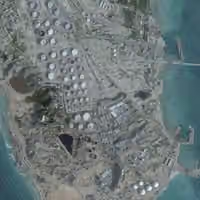
Iran has halted exports of all petrochemical products until further notice to prevent shortages of raw materials and stabilize the domestic market, state-linked media reported.
A letter issued by a senior official at the National Petrochemical Company instructed producers to stop exports and redirect supply to domestic industries.
The directive said the move aims to support downstream industries and consumers following damage caused by recent attacks and to ensure adequate supply in the domestic market, the report said.