• العربية
  • فارسی
Brand
  • Iran Insight
  • Politics
  • Economy
  • Analysis
  • Special Report
  • Opinion
  • Podcast
  • Live TV
  • Iran Insight
  • Politics
  • Economy
  • Analysis
  • Special Report
  • Opinion
  • Podcast
  • Live TV
  • Theme
  • Language
    • العربية
    • فارسی
  • Iran Insight
  • Politics
  • Economy
  • Analysis
  • Special Report
  • Opinion
  • Podcast
  • Live TV
All rights reserved for Volant Media UK Limited
volant media logo
PODCAST

Worst outcome is Islamic Republic’s survival, ex-CIA official says

Negar Mojtahedi
Negar Mojtahedi

Iran International

Apr 12, 2026, 22:50 GMT+1
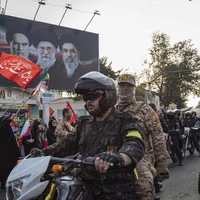
Members of the police stand guard on a street, with a large billboard featuring Iran's late Supreme Leader Ayatollah Ali Khamenei in the background, amid the U.S.-Israeli conflict with Iran, in Tehran, Iran, March 12, 2026. REUTERS/Alaa Al-Marjani Purchase Licensing Rights

As a fragile ceasefire holds between the United States and Iran, former CIA analyst and former National Security Council director Ken Pollack is warning that the greatest risk may be a war that ends with the Islamic Republic still intact.

“I don't see anything from the Trump administration that indicates an interest in absolutely getting rid of this regime,” Pollack said, referring to the prospect of regime change.

“The initial rhetoric about regime change is just gone. In fact, the president is constantly talking about how wonderful this leadership is, that it's better, that it is more reasonable than we had at the beginning, which I just see as absolutely fantastical.”

US-Iran talks were held in Pakistan on Saturday but ended without a deal.

In those discussions, there was little mention of the people of Iran. Just weeks ago, politicians across Washington and beyond spoke openly about them. Now, as diplomacy and de-escalation dominate the headlines, that focus appears to be fading.

For Pollack, the greatest concern is not the escalation of war but the survival of the regime.

“This war ending with this leadership in control of this regime—that's about the worst outcome that I can possibly imagine,” Pollack told the Eye for Iran podcast.

For many inside Iran, that fear is deeply personal.

The concern is not simply that the regime remains in power after absorbing military strikes. It is that a wounded but surviving leadership could emerge even more brutal, convinced it has weathered the storm and defeated outside pressure.

Pollack described the current leadership as “more willing to use force, both against their own people and against the people of the Middle East.”

Since the 40-day war, several political dissidents have been hanged in Iran. Arrests and crackdowns—with the regime’s repressive apparatus taking over the streets—are fueling fears that any pause in military confrontation may be followed by intensified domestic repression.

Ceasefire or a pause

Pollack was skeptical that the current lull in fighting represents any meaningful end to the conflict, saying it was a “partial ceasefire” at best.

“Both sides have agreed to a ceasefire, [but] it's not at all clear that they've agreed to the same ceasefire,” he said, arguing that the disconnect reflects a deeper strategic problem: each side believes it has leverage.

According to Pollack, Tehran appears convinced it has demonstrated an ability to absorb punishment while still imposing political and economic costs on Washington, particularly through threats to oil markets and shipping routes.

That perception matters because survival itself can be transformed into regime messaging.

A leadership that emerges from war still standing can portray endurance as victory—both to its internal security forces and to the wider region.

The people of Iran risk being forgotten again

For Iranians who had hoped strikes on the regime’s security apparatus might open space for political change, the ceasefire raises a different fear: that the world’s focus will once again shift away from them.

That concern was central to Pollack’s warning.

He said Iran had been in a “pre-revolutionary state,” with the public one spark away from another mass uprising. But a bad ending to the war could shatter that fragile sense of possibility.

“I worry that the outcome of the war may cause Iranians to simply decide that there is no opportunity to overthrow this regime,” he said.

That may be the deepest consequence of all.

“I don't see a good outcome that includes having this regime still in place,” Pollack said.

You can watch Eye for Iran on YouTube or listen on any podcast platform of your choosing

Most Viewed

What the US-Venezuela oil model could mean for Iran’s energy future
1
ANALYSIS

What the US-Venezuela oil model could mean for Iran’s energy future

2

Iran sanctions reach education: Duolingo blocked, TOEFL and GRE in doubt

3

Poverty pushes Iranian children into hazardous border work

4

Iran court sentences 10 protesters to death in Isfahan

5

Iran arrests alleged financial intermediary over €300 million bank debt

Banner
Banner
Banner

Spotlight

  • Iranians hit back at VP's case for pricier gasoline as dollar passes 2.1m rials
    VOICES FROM IRAN

    Iranians hit back at VP's case for pricier gasoline as dollar passes 2.1m rials

  • Nearly half in poll would not buy home in Iran even if they could afford it
    VOICES FROM IRAN

    Nearly half in poll would not buy home in Iran even if they could afford it

  • Syria veteran emerges as key figure in Shahriar crackdown

    Syria veteran emerges as key figure in Shahriar crackdown

  • Iranians tell of shrinking paths to study abroad
    VOICES FROM IRAN

    Iranians tell of shrinking paths to study abroad

  • What the US-Venezuela oil model could mean for Iran’s energy future
    ANALYSIS

    What the US-Venezuela oil model could mean for Iran’s energy future

  • Washington’s economic war on Iran starts in Dubai, not Beijing
    ANALYSIS

    Washington’s economic war on Iran starts in Dubai, not Beijing