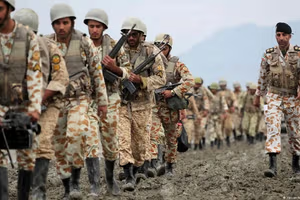
What follows is a list of fifty-two senior military, intelligence and security officials of the Islamic Republic who have been killed in recent years—mostly in Israeli operations and in some cases with US involvement.
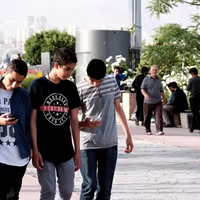
A man walks on a street after US President Donald Trump said that he had agreed to a two-week ceasefire with Iran, in Tehran, Iran, April 8, 2026.
Pro-government groups protested a ceasefire with the United States and planned negotiations, accusing officials of betraying the leadership and demanding continued confrontation, according to videos circulating on social media.
Footage shared on social media showed demonstrators gathering in the capital, where a speaker warned Parliament Speaker Mohammad Bagher Ghalibaf, reported to be leading upcoming talks with the United States, not to abandon retaliation after the killing of former Supreme Leader Ali Khamenei.
“Mr. Ghalibaf, whatever you have in this country is because of our martyred leader. Damn you if you want to trample on the blood of our leader,” the speaker said.
Other clips showed crowds chanting against “compromise” and calling for continued war with the United States and Israel. Some demanded allegiance to new leader Mojtaba Khamenei, while others questioned why earlier threats, including keeping the Strait of Hormuz closed, had not been carried out.
A woman in one video said, “We have not taken revenge for our leader. We want to remain enemies with America and Israel until the last drop of our blood. We do not want to negotiate.”
Hardline media rejects ceasefire
Hossein Shariatmadari, editor-in-chief of the hardline Kayhan newspaper, wrote on Wednesday that any temporary ceasefire or negotiation with the United States would only help Washington recover and prepare for further attacks.
Shariatmadari said even if the other side accepted all of Iran’s reported conditions, there was no reason to believe the United States would honor them.
State media debate exposes divisions
Disagreements over negotiations surfaced during live broadcasts on state television, where an analyst argued over whether to continue talks or escalate.
Mehdi Khanalizadeh, a commentator, said on Wednesday attacks had undermined the basis for diplomacy. “America and Israel have attacked the negotiating table and there is no longer a foundation for talks,” Khanalizadeh said.
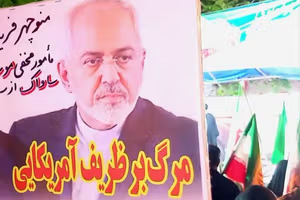
This was not something new. On Saturday, hardline figures targeted officials who had advocated de-escalation, including former foreign minister Mohammad Javad Zarif and former president Hassan Rouhani.
Hamid Rasaei, a lawmaker, called on the judiciary to detain both men after Rouhani urged preparations to end the war and Zarif proposed a negotiated settlement.
In an article in Foreign Affairs, Zarif argued Iran should use its position to “declare victory and make a deal,” proposing limits on the nuclear program and reopening the Strait of Hormuz in exchange for lifting sanctions.
Rouhani said ending the conflict in a way that protects national interests required policy changes and coordination to safeguard strategic areas.
At rallies, demonstrators burned images of Zarif and Rouhani, accusing them of serving US interests. Saeed Haddadian, a maddah (religious eulogist and chant leader) close to the establishment, issued a direct warning.
“I give Zarif three days. If he does not say he screwed up, on the fourth night we will gather and go to his house,” Haddadian said.
A person holds an image of late Supreme Leader Ali Khamenei, with an image of Iran's new Supreme Leader Mojtaba Khamenei on a billboard in the background, on the day of a ceremony marking 40 days since Khamenei was killed in Israeli and US strikes, in Tehran, Iran, April 9, 2026.
Fortieth-day ceremonies for Iran’s former Supreme Leader Ali Khamenei began on Thursday during a fragile two-week ceasefire with the United States and Israel, as authorities continued to withhold clear information about his burial 40 days after his killing.
State media reported that mourning processions started in the morning across several cities and would continue until 8 p.m. with organized groups moving through urban centers as part of coordinated nationwide commemorations.
Ali Khamenei was killed on February 28 minutes after the war began. Iranian state media confirmed his death the following day, and authorities announced 40 days of public mourning.
Pro-government women dressed in black beat drums during a procession marking the 40th day since the death of Iran’s Supreme Leader Ali Khamenei in Tehran on April 9, 2026.
Officials have not said where or how he was buried, leaving room for claims that the burial was conducted in secret – or even that his body has yet to be formally interred or recovered.
In Shiite tradition, the fortieth day after death is closely tied to visits to a grave and large public gatherings. The absence of a confirmed burial site has set this commemoration apart, raising questions among observers.
Clergy deliver remarks during a ceremony marking the 40th day since the death of Iran’s Supreme Leader Ali Khamenei at a church in Tehran on April 8, 2026.
Church ceremony triggers wave of mockery
A separate fortieth-day ceremony held at Tehran’s Saint Sarkis Church on Wednesday drew widespread attention and a flood of mocking reactions online.
The event, attended by Culture Minister Abbas Salehi, marked an unusual venue for a ceremony tied to a central figure in Shiite political and religious life.
“They held a fortieth in a church while his body has not even been buried,” one user wrote. “Someone who literally claimed to be the most devout Muslim still has not even had funeral prayers.”
Another comment took a more scathing tone: “Forty days have passed and his corpse is still lying around. The fortieth is a sacred day in Shiite tradition, when people gather at a grave for a proper ceremony. But for him, none of that is possible.”
Iran’s former intelligence minister Mahmoud Alavi (front row, left) and Culture Minister Abbas Salehi (front row, right) attend a memorial ceremony in a church in Tehran on April 8, 2026.
Several users framed the situation as symbolic retribution. “This is karma,” one wrote. “They insulted people and denied dignity to the dead for years, and now he has no grave, no ceremony.”
Others directly referenced past state restrictions on mourning for protesters. “They used to prevent families from holding funerals, demand payment for burial, and intimidate mourners,” one user wrote. “Now the same has come back to them.”
The choice of a church as a venue became a focal point of ridicule. “From fear of the followers of Moses to taking refuge with the followers of Jesus,” one comment read.
Another user wrote: “They are holding the ceremony in a church because they know it will not be targeted,” suggesting the decision was driven by security concerns.
Others highlighted what they described as contradiction. “These same authorities arrested and persecuted Christians, and now they are holding a ceremony in a church after keeping his body for 40 days,” one comment read.
Ceasefire backdrop and continued tensions
The commemorations come after 40 days of conflict that continued until Tuesday night, followed by a temporary halt in fighting.
A two-week ceasefire between Tehran and Washington – with Israel backing it – was agreed after last-minute mediation led by Pakistan.
However, explosions and air defense activity were reported in multiple cities on Wednesday and Thursday night, according to local accounts, while strategic islands were targeted in strikes that some media attributed to regional actors.
Confident that US and Israeli strikes would avoid civilian areas, government supporters in recent weeks gathered at evening local events, repeating official narratives and calling for continued confrontation rather than negotiations.
The fortieth-day ceremonies have again provided a platform for such pro-government supporters.
Authorities emphasize continuity
The Islamic Revolutionary Guards Corps said in a statement marking the fortieth day that Khamenei’s death was as consequential as his life in advancing the Islamic Republic’s trajectory.
“The loss of the leader is difficult, but enduring his absence is made possible through the continuation of his path and the realization of promised outcomes,” the Guards said.
Videos circulating online also showed a visible presence of Afghan immigrant participants in ceremonies in Tehran, highlighting the broader networks mobilized for the commemorations.
Costa Rica designated Iran’s Islamic Revolutionary Guards as a terrorist organization, the foreign ministry said on Thursday, in a move that also blacklisted three other Iran-backed groups in the region.
Hezbollah in Lebanon, Hamas in Gaza, and Houthis in Yemen were also designated.
The government made the decision on Monday, according to the ministry, which said the measure was taken in line with Costa Rica’s international commitments to combat terrorism and its financing.
The move will "allow intelligence authorities and judicial bodies to strengthen their prevention, investigation, and prosecution capabilities, acting more decisively against any logistical and financial support networks that may be operating within the country to sustain these organizations,” the foreign ministry said.
It added that the designation would help intelligence and judicial authorities strengthen their ability to prevent, investigate and prosecute logistical and financial support networks linked to the groups.
“The designation seeks to prevent any form of action or influence by these groups in Costa Rica, safeguarding the security of the population and integrity of our democratic institutions," according to the statement.
Several countries have moved in recent weeks to designate the IRGC as a terrorist organization, while the Trump administration has urged allies to take similar action against the IRGC and Hezbollah.
Iceland, Moldova, Bosnia and Herzegovina, Montenegro, North Macedonia, and Liechtenstein designated the terror group on March 20, followed by Argentina on March 31.
Motorcycle-riding security agents from the Imam Ali battalions, one of the forces used to suppress street protests in Iran
Israel’s campaign in Iran has reached far beyond missile depots and military command. Over roughly a month, it has also hit the architecture of domestic repression: intelligence compounds, police stations, Basij bases, judicial buildings, and senior officials tied to crackdowns.
That matters not only because of the damage done, but because of what these places meant. In Iran, repression has never depended on one institution alone. It has been built as a layered system, running from the top decision-making bodies in Tehran down to the neighborhood police station, the local Basij outpost and the courthouse where detainees are processed.
A review by Iran International of citizen reports and source material found that, in about one month after the war began, at least 130 sites tied to internal repression were destroyed or hit.
They included 57 Basij buildings or bases, 43 police (FARAJA) facilities, 10 Revolutionary Guards compounds, and 11 security complexes involved in repression. Other targets included judicial buildings and the state broadcaster, institutions that helped complete the chain through prosecutions, propaganda and coerced confessions.
Iran International sources also put the toll among security forces at nearly 5,000 dead and about 21,000 wounded.
From the command center to the street
The internal security system has long worked in three layers.
At the top sits the command structure: the Supreme Leader, the Supreme National Security Council, provincial security councils and, in Tehran, the IRGC’s Tharallah headquarters, which can take control of multiple security organs during major unrest. Around the capital, a similar role has been played by the Seyyed al-Shohada corps.
Below that are the operational forces: The Police Command of the Islamic Republic of Iran (abbreviated as FARAJA); special anti-riot units; provincial Revolutionary Guards formations; and IRGC’s specialized units such as Saberin and Fatehin.
Alongside them is the Basij, the paramilitary network embedded in neighborhoods across the country. Its Imam Ali battalions, often arriving on motorcycles, became one of the most recognizable instruments of street repression after the 2009 protests.
Iran’s then-President Ebrahim Raisi meets members of the Fatehin unit after the crackdown on the 2022 protests.
The third layer is institutional support: intelligence bodies, courts, prisons and state media.
The strikes appear to have touched every layer.
Senior figures reported killed include Ali Khamenei, the longtime ultimate authority over crackdowns; the intelligence minister and several of his deputies; senior Guards and Basij commanders; commanders tied to Tehran’s suppression apparatus; police intelligence officials; and members of the judiciary, including officials linked to Evin prison and Tehran’s prosecutorial system.
The symbols that fell
The targets were not only militarily useful. Many were symbols.
In Tehran, the Ministry of Intelligence and compounds linked to the Revolutionary Guards’ intelligence arm were hit again after earlier strikes in the June 12-day war. Tharallah-linked facilities in northern Tehran, security clusters in eastern Tehran, anti-riot police facilities and Basij sites across the capital were also struck.
Some locations had an importance that went beyond their walls. Tehran’s Revolutionary Court building on Moallem Street was one of them. For decades, it stood as a symbol of summary trials, political prosecutions and death sentences. Its destruction carried a message larger than the physical damage.
The same was true of the state broadcaster. For many Iranians, it was not just a media institution but a place associated with forced confessions and public humiliation of dissidents. Seeing it hit again mattered for that reason.
Even when buildings had been partly emptied, they still housed the tools of coercion: files, servers, records, communications systems, vehicles and equipment.
In some post-strike videos, papers and official documents could be seen scattered in the streets after blasts ripped through buildings that looked outwardly residential or commercial.
One attack in western Tehran offered a different picture: a strike on the 12,000-seat Azadi sports hall, where anti-riot personnel appear to have been moved. Iran International’s reporting estimates that between 900 and 1,200 security personnel may have been killed there.
From the capital to small towns
What happened in Tehran was echoed outside it.
On the capital’s outskirts, command centers in Rey, Karaj and Mahdasht were hit, along with Basij and police-linked sites in surrounding towns.
In the provinces, Iran International identified heavy strikes on intelligence, police, judicial and Guards facilities in cities including Isfahan, Khorramabad, Ilam, Sanandaj, Semnan, Shiraz, Urmia and Tabriz.
In small towns, local police posts carry a special weight. They are often the clearest symbol of the central government’s presence, and one of the first places where people encounter coercion directly.
That is what makes a place like Abdanan important. The town had already become known for the violence used against residents during the January uprising. Even a mourning ceremony for local victims was met with gunfire.
Days later, residents watched their police station and Guards facilities explode. For people who had just buried their dead, the collapse of those buildings was not just another wartime image. It was the visible breaking of a local order that had seemed untouchable.
What remains after the strikes stop
If the campaign ends soon, the central question will not be only what has been destroyed, but what has been exposed.
The Islamic Republic’s internal coercive machine appears weaker, less insulated and less imposing than before.
Walls around intelligence compounds have fallen. Buildings long associated with fear have been reduced to rubble. Officials who once threatened subordinates from the top of the pyramid are gone.
But the country that remains will also be poorer and angrier.
Official figures show point-to-point food inflation in the last month of the Persian year running above 113%, with some staples such as cooking oil up as much as 220% and bread up 140%, while wages rose only 20% to 30%.
Power cuts, already worsening before the war because of years of underinvestment, point to deeper structural decay that long predates the current fighting.
The war will end. What will remain for ordinary Iranians is a country already battered by record food inflation, stagnant wages and years of neglected infrastructure long before the current fighting began.
For many of those who lost relatives in the January crackdown, that larger story may be distilled into one image: not an oil turbine or a military depot, but the police station, Basij base or courthouse that once embodied fear, now lying in ruins.
President Masoud Pezeshkian (left) and IRGC chief commander Ahmad Vahidi
A deepening rift at the top of the Islamic Republic has spilled into an unusually sharp confrontation, with President Masoud Pezeshkian accusing senior Guards commanders of unilateral actions that have wrecked ceasefire prospects and pushed Iran toward disaster.
Two sources close to the presidential office said a tense exchange took place on Saturday, April 4, between Pezeshkian and Hossein Taeb, a powerful figure close to Supreme Leader Mojtaba Khamenei. Those present described the conversation as unusually difficult and highly charged.
During the meeting, Pezeshkian accused IRGC chief commander Ahmad Vahidi and Ali Abdollahi, commander of Khatam al-Anbiya Central Headquarters – the country’s armed forces' unified command, of acting unilaterally and driving escalation through attacks on regional countries, especially against their infrastructure.
According to the sources, Pezeshkian said those policies had destroyed any remaining chance of a ceasefire and were steering the Islamic Republic directly toward “a huge catastrophe.”
He also warned that, based on what he described as precise assessments, Iran’s economy would not be able to withstand a prolonged war for much longer and that full economic collapse was inevitable under current conditions.
The confrontation comes amid mounting evidence of a broader power shift inside the Islamic Republic, with military and intelligence networks increasingly displacing both the elected government and the traditional clerical order.
A regional source familiar with internal developments told Iran International in February that the model of velayat-e faqih (guardianship of the jurist) that has defined the Islamic Republic for more than four decades is now undergoing a fundamental transformation and even an “ideological collapse.”
According to that source, the appointment of Mojtaba Khamenei to the leadership, despite lacking the traditional qualifications and legitimacy associated with the position, took place through an opaque process that in practice amounts to the sidelining of the traditional clergy and the consolidation of full control by the Guards’ military-intelligence apparatus.
The source said this process has strengthened what many insiders describe as the Islamic Republic’s “hidden state.”
Iran International has previously reported growing tensions between Pezeshkian and senior IRGC commanders, particularly Vahidi, over how the war should be managed and over its destructive impact on people’s livelihoods and the economy.
On March 28, informed sources said Pezeshkian had criticized the Guards’ approach to escalating tensions and continuing attacks on neighboring countries, warning that without a ceasefire the economy could collapse within three weeks to a month.
Subsequent reporting by Iran International showed that the president’s authority has continued to shrink.
Sources said the Guards have resisted Pezeshkian’s appointments and decisions, effectively stripped the government of executive control and erected a security barrier around the core of power.
According to those reports, Pezeshkian’s attempt to appoint a new intelligence minister collapsed under direct pressure from Vahidi, who rejected all proposed candidates, including Hossein Dehghan, and insisted that all key wartime positions must, for now, be chosen and managed directly by the Guards.
Alongside the political infighting, fresh field reports received by Iran International point to a worsening human and logistical crisis inside the Guards and the Basij.
Sources said that over the past 72 hours, operational forces have faced acute shortages of basic supplies, including edible food, hygiene facilities and places to sleep.
Recent strikes on infrastructure and bases have left many Guards and Basij personnel sleeping in the streets, and in some areas they have had access to only one meal a day.
According to informed sources, some personnel were forced to buy food from shops and restaurants with their own money after expired rations were distributed.
At the same time, disruptions affecting Bank Sepah’s electronic systems have reportedly delayed the salaries and benefits of military personnel, fueling fresh anger and mistrust within the ranks.
Iran International had previously reported similarly dire conditions in field units, including severe shortages of ammunition, water and food, as well as growing desertions by exhausted soldiers.
Even in the Guards’ missile units, which have historically received priority treatment, sources reported serious communications failures and food shortages. They said commanders were continuing to send only technical components needed to keep missile systems operational, rather than food or basic individual supplies for personnel.