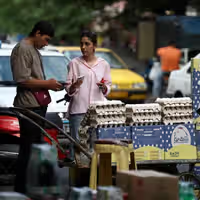
As photos of wounded civilians circulated widely on social media, some users accused photographers and authorities of staging scenes for propaganda, claiming that individuals depicted in widely shared images were actors and that injuries, dust and distress visible in the photos had been artificially created using makeup and staged scenes.
The accusations spread quickly across Persian-language social media, with skeptics pointing to perceived similarities between people appearing in images linked to separate incidents as supposed evidence.
Even the Persian-language account of Israel’s foreign ministry weighed in on the controversy by reposting one of the disputed images and writing: “If they call the Gaza filmmaking industry ‘Pallywood’, what do they call this?”
But the claims were soon challenged by fact-checkers and other users, and in some cases the accusations were later withdrawn.
Iran’s independent fact-checking platform Factnameh said a review of several of the controversial images found no evidence supporting claims that they had been staged or taken at different times and locations as alleged.
“Given the presence of debris and victims, the idea that actors were staged in such a scene is highly unlikely,” the platform said, noting that the individuals in the images show clear differences in facial features and body structure despite some similarities.
Mehdi Ghasemi, one of the photographers whose work came under scrutiny, rejected the allegations and defended his work.
“I’m 47 years old, and it’s been 33 years since I received my first documentary photography award, and I haven’t taken a single reconstructed or manipulated frame,” he wrote on X.
One user who had asserted that a woman in a widely circulated photograph was an actress later deleted the post and issued an apology after acquaintances identified the woman and her husband as real individuals whose home had been destroyed in the strikes.
The controversy has unfolded amid tight wartime restrictions on reporting and photography in Iran.
Critics argue that permits to document sensitive scenes are tightly controlled and often granted only to photographers seen as aligned with the authorities, making independent documentation of chaotic strike sites difficult.
Combined with broader limits on information flow during the conflict, those restrictions have left social media as one of the primary arenas for competing narratives about events on the ground.
The dispute reflects how deeply distrust of official narratives has taken root in Iranian society after decades of censorship and propaganda. In such an environment, even genuine documentation can quickly become the subject of suspicion.
“The issue is exactly like the story of the boy who cried wolf,” one user wrote online.
“When a government lacks legitimacy to this extent and has always chosen to lie at every step, eventually no one believes the truth either. Now factor in cutting off communication channels on top of that, and you end up with the situation we are in.”
For others, however, the rush to dismiss images of civilian suffering as staged propaganda risks deepening divisions at a moment when the war itself is already reshaping daily life across the country.