Official figures released at the end of fiscal year 1404 (March 2026) show annual inflation at 50.6 percent, according to data compiled by government bodies including the parliament’s Research Center. Prices rose 5.6 percent in March alone.
But economists say the headline figure understates the severity of the crisis. The more revealing measure—point-to-point inflation—shows how sharply living costs have risen over the past year.
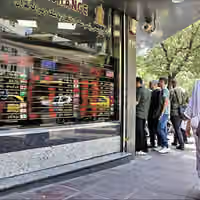
Government statistics indicate that prices in March 2026 were 71.8 percent higher than a year earlier, a surge that has sharply eroded household purchasing power. In major cities such as Tehran, the increase is believed to be even higher, particularly for food.
The shock has unfolded as weeks of US and Israeli strikes have disrupted economic life across the country. In Tehran, where many residents have temporarily left the city, large parts of the capital’s commercial activity have slowed sharply.
Many businesses remain closed and those who have stayed behind often limit their movements, wary of being caught in unpredictable air strikes.
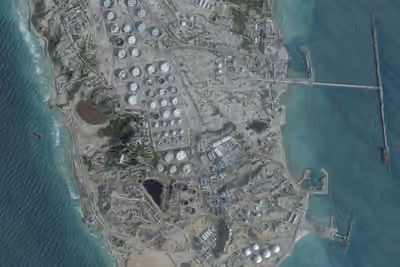
Attacks on what the attackers describe as “regime infrastructure” have also begun to hit the industrial economy more directly. Recent strikes on major steel production facilities—among the country’s most important industrial employers—have disrupted supply chains and raised fears of wider job losses in manufacturing regions.
For working-class and rural families, the situation is especially acute. Following the removal of preferential exchange rates (arz-e tarjihi), monthly food inflation has climbed above 100 percent, turning basic nutrition into the central economic struggle for many households.
Economists say national averages obscure the depth of the crisis. In some food categories, the real cost of living has effectively doubled, with price increases reaching as high as 150 percent.
Labor activists told the Iranian Labor News Agency (ILNA) that the government’s electronic commodity coupon system—introduced to cushion the impact of rising prices—covers only a small portion of what they describe as the “worker’s basket” of essential goods.
The government-linked Workers’ House has called for a return to direct distribution of staples such as rice, cooking oil and sugar, similar to the rationing system used during the Iran-Iraq war in the 1980s.
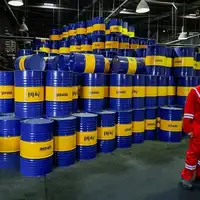
Workers in high-risk industries such as construction say the government has suspended its contribution to social-security insurance quotas, leaving many without coverage as workplace accidents increase amid wartime damage to infrastructure.
In mining regions such as Tabas in northeastern Iran, thousands of workers are reportedly unable to retire because employers—under financial strain during the war—cannot pay the required 4 percent premium for jobs classified as “hard and hazardous.”
Economists and labor advocates say the government must urgently introduce targeted relief.
Proposals include special allowances for workers covered by labor law to offset soaring food prices, as well as legal intervention by the judiciary and the Social Security Organization to allow workers in hazardous occupations to retire even if employers cannot currently meet their contribution requirements.
Without such measures, analysts warn, the country risks a deeper erosion of living standards at a moment when the economic effects of war are already reshaping everyday life.