Satellite imagery shows destruction of Iran's Ardakan yellowcake production plant
High-resolution airbus satellite imagery taken on march 28 shows the main processing building at Iran's Ardakan yellowcake production plant and its auxiliary building were destroyed after an Israeli strike, Institute of Science said on Monday.
The United Arab Emirates on Monday condemned a terrorist plot in Bahrain that authorities say was thwarted, reaffirming its support for the kingdom’s security and stability.
In a statement, the UAE’s foreign ministry denounced the planned attack and expressed solidarity with Bahrain, backing measures taken to counter threats and maintain stability.
Iran’s parliament speaker Mohammad Bagher Ghalibaf appeared to dismiss comments by US President Donald Trump that his administration was in talks with him and that Iran had accepted most of the 15-point US proposal.
“The enemy promotes its desires as news while threatening our nation at the same time. Big mistake,” Ghalibaf wrote on X.
“If they hit one, they'll take several back. God willing, the people of Iran, under the leadership of the Supreme Leader, will make the enemy regret the aggression and reclaim their rights,” he added.
Trump told the New York Post earlier in the day he would soon determine whether Ghalibaf was willing to work with Washington.
Iran’s security and military forces moved personnel, weapons and equipment into at least 70 civilian sites during the US-Israeli airstrikes, an Iran International investigation found, exposing what appears to be a nationwide pattern of using public spaces for military purposes.
The sites span 17 provinces, 28 cities and two villages. Nearly half of them – 34 in total – were primary or secondary schools. Other locations identified in eyewitness accounts and documents reviewed by Iran International included hospitals, stadiums, universities, mosques, parks and government offices.
The accounts were gathered over a 13-day period from March 2 to March 14, 2026, during a near-total internet shutdown that sharply restricted the flow of messages, photos and video from inside Iran.
While Iran International could not independently verify every account, it geolocated visual evidence from seven reported sites, all of them schools.
Civilian sites and battlefield risk
The deployment of military forces at civilian sites “shifts battlefield risks onto civilians,” a regional security source who requested anonymity said, adding that using such locations for military purposes is prohibited under international law.
“When security or paramilitary forces move into schools, hospitals or mosques, they endanger civilians physically, degrade protected civilian services and may turn those sites into military objectives,” the source said.
Under international humanitarian law, civilian sites can lose protected status if used for military purposes, though attacking forces must still comply with rules on distinction, proportionality and precaution.
The source said the legal implications vary depending on the type of site but warned that such practices can strip civilian locations of their protected status.
“Schools are civilian objects; using them as barracks, firing positions, detention sites, or weapons depots can make them lawful military targets, while still leaving the attacker bound by distinction, proportionality, and feasible precautions,” the source said, adding that this “amounts to human shielding.”
At least four hospitals were identified in eyewitness accounts as having nearby or associated military deployments, including Golestan Hospital in Ahvaz and medical sites in Kermanshah and other western regions.
“Hospitals get even stronger protection than schools. Under International Humanitarian Law, they must be respected and protected, but if they are used outside their humanitarian role, such as for a base, observation post, military center, shelter for military-security personnel, or weapons depot, they lose that special protection, although a clear warning is required before any attack,” the source said.
At least three mosques were identified in eyewitness accounts as having been used for military deployments. In the capital, Tehran, this included Rezvan Mosque on March 8 and Chahardeh Masoum Mosque in University Town on March 7, where special police units were stationed.
Malek Ashtar Mosque in Khosrowshah in East Azarbaijan province was also used on March 9, where IRGC forces were relocated.
Mosques are protected as civilian objects and may also qualify as cultural property under the 1954 Hague Convention for the Protection of Cultural Property, the source said.
“Using mosques for military purposes is prohibited, but if turned into a military objective, they lose protection, while attacking forces must still take precautions and avoid indiscriminate or disproportionate action,” the source added.
How the reporting was assembled
As authorities imposed a near-total internet shutdown across the country after the outbreak of the war, only a limited number of messages were able to get through filtering systems, while photo and video footage remained scarce.
Iran International collected eyewitness accounts from March 2 to March 14 but could not independently verify every claim.
It was nevertheless able to geolocate visual evidence accompanying some of the reports, identifying seven locations, all of them schools.
A pattern across multiple provinces
The accounts reviewed by Iran International illustrate the breadth of the reported deployments across multiple provinces.
In the northeastern Iranian city of Mashhad, footage sent to Iran International on March 10 from Fakouri Boulevard showed vehicles belonging to security forces present in the courtyard of Ali Shahrestani primary school.In Tehran, eyewitness reports and images sent to Iran International on March 6, from the city’s Tehranpars neighborhood showed special police unit vehicles deployed inside the courtyard of Hashemi Nejad boys’ primary school on Parvin Boulevard, next to Bent ul-Hoda girls’ school.Footage and eyewitness reports from March 3, in Tehran’s Pirouzi neighborhood showed military forces deployed in the courtyard of Fatemeh Talimi girls’ high school, with buses stationed nearby and an individual carrying a weapon visible in the images.In Qazvin in northwestern Iran, footage sent to Iran International on March 2 showed military forces and motorcycles deployed at Sedigheh Kobra Girls’ School on Shahid Sales Street in the Sartak neighborhood. In Shahriar, west of Tehran, footage sent to Iran International on March 13 showed a Toyota pickup truck arriving at Al-Zahra High School carrying what appeared to be a machine gun concealed under a tarp.White Toyota pickup trucks fitted with machine guns or used to transport security forces were also reported during the crackdown on January’s nationwide protests in Tonekabon in Mazandaran province in northern Iran on January 11, 2026.In the northern Iranian city of Tonekabon, footage sent to Iran International on March 10 showed a police car inside Chamran Primary School on Sheikh Fazlollah Nouri Street in a busy central area, with witnesses saying forces had moved from a nearby police station into schools.
In Tehran and surrounding areas in north-central Iran, eyewitness reports said police, intelligence and administrative offices in Malard were relocated on March 8 to Fatemiyeh Girls’ High School, which is located alongside two other schools near a gas station.
One of the main hubs for Iran’s plainclothes security forces in Tehran is the Basij’s Meghdad Resistance District, known as the “Meghdad base.” It is located on Azadi Street, next to Sharif University of Technology.
During the June 15, 2009 protests – part of the mass demonstrations that followed Iran’s disputed presidential election and became known as the Green Movement – gunfire using live ammunition was directed at demonstrators from the base’s rooftop.
The Meghdad base sits next to the central headquarters of the West Tehran Combatants Council, a complex with significant influence across paramilitary and security structures. The surrounding area was targeted in strikes on March 6.
After the strikes, eyewitness accounts on March 8 said remaining personnel and equipment had been moved to a fire department building directly opposite the former Meghdad base.
Another eyewitness account on March 9 said forces and equipment were relocated again, this time to a Bank Mellat complex on Azadi Street near the start of Jeyhoon Street. The site is one of the bank’s key national facilities and houses its data center.
Beyond the capital, similar deployments were reported across multiple regions of the country.
In Khuzestan province in southwestern Iran, eyewitness accounts said military forces were stationed at Takhti stadiums in Izeh and Ahvaz, as well as at Chamran University and near Golestan Hospital in Ahvaz, and at a girls’ primary school in Dezful.
In Fars province in southern Iran, military forces were reported at Sardaran Stadium and near the Negin commercial complex in Shiraz, as well as at schools in rural areas.
In Kermanshah in western Iran, missile launchers and military forces were deployed near major hospitals and at an industrial factory. In East Azarbaijan in northwestern Iran, forces were reported at multiple schools in Tabriz and in Hadishahr.
In Isfahan province in central Iran, forces were stationed at women’s parks, sports facilities and schools in several cities, including Isfahan, Dastgerd and Naein. In Alborz province west of Tehran, deployments were reported across Karaj, Hashtgerd and Mehrshahr.
In Razavi Khorasan in northeastern Iran, forces were reported to have used schools in Mashhad as bases, while in Bushehr in southern Iran they were stationed at universities.
In West Azarbaijan in northwestern Iran, forces were reported at a school in Khoy, while 22 Bahman Stadium in Qazvin in north-central Iran served as a main base.
In Kohgiluyeh and Boyer-Ahmad province in southwestern Iran, military forces used Naft Stadium in Gachsaran. In Markazi province in central Iran, deployments were reported at a school and a government office in Arak. In Mazandaran in northern Iran, schools in Tonekabon were used as bases.
In Golestan in northern Iran, military forces were reported at a school and a government building in Gorgan, while in Lorestan in western Iran, deployments were reported at several high schools in Borujerd.
US warning and Israeli response
Iranian officials have repeatedly denied accusations that the country uses civilians as shields and have accused Israel of targeting civilian infrastructure during the conflict.
The Israeli military, when contacted for comment, confirmed that Iranian forces were deploying personnel and weapons at civilian sites such as schools, mosques and stadiums.
“Iran’s regime, like all of its proxy and terrorist groups across the Middle East that are activated and employed by this regime, has effectively turned defenseless people into its human shields and hides behind these innocent, unfortunate civilian populations,” Israel Defense Forces Persian-speaking spokesman Kamal Penhasi told Iran International.
“It tries to conceal its military assets and weapons behind people and among the population, including in hospitals, schools, and mosques,” he added.
Asked how civilian harm is minimized in populated areas, Penhasi said evacuation warnings are issued ahead of operations and precision-guided weapons are used to limit collateral damage.
“We do everything within our power to the extent possible to prevent harm to civilians and the citizens of the dear Iranian nation.”
Penhasi urged people to distance themselves from such locations and follow evacuation warnings.
“I ask the people of Iran to pay attention to our messages to protect their lives and safety. As soon as they receive a warning message, they should move away and also pass it on to their neighbors, friends, and relatives,” he said.
Iran International also reached out to the US Central Command, the White House and the Pentagon for comment, but they did not immediately respond to requests for comment.
US Central Command on March 8 issued a safety warning to civilians in Iran, saying civilian locations used for military purposes could become legitimate military targets under international law.
“The Iranian regime is using heavily populated civilian areas to conduct military operations, including launching one-way attack drones and ballistic missiles,” CENTCOM said in a statement.
“This dangerous decision risks the lives of all civilians in Iran since locations used for military purposes lose protected status and could become legitimate military targets under international law,” the statement added.
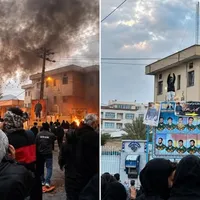
Smoke billows over western Tehran skyline after reported strikes, March 30, 2026
The Israeli military said on Monday it had completed a wide-scale wave of strikes in central Tehran, as Iranian media reported attacks on multiple areas of the capital, including the northeast and west, with explosions heard in neighborhoods such as Shahrak-e Gharb and Saadat Abad in western Tehran and Pounak.
Eyewitnesses told Iran International that multiple blasts were heard near Atieh Hospital in Shahrak-e Gharb in western Tehran, while more than 10 explosions were reported in the Shahr Ziba area, also in western Tehran.
Explosions were also reported in Gohardasht in Karaj, west of Tehran, as well as in the northwestern Iranian city of Tabriz and Shiraz in southern Iran.
Israel’s military has been ordered by the country’s political leadership to shift to striking economic targets in Iran after nearly completing attacks on military sites defined at the start of the conflict, The Times of Israel reported on Monday.
The report said Israel believes it has largely achieved its initial objective of degrading Iran’s military capabilities and is now entering what it described as a “completion phase.”
Israeli leaders have directed the military to target sites aimed at causing economic damage, including gas infrastructure and major steel facilities, with further such strikes planned, the report said.