• العربية
  • فارسی
Brand
  • Iran Insight
  • Politics
  • Economy
  • Analysis
  • Special Report
  • Opinion
  • Podcast
  • Iran Insight
  • Politics
  • Economy
  • Analysis
  • Special Report
  • Opinion
  • Podcast
  • Theme
  • Language
    • العربية
    • فارسی
  • Iran Insight
  • Politics
  • Economy
  • Analysis
  • Special Report
  • Opinion
  • Podcast
All rights reserved for Volant Media UK Limited
volant media logo

US pays $129 million to victims of Iran-linked terrorism in New York case

Mar 24, 2026, 09:37 GMT+0
The building at 650 Fifth Avenue

The United States has paid $129 million to victims of Iran-linked terrorism as part of a broader $318 million settlement tied to a long-running case over a Manhattan office tower, prosecutors in New York said on Monday.

US Attorney for the Southern District of New York Jay Clayton said the payment followed nearly two decades of litigation over assets connected to 650 Fifth Avenue, a 36-story building authorities said concealed financial interests of the Iranian government through Bank Melli.

“Iran has sponsored terrorism for decades... Since the inception of this litigation… we pursued hidden Iranian government assets tied to a Manhattan skyscraper to ensure those funds would ultimately compensate victims of Iran-sponsored terrorism rather than terrorists and their enablers,” Clayton said in a statement.

The case began in 2008, when US authorities moved to seize assets linked to Bank Melli Iran, which had allegedly used front companies to maintain a stake in the building and bypass sanctions. Prosecutors said the structure allowed Iran to generate income from the property while concealing ownership.

The 650 Fifth Avenue tower was built before the 1979 revolution by the Pahlavi Foundation as a source of revenue, but control of the property passed to the Islamic Republic after the fall of the monarchy. In later years, the foundation was renamed the Alavi Foundation, while Bank Melli acquired a stake in the building that US authorities say was managed through front companies known as Assa.

Under a final settlement reached in January 2025 between the US government, victims’ groups and the building’s owners, $318 million will be paid to victims. The initial $129 million installment was completed on March 20, with the remaining $189 million to be paid over three years with interest.

Clayton said the case reflected the Justice Department’s goal of “vindicating the rights of victims of the Government of Iran’s long-standing policy of supporting and promoting terror attacks across the world.”

Victims eligible for compensation include those affected by attacks attributed to Iranian-backed groups, including the 1984 bombing of US military facilities in Beirut, the September 11 attacks and other incidents targeting civilians.

As part of the settlement, the partnership controlling the building is being dissolved, and ownership transferred to a new entity, with approvals from US authorities including the Treasury Department.


Most Viewed

How to beat Iran’s internet kill switch
1
OPINION

How to beat Iran’s internet kill switch

2
VOICES FROM IRAN

Iranians vent frustration as Trump revives talk of Tehran deal

3
INSIGHT

Hope and hostility collide in Tehran over possible deal with US

4

Iranian threat in Germany more urgent than publicly announced - NYT

5
VOICES FROM IRAN

Internet shutdown pushes Iranians onto distrusted domestic apps

Banner
Banner

Spotlight

  • Ghalibaf pushes for the role many thought he already had
    INSIGHT

    Ghalibaf pushes for the role many thought he already had

  • Internet shutdown pushes Iranians onto distrusted domestic apps
    VOICES FROM IRAN

    Internet shutdown pushes Iranians onto distrusted domestic apps

  • Iranians vent frustration as Trump revives talk of Tehran deal
    VOICES FROM IRAN

    Iranians vent frustration as Trump revives talk of Tehran deal

  • Hope and hostility collide in Tehran over possible deal with US
    INSIGHT

    Hope and hostility collide in Tehran over possible deal with US

  • How to beat Iran’s internet kill switch
    OPINION

    How to beat Iran’s internet kill switch

  • Pro-regime graffiti in Los Angeles sparks concern in Iranian-American hub

    Pro-regime graffiti in Los Angeles sparks concern in Iranian-American hub

•
•
•

More Stories

'Part of the dance': experts question the purpose of US-Iran contacts

Mar 23, 2026, 21:56 GMT+0
•
Negar Mojtahedi

Ambiguous reports of contacts between US and Iranian officials may reflect a tactical effort to calm markets, shape global opinion and deepen uncertainty inside a state already gripped by paranoia, analysts and former US officials told Iran International.

President Donald Trump said Monday that recent exchanges with Iran had been “very, very good,” and announced a five-day postponement of threatened strikes on Iranian power plants and energy infrastructure.

He later said both sides wanted to “make a deal" and that Iran had agreed to "zero" enrichment of uranium.

Reuters quoted a senior Iranian official on Monday saying that US had requested a meeting with Iran's parliament speaker Mohammad-Bagher Ghalibaf, but Tehran has yet to respond. Trump, however, said he was already speaking with "a top person" in Iran.

“They called, I didn’t call. They want to make a deal, and we are very willing to make a deal," he told reporters.

Tehran denied any talks had taken place. Markets nevertheless reacted sharply: US stocks surged while oil prices fell after Trump’s comments.

For Joel Rubin, former Deputy Assistant Secretary of State in the Obama administration, any apparent outreach should be viewed as one front in a broader conflict.

“There’s two wars underway,” Rubin told Iran International. “There’s the physical war … [and] it’s also fought on social media, I guess, influencing global opinion.”

Rubin said Trump’s move looked like “a tactical maneuver,” aimed in part at steadying jittery oil markets while buying time to build broader international backing.

“Trump’s move here with a little patience, the tactical maneuver is a very smart one if you want to try to build up more international backing for this effort, which quite frankly would be in our national security interests to do so,” Rubin told Iran International.

At the same time, Rubin cautioned against reading too much into reports of a US-Iran channel, especially when Tehran is publicly denying any engagement.

“Ever since the war began, [Iran] has basically said they don’t want to talk,” Rubin said. “But that doesn’t mean they aren’t talking.”

If messages are being passed, he said, they do not appear to be part of any formal negotiation.

“I think if there is any information sharing between the sides or through third parties, it is not very structured,” Rubin said. “I would say people need to view this as part of the dance because there will ultimately be some kind of endgame.”

Internal retaliation, external assassination

The very act of naming Ghalibaf as a potential interlocutor could itself carry serious consequences inside Iran’s power structure. In a system already shaken by precision strikes on senior figures — including Ali Larijani — publicly linking an official to backchannel contacts with Washington risks casting suspicion on his loyalty and exposing him to internal retaliation or even making him a target for external actors.

Behnam Ben Taleblu, senior director of the Foundation for Defense of Democracies’ Iran program, said Ghalibaf’s name surfacing in these reports is not far-fetched.

“Ghalibaf is a deep state insider who the value he offers this regime is much more than his civilian title leads on,” Taleblu told Iran International.

Still, Taleblu warned that the picture remains deeply unclear.

“We are still very much in the fog of war,” he said. Even if some coordination is happening behind the scenes, he argued, it is far more likely to be about deconfliction than diplomacy.

“These conversations, if they’re true, are not about a deal,” Taleblu said. “Likely would it be about de-confliction and an off-ramp and how to phase in the ceasefire. It’s hard to see how folks could be talking about a deal right now rather than a way to end the conflict.”

Taleblu also said Trump’s temporary pause on energy strikes appeared aimed at preventing the war from spilling more decisively into the global economic arena.

“I think it’s absolutely a way to calm the markets,” he said. “The conflict is continuing. The regime continues to fire missiles and drones.”

In his view, the White House is trying to stop the war’s political and security rationale from sliding into a full-blown energy and economic crisis.

“The framing for the conflict is evolving very quickly from something that is political and security related to something that is about energy and economics,” Taleblu said.

'Tehran buying time'

Dr. Eric Mandel, founder of the Middle East Political Information Network, said the regime’s core strategy "is all about delaying and outweighing the Americans, not the Israelis."

Drawing on his experience around the 2015 nuclear deal debate, Mandel argued Tehran is using intermediaries to buy time and test Trump’s resolve.

“The Iranians are using the intermediaries, Turkey, Egypt, Oman, for this delay,” he told Iran International.

Mandel said Washington should be wary of mistaking tactical messaging for a genuine shift in the regime’s intentions.

“We cannot be fooled by this,” he said. “As long as the regime [is] there, the spots are the same, even if they try to paint them over.”

Taken together, the analysts said Monday’s mixed signals do not point to a clear diplomatic breakthrough. Instead, they reflect a fast-moving conflict in which military pressure, market shock, psychological warfare and backchannel messaging are all unfolding at once.

As Taleblu put it, this is a moment to see the conflict not as “a snapshot but as a video.”

Weaponizing ambiguity: how US shadow diplomacy may be fracturing Iran regime

Mar 23, 2026, 18:38 GMT+0
•
Mehdi Parpanchi

Whether real or not, President Donald Trump’s statement that Iran has reached out for talks is already having an impact: fueling mistrust within Tehran leadership while easing tensions in global oil markets, even as Iranian officials deny any such contact.

President Trump said on Monday that Iran had reached out to Washington for talks after the US threatened to strike Iranian energy infrastructure.

He said, “They called, I didn’t call. They want to make a deal, and we are very willing to make a deal.”

He also claimed that the United States had been speaking to “a top person” in Iran, though not to the new supreme leader, and added that “we don’t know whether he is living.”

At the same time, Trump said the threatened strike on Iran’s major power plants had been paused for five days. Oil prices fell after his remarks, while Iran’s foreign ministry denied that any such talks had taken place.

But the importance of Trump’s remarks is not only in the news itself. It is also in what the statement is designed to do.

Trump is trying to achieve two things at once.

First, he is using ambiguity as a political and psychological weapon inside the Islamic Republic. By saying he has been talking to a very senior Iranian figure without naming that person, he is planting doubt and suspicion among what remains of the leadership.

In current conditions, that matters. Iran’s leaders are living in hiding. Command centers are disrupted. Communications are limited out of fear of interception and assassination.

Meetings are difficult, if not impossible. In that setting, a statement like this will be deeply unsettling. Each senior figure will now be asking: Who is talking to Washington? Who is looking for an off-ramp? What is being hidden from the others?

By naming no one, Trump makes everyone in Tehran wonder who is talking to Washington.

This does not affect only the top. Lower-ranking officials also hear the same message. If they begin to believe that some of their leaders are quietly searching for a way out, they will become more uncertain, more demoralized, and more open to defection.

At the same time, hardliners will turn even more aggressively against figures they see as less rigid and begin looking for the supposed traitor within the system, especially after Trump suggested that even Mojtaba Khamenei is unaware of these contacts.

Some reports pointed to Mohammad Bagher Ghalibaf as the possible figure involved. Ghalibaf himself denied that and called the reports fake news aimed at influencing financial and oil markets.

But in an atmosphere like this, denial does not cancel out the effect. It creates new questions instead of closing them down. Some will ask: What if Ghalibaf is lying? Others will ask: what if someone else is involved?

The foreign ministry’s denial will have the same effect. In a system already shaped by fear and mistrust, public denials can deepen suspicion rather than contain it.

In a leadership living in hiding, ambiguity is not just rhetoric. It is a weapon.

Some hardline members of parliament, including Hamid Rasaei, have already gone public and started asking questions. That is exactly what Trump wants to achieve.

Second, Trump is also sending a message to the markets. By talking about a possible deal and pausing strikes on critical Iranian infrastructure, he signaled that the conflict will not move immediately into a more dangerous phase.

The effect was immediate: oil prices fell. This also gave Trump an off-ramp of his own. It allowed him to step back, for now, from a strike on Iran’s power plants while still claiming momentum and leverage.

So even if these contacts are real, limited, exaggerated, or deliberately ambiguous, the statement is already producing an outcome Trump wants: psychological pressure inside Tehran and calmer energy markets outside it.

That is the core point. This is not a normal diplomatic process. We do not know whether these talks are real, serious, or meaningful in any conventional sense. But that is no longer the only question. The statement itself is already doing political and economic work. It is widening mistrust inside the Islamic Republic and helping calm panic in global oil markets.

But there is a deeper question. Even if the reports are true, even if someone inside the system is involved in real contacts, can he actually deliver anything that matters? Will IRGC commanders listen? Will the men sitting behind the missile launchers take their cue from a political figure seeking an off-ramp? Or will they see whoever is talking to Washington not as a decision-maker, but as a traitor who deserves punishment or death?

That is the real uncertainty. The problem is not only whether there is a channel. It is whether anyone on the Iranian side still has the authority to make that channel meaningful.

From ultimatum to pause: confusion and fear rise over Trump’s Iran signals

Mar 23, 2026, 14:39 GMT+0
•
Maryam Sinaiee

Since Donald Trump threatened to target Iran’s power plants, anxiety has surged among Iranians at home and abroad, many warning that this directly targets people’s lives, not the government.

Inside Iran, fears of widespread blackouts have prompted many citizens to prepare for worst-case scenarios. In the past two days social media reports indicate that many have rushed to purchase home generators, batteries, radios, flashlights, water, food, medicine, and fuel in the past two days.

Users on X, many among whom use the hashtag #SpareIranPowerPlants warn that destroying power plants could trigger “the complete collapse of other vital infrastructures,” including water systems, sewage networks, the internet, and mobile communications, and could lead to food shortages and the breakdown of healthcare services.

“Striking power plants only helps the Revolutionary Guards (IRGC) portray its savagery as legitimate and could be the biggest miscalculation of this war,” one user posted.

Trump postpones ultimatum

On Monday, as Trump’s 48-hour deadline to Tehran drew near, he wrote on Truth Social that he had ordered the Pentagon to halt “all military attacks” on Iran’s power plants and energy infrastructure for five days.

Trump said “very good and constructive talks” aimed at a “complete resolution of hostilities in the Middle East” had taken place over the past two days between Tehran and Washington and added that discussions would continue through the week.

According to Axios, officials from Turkey, Egypt, and Pakistan have been mediating and passing messages between Tehran and Washington in recent days.

In a phone interview with CNBC, Trump described the talks as “very intense” and said he remained hopeful for a “very significant outcome.”

Iran's foreign ministry spokesman, Esmaeil Baghaei, rejected any talks with Washington over the past 24 days, saying that Tehran's position on the Strait of Hormuz and its conditions for ending the war have not changed.

Diverging interpretations

The five-day pause has temporarily eased tensions but deepened uncertainty over Washington’s intentions. In Iran, some interpreted the pause as a retreat.

Mohammad Hossein Khoshvaght, a former government official with close ties to the ruling establishment wrote: “As predicted, Trump backed down from the threat of attacking our power plants in the face of Iran's power and resolve, showing that he only understands the language of strength and submits to it!”

Some others described the move as deception or an attempt to stabilize global markets.

A pro-government user wrote: Trump's contradictory behaviors indicate that we are dealing with a clear pattern of ‘deception operations’.”

“Just a few days ago, he claimed there was no one in Iran to negotiate with, and now he's talking about delaying the attack and engaging in dialogue. This fluctuation is not a sign of Trump's strength, but rather an effort to reduce the pressures of war and manage global public opinion,” he added.

Yet others, particularly among the opposition, appear confused by what they see as inconsistencies in Trump’s positions.

“So, while Trump was holding ‘deep, precise, and constructive’ negotiations with the Islamic Republic, he set a 48-hour ultimatum to strike Iran's energy infrastructure, and when he felt he'd had a ‘very good and constructive’ negotiation, he extended the ultimatum by five days?” a user asked.

Responsibility and blame

Some among the opposition argue that the responsibility for the crisis lies with the Islamic Republic and the IRGC.

“We must firmly demand that the Islamic Revolutionary Guard Corps accept Trump’s 48-hour ultimatum to reopen the Strait of Hormuz If we are truly concerned about ‘Iran’,” dissident academic Ali Sharifi-Zarchi posted on X.

From a legal perspective, UK-based human rights lawyer Mohammad Moghimi warned that destroying power grids would “jeopardize access to water, food, and medical care” and argued that attacking civilian infrastructure is “a clear violation of international law and a war crime.”

Exiled prince's position

Iran's exiled Prince Reza Pahlavi on Sunday called on Trump and Benjamin Netanyahu to avoid targeting civilian infrastructure while maintaining pressure on the Iranian government.

“Iran’s civilian infrastructure belongs to the Iranian people and to the future of a free Iran. The Islamic Republic’s infrastructure is the machinery of repression and terror used to keep that future from becoming reality,” he wrote on X, adding: “Iran must be protected. The regime must be dismantled.”

In a separate post, he added: “President Trump is right (about Peace Through Strength). This regime only understands strength… When Iran is free, the world will have lasting peace.”

Russia, China push back against Hormuz restrictions

Mar 23, 2026, 12:38 GMT+0

Russia and China expressed concern on Monday over restrictions in the Strait of Hormuz and warned that further escalation could widen the conflict and disrupt global energy supplies.

Russia’s foreign ministry said on Monday it opposed any blockade of the waterway but added that the situation should be viewed within a broader global context, according to Interfax.

China urged all sides to halt military activity and return to negotiations, warning that continued confrontation risks destabilizing the region.

“Should hostilities continue to escalate and the situation deteriorate further, the entire region will be plunged into chaos,” foreign ministry spokesperson Lin Jian said. “The use of force will only lead to a vicious cycle.”

Disruptions shake energy markets

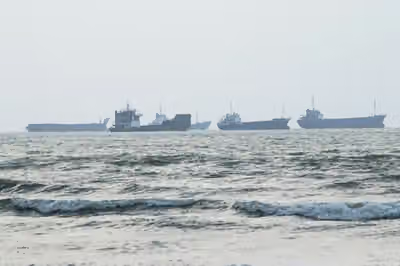
Recent limits on shipping through the strait have disrupted energy flows and driven oil prices higher, highlighting the route’s role as a conduit for roughly one-fifth of global crude and liquefied natural gas.

  • South Pars strike stirs debate among Iranians over impact and intent

    South Pars strike stirs debate among Iranians over impact and intent

The disruption follows rising tensions that have curtailed maritime traffic and raised concerns among energy-importing countries over prolonged supply constraints.

US President Donald Trump on Monday said he would postpone planned strikes on Iranian energy infrastructure after what he described as constructive talks with Tehran.

“Based on the tenor and tone of these in-depth, detailed, and constructive conversations, I have instructed the Department of War to postpone any and all military strikes against Iranian power plants and energy infrastructure for a five-day period,” Trump wrote on Truth Social.

The remark follows his earlier 48-hour ultimatum warning Iran to reopen the strait or face military action targeting its energy sector.

This comes weeks after large-scale US and Israeli strikes on Iran began on February 28, killing Supreme Leader Ali Khamenei, senior commanders and destroying military infrastructure.

  • Iran signals it will not back down after Trump power grid threat

    Iran signals it will not back down after Trump power grid threat

Iran sets terms for access

Iran’s Defense Council said on Monday that passage through the strait would depend on coordination with Tehran for countries it described as non-belligerent.

“The only way to pass through the Strait of Hormuz for non-belligerent states is by coordinating passage with Iran,” the council said.

The statement warned that any attack on Iran’s energy infrastructure would draw a strong response and raised the possibility of mining maritime routes if Iranian territory were targeted.

Diplomatic push to keep waterway open

NATO Secretary General Mark Rutte said 22 countries were working together to ensure the strait remains open, reflecting growing international concern.

Earlier this month, China held discussions with Iran aimed at securing safe passage for oil and liquefied natural gas tankers through the Strait of Hormuz as the conflict intensified, according to three diplomatic sources talking to Reuters.

Suspected Iran-linked group claims north London Jewish ambulance arson

Mar 23, 2026, 10:50 GMT+0

An Iran-aligned militant network has claimed responsibility for the arson attack on Jewish ambulances in north London early Monday, a monitoring organisation said, linking the incident to a string of similar fires across Europe.

The SITE Intelligence monitoring service said a group calling itself the Islamic Movement of the People of the Right Hand had carried out the attack near a synagogue in Golders Green, adding it had also been behind fires in Belgium, Greece and the Netherlands.

Prime Minister Keir Starmer described the incident as “a deeply shocking antisemitic arson attack,” adding: “My thoughts are with the Jewish community who are waking up this morning to this horrific news. Antisemitism has no place in our society.”

Police said four ambulances operated by the Hatzola volunteer emergency service were set ablaze shortly after 01:30 GMT, triggering explosions from gas cylinders onboard and damaging nearby residential buildings.

No injuries were reported, though dozens of residents were evacuated as a precaution after windows in a nearby apartment block were shattered.

Police search for suspects

The Metropolitan Police said officers were examining CCTV footage and searching for three suspects seen approaching the vehicles before the fire.

Fire crews deployed six engines and around 40 firefighters to contain the blaze, which was brought under control shortly after 03:00 GMT.

Religious leaders and officials condemned the targeting of an emergency medical service run by volunteers.

London mayor Sadiq Khan said police patrols would be increased in the area.

Israel’s embassy in Britain called for decisive action in response to the attack.

“Enough is enough,” the embassy said. “There must be a thorough investigation and decisive action to put an end to this climate of intimidation before it spirals further.”

Rising incidents since 2023

Antisemitic incidents have increased in Britain and globally since the October 2023 Hamas attack on Israel and the war in Gaza that followed.

British officials have recorded a sustained rise in such cases, including a deadly attack on a synagogue in Manchester in 2025.

Starmer said earlier this month the government would work with Jewish and Muslim organisations to strengthen protections at sensitive sites.