With a career spanning both the Islamic Revolutionary Guard Corps (IRGC) and the political establishment, including a decade as parliament speaker, Larijani functioned as a bridge between Iran’s military and civilian centers of power.
That position—part coordinator, part mediator—made him one of the system’s most important internal stabilizers. His removal further narrows the circle of actors capable of managing competing interests within the system.
Supreme Leader Mojtaba Khamenei praised him in a brief statement Wednesday, vowing to avenge his blood.
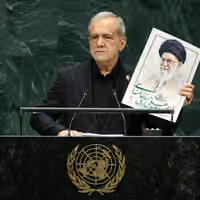
Senior officials sought to project continuity. President Masoud Pezeshkian said Larijani’s “path of resistance combined with rationality” would continue, while Foreign Minister Abbas Araghchi insisted that the absence of any individual cannot destabilize the Islamic Republic’s “powerful political structure.”
Even with continuity, however, the system Larijani helped manage now faces a more immediate test: succession.
Formally, the secretary of the SNSC is appointed by the president, but the role only acquires real authority when the Supreme Leader designates the holder as his representative, granting voting power within the council.
Early indications suggest that Mojtaba Khamenei is overseeing key appointments. Whether he does so here will shape both the balance of power and the direction of decision-making.
Two names dominate early speculation.
Mohammad-Bagher Ghalibaf, the current speaker of parliament, is already a member of the council and holds voting rights, making his elevation procedurally straightforward.
A former IRGC Air Force commander and national police chief, he brings operational experience and political stature. But his appointment carries risks. His high profile and role in recent military operations could place him near the top of potential Israeli target lists, raising questions about durability and continuity.
Ali-Akbar Ahmadian, a senior IRGC naval commander, represents a more technocratic option. He previously served as both secretary of the council and the Supreme Leader’s representative before being reassigned in 2025.
His return would provide institutional familiarity, but he would require reappointment by the new leadership to regain full authority. Compared to Ghalibaf, he offers less political reach but fewer immediate security liabilities.
Other figures—including former IRGC commander Mohsen Rezaei and former SNSC secretary Saeed Jalili—have been mentioned but appear less likely contenders, either because they would require additional endorsement or because of political frictions within the current leadership.
Larijani’s influence rested less on formal authority than on his ability to navigate between institutions that do not always align: the IRGC, the presidency, parliament, and the clerical establishment. Replacing that function may prove harder than filling the office.
His absence therefore raises a broader question about the system’s internal cohesion. Without a figure capable of managing competing centers of power, the risk of renewed factionalism increases—particularly at a time when external pressure is intensifying.
Iran’s leadership insists the system remains stable. The coming appointment will test that claim.