Inside Iran, political figures who disappeared from public view after the February 28 strike are gradually re-emerging through statements congratulating him on his elevation to leadership.
Among them are Mohammad Mohammadi Golpayegani, the former leader’s chief of staff, and Asghar Mirhejazi, his powerful security chief, who issued a rare joint message despite earlier reports that Mirhejazi had been killed in the attack.
Former President Mahmoud Ahmadinejad, also rumored to have died in a strike on his home, released a similar message.
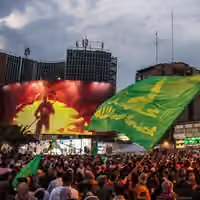
These congratulatory notes appeared during one of the most solemn Shiite mourning periods, commemorating Imam Ali. At the same time, part of the country is mourning the former leader, while Mojtaba himself is grieving the loss of close family members.
State officials, including President Masoud Pezeshkian, Majles Speaker Mohammad Bagher Ghalibaf and security chief Ali Larijani, have recently appeared in simple, Zelensky-style military uniforms without insignia. All three have pledged allegiance to Mojtaba.
Social media has filled with dark humor about Ali Khamenei’s death and Mojtaba’s life expectancy.
More serious posts include the resurfacing of an old video circulated widely on X, reportedly with IRGC encouragement, in which reformist politician Faezeh Hashemi says she would prefer Mojtaba to the “fanatic elderly candidates” for leadership. Like others, she suggested he might introduce reforms.
Mojtaba’s record since 2005, however—particularly during elections and protest crackdowns—offers little evidence of reformist tendencies. Many analysts warn that Iran may become even more radicalized under his rule, noting his long-standing ties to vigilante groups involved in suppressing dissent.
Debate over hereditary succession has intensified. Critics argue that dynastic leadership contradicts the Islamic Republic’s founding principles. Others counter that hereditary succession mirrors the lineage of the Twelve Imams.
Members of the first group note that Khomeini’s son Ahmad was never allowed to inherit power—an argument echoed implicitly by some of Khomeini’s descendants, including his great-grandson Ali, on X.
Former IRGC commander Mohsen Rezaei and former state TV chief and tourism minister Ezzatollah Zarghami have both said they have been close friends of Mojtaba for years, describing him as “modest” and “simple.”
Rezaei, who appeared frequently on state television after Khamenei’s death, has promised to share more about Mojtaba in the coming days.
State TV’s IRINN channel has twice acknowledged that Mojtaba’s leadership faced serious resistance within the Assembly of Experts. In an unusual live broadcast comment, one analyst even suggested opposition to Mojtaba might emerge from within his own support base.
Some media outlets, including Khabar Online, cautiously suggested this week that Mojtaba’s rise could signal a more prolonged and unpredictable phase of conflict, reflecting broader uncertainty inside Iran’s political establishment over the direction his leadership may take.