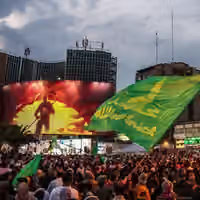
President Donald Trump told NBC that he believes Iran “made a big mistake” by choosing Mojtaba Khamenei as the country’s new supreme leader.
“I don’t know if it’s going to last. I think they made a mistake.”
He also said it is “too soon” to discuss the possibility of the United States seizing Iran’s oil, though he did not rule out the option.
Iranian media reported on Monday evening that a fresh wave of explosions had been heard in several cities across the country.
According to the reports, multiple explosions were heard in Tehran on Monday night, including in western parts of the capital.
At the same time, some Iranian outlets said a number of Basij and Islamic Revolutionary Guard Corps (IRGC) bases in Karaj, Nazarabad, Andisheh and Shahriar were targeted by drone and missile strikes, with explosions reported in those areas.
Several media outlets also reported hearing a number of powerful explosions in Isfahan. An eyewitness told Iran International that blasts were heard near 22 Bahman Street and Bagh-e-Kashefi in the city.
In addition, some viewers told Iran International that several explosions were heard on Monday afternoon in Ahvaz.
In the southeastern city of Zahedan in Sistan and Baluchestan province, the local outlet Haalvsh reported that several heavy explosions were heard across different parts of the city on Monday night.
Ukrainian President Volodymyr Zelenskiy said on Monday that Moscow was trying to manipulate the conflict involving Iran to its advantage.
"We see that the Russians are now trying to manipulate the situation in the Middle East and the (Persian) Gulf region in favor of their aggression, and also to effectively turn the Iranian regime’s strikes against its neighbors and American bases into a second front of Russia’s war against Ukraine and, more broadly, against the entire West," he said in a post on X.
"This must not be allowed. Evil must not be given opportunities for coordination, but the protection of life must be clearly coordinated," he added.
The United States has intercepted encrypted communications believed to have originated in Iran that may be intended to activate sleeper cells outside the country, ABC News reported, citing a federal government alert sent to law enforcement agencies.
The alert, reviewed by ABC News, cited preliminary signals analysis of a transmission likely of Iranian origin that was relayed across multiple countries shortly after the death of Iran’s former leader Ali Khamenei.
The intercepted transmission was encoded and appeared to be intended for clandestine recipients who possess the encryption key, the report said.
The message could be intended to activate or provide instructions to covert operatives or sleeper assets operating outside Iran, according to the alert cited by ABC News.
The alert said there was no operational threat tied to a specific location but instructed law enforcement agencies to increase monitoring of suspicious radio-frequency activity.
US and Israeli forces carried out an attack on Feb. 28 that killed Ali Khamenei, after which officials expressed concern that Iranian sleeper cells abroad could be activated in retaliation, the report said.
By elevating Mojtaba Khamenei—a figure most Iranians have never heard speak—the Islamic Republic has completed a long drift away from popular legitimacy.
For years, Mojtaba has operated largely behind the scenes within Iran’s political and security elite. The only public recording of his voice is a one-minute video in which he tells seminary students that his classes have been cancelled.
He appears to lack any significant public profile or popular following among the wider population—an element the Islamic Republic now seems increasingly unconcerned about.
Mojtaba played a significant role in the election of Mahmoud Ahmadinejad in 2005 and has long been seen as influential in the expansion of the Revolutionary Guards’ intelligence and economic reach, as well as in policies used to suppress dissent.
His rise reflects the priorities of a system that now appears to value internal cohesion and security ties more than public stature.
The issue of choosing the supreme leader has always posed both a philosophical and practical challenge in the Islamic Republic. If the leader is the representative of God on earth and a successor to the Prophet Mohammad, the question is how that authority is conferred: through popular recognition or divine designation.
These two impulses have shaped debates over the nature of the Islamic Republic for decades. One emphasizes the system’s republican and electoral elements; the other gives primacy to its theocratic foundations.
Popularity factor
The question barely arose when Ruhollah Khomeini came to power. He embodied both elements: he enjoyed broad popular support and was among the most prominent religious figures of his time.
Khomeini’s ascendancy preceded the formal codification of the office of supreme leader. The robe, as a Persian expression would have it, was cut to his measure
This was reflected in the first constitution adopted after the 1979 revolution, which described the leader as one “recognized and accepted by the overwhelming majority of the people,” as was the case with Khomeini.
That provision was revised in 1989, when Ali Khamenei was selected as the second supreme leader. The reference to popular acceptance was removed, assigning the decision solely to the Assembly of Experts.
Yet popularity still mattered. Ali Khamenei did not hold a high religious rank at the time and was not yet an ayatollah. But after eight years as president he was a familiar national figure, and public recognition and political experience were judged more important than clerical standing.
Staying the course
The selection of Mojtaba suggests those considerations now carry far less weight. He has been elevated not because of religious stature, executive experience or public standing, but largely because of his ties to the security establishment.
If the Islamic Republic had followed its previous trajectory, it might have been expected to choose one of the former cleric presidents—most plausibly Hassan Rouhani, who in recent months appeared to be positioning himself for such a role.
By choosing Mojtaba, the Islamic Republic has effectively crossed a threshold. The system that once defined itself in opposition to hereditary rule now appears willing to tolerate it, prioritizing continuity and control over ideological consistency.
While officials have presented Mojtaba’s appointment as an emergency wartime decision, his decades of behind-the-scenes activity suggest a far longer process of consolidation.
His succession also narrows the already limited space for fundamental change.
As Iran confronts war with the United States and Israel abroad while continuing to face deep mistrust at home, the balance of power now points firmly toward continuity—and toward a system with little interest in resolving tensions either with its own society or with its adversaries.