The situation grew more complicated after US President Donald Trump publicly signaled a desire to influence Iran’s leadership transition and the future structure of the regime.
The pressure mounted further when lawmaker Mohsen Zanganeh said Friday that “senior clerics in the Assembly of Experts have nominated two clerics for Iran’s next leadership, but both have declined the position.”
Amid mounting reports of disagreement and deadlock, the Expediency Discernment Council moved to suspend the Assembly of Experts—the body constitutionally responsible for selecting the supreme leader—and shift authority to a provisional leadership structure.
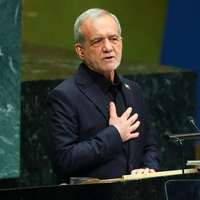
Under Article 111 of Iran’s constitution, that shift elevated Pezeshkian, as head of the Provisional Leadership Council, to a position granting him many of the powers of the supreme leader, including command of the armed forces.
Critics say he has so far refrained from intervening decisively in major state affairs and has instead focused on secondary issues, including preparations for local elections scheduled for May.
“Today Pezeshkian is simultaneously the president, head of the leadership council, and the commander-in-chief,” former transport minister Abbas Akhundi wrote on X. “He must step into the field and declare: everyone is under my command.”
Akhundi argued the succession debate itself is ill-timed. “Any action that diverts attention from the war … is playing into Israel’s hands,” he added. “Becoming preoccupied with succession at a time of war is a harmful distraction.”
Wartime power centers
The Revolutionary Guards remain central to both the war effort and domestic politics. While engaged in a widening regional confrontation, the IRGC has also been deeply involved in the succession debate.
Reports indicate it has strongly backed Mojtaba Khamenei despite constitutional sensitivities and resistance from parts of the clerical establishment.
The sidelining of the Assembly of Experts underscores institutional divisions. Some clerics argue that naming a successor during wartime risks deepening fractures, while others insist a swift decision is necessary to project unity and control.
The Expediency Discernment Council has played a decisive role by affirming the authority of the provisional leadership structure, signaling that the succession question has reached a level of internal dispute requiring extraordinary intervention.
Security chief Ali Larijani has also reportedly intervened in the deliberations to promote his brother Sadeq Larijani as a candidate for supreme leader.
Sadeq Larijani was once head of judiciary and now heads the Expediency Council, where he can in theory slow the succession process and complicate the IRGC’s push for Mojtaba Khamenei.
For now, uncertainty over succession and authority continues to shape Iran’s wartime politics, with key figures—including Mojtaba Khamenei, senior IRGC leaders and Ali Larijani—remaining largely silent in public.