• العربية
  • فارسی
Brand
  • Iran Insight
  • Politics
  • Economy
  • Analysis
  • Special Report
  • Opinion
  • Podcast
  • Iran Insight
  • Politics
  • Economy
  • Analysis
  • Special Report
  • Opinion
  • Podcast
  • Theme
  • Language
    • العربية
    • فارسی
  • Iran Insight
  • Politics
  • Economy
  • Analysis
  • Special Report
  • Opinion
  • Podcast
All rights reserved for Volant Media UK Limited
volant media logo
INSIGHT

Ghalibaf defends Iran-US talks amid hardline backlash

Maryam Sinaiee
Maryam Sinaiee

Iran International

Apr 19, 2026, 23:03 GMT+1
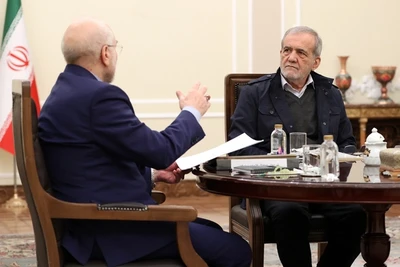
Iran's parliament speaker Mohammad Bagher Ghalibaf in an interview with the state broadcaster IRIB, April 18, 2026

Iran’s lead negotiator and parliament speaker Mohammad-Bagher Ghalibaf defended indirect talks with the United States in a televised interview Saturday after hardline critics accused him of “betrayal” and even hinted at a “coup” over the negotiations in Islamabad.

The backlash, which has intensified in recent days across hardline media and social platforms, prompted Ghalibaf to sit for a lengthy interview on state television aimed largely at persuading critics who reject any form of diplomacy and advocate continued confrontation.

In the interview, Ghalibaf framed negotiations not as a retreat but as a continuation of the conflict by other means. Diplomacy, he said, is neither a withdrawal from Iran’s demands nor separate from the battlefield, but a way to consolidate military gains and translate them into political outcomes and lasting peace.

Most notably, perhaps, he cautioned against exaggerating Iran’s leverage, stressing that US military superiority and capabilities should not be underestimated.

Hardline critics have intensified attacks on Ghalibaf, particularly on domestic social media platforms such as Eitaa, accusing him of ignoring red lines set by Supreme Leader Ali Khamenei and signaling weakness toward the United States.

One critic wrote in a post that “there is no good in negotiation except harm,” adding that Ghalibaf’s remarks suggested an optimism about progress in the talks that was “worrying.”

Another post went further, calling on the Revolutionary Guard to intervene and stop what it described as Ghalibaf’s “betrayal.”

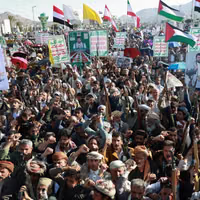
Similar rhetoric has surfaced in nighttime gatherings by pro-government supporters, where speakers denounce negotiations and potential concessions—such as handing over enriched nuclear material, a core US demand—and chant slogans including “Death to compromisers.”

Ghalibaf did emphasize his personal commitment, declaring that for him there is no distinction between the battlefield and the negotiating table and that he is ready to sacrifice “both my life and my reputation” for “the people to attain their rights.”

The controversy widened after a social media account linked to ultrahardliner Saeed Jalili, a longtime political rival of Ghalibaf and a member of Iran’s national security council, published a post with the hashtag “coup plotter.”

The post called on Mojtaba Khamenei to publicly clarify his position if he indeed supports the negotiations, warning that without such confirmation officials could be accused of acting without the leader’s authorization.

The account was deactivated shortly afterward without explanation.

Jalili, who previously served as Khamenei’s representative on the Supreme National Security Council, has not commented publicly on the controversy, and there has been no official announcement about whether he retains that role under the current leadership.

Despite the backlash, several reformist figures have publicly backed Ghalibaf’s approach.

“A rare historical moment has placed Ghalibaf in a position where anyone who even slightly cares about Iran should support this rational soldier-politician and his decisions on war and peace,” Mohammad Ali Abtahi, a former vice president under Mohammad Khatami wrote on X.

Journalist and commentator Ahmad Zeidabadi also defended him, arguing that volunteering to negotiate in such a tense environment required significant political and reputational risk.

Iranian media outlets have also offered differing interpretations of the interview. The conservative website Tabnak said Ghalibaf was outlining a strategic framework in which military strength, public support and diplomacy operate simultaneously.

The centrist outlet Asr-e Iran described the remarks as a broader roadmap for confronting the United States and Israel, arguing that diplomacy should be seen as a continuation of Iran’s battlefield resistance rather than a departure from it.

Most Viewed

100 days after carnage: Iran economy reels from war, inflation, unemployment
1
INSIGHT

100 days after carnage: Iran economy reels from war, inflation, unemployment

2
EXCLUSIVE

Iranian assaulted in London amid concern over threats to regime critics

3

IRGC fires at Indian vessel in Hormuz

4
INSIGHT

A nation in limbo: 100 days after the massacre, has the world moved on?

5
ANALYSIS

From instability to influence: Pakistan’s pivotal role in US-Iran diplomacy

Banner
Banner

Spotlight

  • Ghalibaf defends Iran-US talks amid hardline backlash
    INSIGHT

    Ghalibaf defends Iran-US talks amid hardline backlash

  • From instability to influence: Pakistan’s pivotal role in US-Iran diplomacy
    ANALYSIS

    From instability to influence: Pakistan’s pivotal role in US-Iran diplomacy

  • A nation in limbo: 100 days after the massacre, has the world moved on?
    INSIGHT

    A nation in limbo: 100 days after the massacre, has the world moved on?

  • The Hormuz get out of jail card turned to a grave
    OPINION

    The Hormuz get out of jail card turned to a grave

  • How Tehran bends its own red lines to boost state rallies
    INSIGHT

    How Tehran bends its own red lines to boost state rallies

  • Iran blackout cripples freelancer, small business incomes
    VOICES FROM IRAN

    Iran blackout cripples freelancer, small business incomes

•
•
•

More Stories

A nation in limbo: 100 days after the massacre, has the world moved on?

Apr 18, 2026, 22:16 GMT+1
•
Negar Mojtahedi

One hundred days after one of the deadliest crackdowns in modern history, Iran remains suspended between grief and uncertainty, with a fractured public mood as some see justice in recent blows to the regime, while others feel left behind with it still in place.

At least 36,500 Iranians were killed by the Islamic Republic during the January uprising, mostly on January 8 and 9, according to classified documents, field reports and witness accounts reviewed by Iran International, with the true toll believed by many to be far higher.

The dead included children, students and the elderly. Among the youngest victims frequently cited was three-year-old Melina Asadi.

three-year-old child identified as Melina Asadi, from Kermanshah, was killed after being directly shot by forces of the Islamic Republic of Iran during popular protests on Tagh- Bostan Boulevard.
100%
Three-year-old child identified as Melina Asadi, from Kermanshah, was killed after being directly shot by forces of the Islamic Republic of Iran during popular protests on Tagh- Bostan Boulevard.

One image from the unrest remains etched in public memory: a bloodied older woman standing in the street, fist raised, saying, “I’m not afraid. I’ve been dead for 47 years.”

Another was the sight of body bags. Videos that emerged despite the blackout showed rows of black bags lining courtyards, makeshift morgues overflowing and desperate families searching among the dead for loved ones.

Some bodies appeared with catheters and breathing tubes still in place, reinforcing witness claims that wounded protesters were killed after reaching hospitals.

One eyewitness, Kiarash — whose surname is being withheld for security reasons — described Tehran’s main cemetery as a “warehouse of bodies,” saying trucks continued arriving to unload more corpses as families waited outside.

The protests, which erupted in early January, were met with overwhelming force. Demonstrators demanding freedom were confronted with live fire, blades and military-grade repression.

Witnesses also described hospitals turned into extensions of the crackdown. Doctors and healthcare workers were allegedly threatened, detained or attacked for treating the injured. Some families say loved ones who survived initial gunfire were later killed inside hospital wards.

One such case was 17-year-old Sam Afshari, whose father told Iran International that after being wounded during protests in Karaj, his son was taken to hospital alive, placed on a breathing tube and then fatally shot.

“They finished him off,” his father said.

  • 'They finished him off': father recounts hospital killing of teen protester

    'They finished him off': father recounts hospital killing of teen protester

Authorities and some outside observers initially portrayed the unrest as primarily economic. But many Iranians rejected that narrative.

While anger first surfaced in the bazaars — historically seen as a pillar of the Islamic Republic’s support base — in late December, demonstrations quickly spread to universities, provincial towns and religious communities.

Unrest reached hundreds of cities and towns nationwide, according to reports reviewed by Iran International.

For many participants, this was not just another protest wave. It was the release of 47 years of accumulated pressure over repression, corruption, economic decline and personal freedoms.

Iranians were demanding a future not defined by compulsory social controls, state violence or a nuclear confrontation that repeatedly drags the country into crisis.

On January 8, authorities cut public access to the internet, triggering a 20-day digital blackout that rights groups say helped conceal the scale of the killings.

The blackout severely restricted access to independent information, communication with family abroad and documentation of abuses.

Iranian officials also acknowledged economic damage, with estimates placing losses in the tens of millions of dollars per day.

Trump support resonated with some protesters

During the uprising, support from US President Donald Trump drew significant attention.

For some Iranians, it mattered because memories of the 2009 Green Movement — the mass protest movement that erupted after disputed elections under President Barack Obama — still run deep. Many from that era felt the world did not do enough.

A few days after the January 8–9 massacre of protesters, Trump publicly backed demonstrators, writing: “Iranian patriots… KEEP PROTESTING… HELP IS ON ITS WAY.” He urged them to “take over your institutions” and warned the US was “locked and loaded.”

Despite mixed views on the effectiveness of a military campaign to topple the Islamic Republic, many Iranians felt so desperate that they wanted Trump to begin strikes as soon as possible.

He did so nearly 50 days after the massacre.

40-day war hits regime hard

On February 28, the United States and Israel launched a coordinated military campaign targeting the Islamic Republic’s leadership, nuclear infrastructure, missile systems, air defenses and internal security apparatus.

The operation included tens of thousands of strikes on military and strategic sites across Iran. Senior regime figures were killed, including Supreme Leader Ali Khamenei, in the most dramatic leadership blow since the 1979 revolution.

Other targets included IRGC commanders, Basij infrastructure, military production centers and strategic compounds tied to regime control. Iranian missile launchers and parts of the country’s strike capability were also heavily degraded.

For many Iranians who blamed these institutions for repression, torture and killings, the campaign was seen not simply as war, but as the first time the machinery used against them had itself come under sustained attack.

Videos reviewed by Iran International showed some Iranians thanking US President Donald Trump and Israeli Prime Minister Benjamin Netanyahu for the strikes. Others celebrated in homes and streets, with some dancing to YMCA — the song closely associated with Trump rallies — seeing the moment as symbolic justice after years of suffering.

Others hoped the weakening of the regime’s coercive apparatus could create space for future protest and political change, as promised by both Trump and Israeli Prime Minister Benjamin Netanyahu.

Yet even as parts of the repressive apparatus were hit, executions of prisoners and dissidents continued. Human rights groups say Iran carried out a record number of executions last year and warn the death penalty may be used even more aggressively after the war.

Diplomacy returns, questions remain?

The military campaign paused with the announcement of a two-week ceasefire on April 8, and the rhetoric has since shifted toward diplomacy: talk of deals, sanctions relief, frozen assets, and uranium transfers.

Iranian civil society groups have urged negotiators to include the release of political prisoners and prisoners of conscience in any agreement, arguing peace without human rights would leave thousands behind.

For many Iranians, the central question remains unchanged: where are the Iranian people in these negotiations?

Those killed in the streets, in detention and in hospitals did not die for another nuclear arrangement, many argue, nor to see one insider replaced by another such as Mohammad Bagher Ghalibaf.

One hundred days later, Iran remains suspended between grief and uncertainty.

Some feel partially avenged by the killing of Khamenei and his commanders, and by the weakening of the regime. Others still hold out hope that change may come. But many say they fear the world has moved on without them.

100 days after carnage: Iran economy reels from war, inflation, unemployment

Apr 18, 2026, 18:10 GMT+1
•
Maryam Sinaiee

One hundred days after thousands of protesters were massacred on January 8 and 9, Iran's already fragile economy has sharply deteriorated, with millions feared to be unemployed as a devastating war compounds the crisis and accelerates economic collapse.

The protests that started in the Grand Bazaar of Tehran in late December and quickly spread across the country were followed by what has been described as the deadliest crackdown on protesters in Iran’s contemporary history in January.

Shortly thereafter, a war involving the United States and Israel began, compounding the country’s economic distress.

The service sector was hit hard during the protests. Advertising agencies, technical consulting firms, digital service providers, and hospitality and tourism businesses have since suffered further, and in many cases irreparable, damage because of the war.

Three weeks of internet disruptions during the protests, and over 1,100 hours since the beginning of the war on February 28, have effectively paralyzed large parts of the digital economy.

"According to official estimates released by Iranian authorities, more than 10 million people in Iran earn their income directly through the internet. As a result, any disruption or shutdown of internet services poses a serious threat to their livelihoods," Dadban, a legal advisory and training center for activists, said in a report.

"With the continuation of this situation, millions have faced a sharp drop in income or unemployment," Dadban added.

More significantly, the conflict has inflicted severe damage on critical economic infrastructure, including key petrochemical industries and steel production across multiple cities. These sectors, considered the backbone of Iran’s industrial economy, have suffered extensive losses.

The destruction of major industries has disrupted the supply of raw materials, triggering cascading effects across manufacturing and related sectors.

Widespread layoffs have followed, affecting not only workers in these industries but also those employed in dependent businesses.

At the same time, exports have declined sharply, further constraining an already limited flow of foreign revenue.

The scale of the economic shock is underscored by official estimates. A government spokesperson has put total war damages at around $270 billion—roughly 57 percent of Iran’s gross domestic product and several times larger than the country’s annual oil revenues.

The figure is estimated to be nearly three times the government’s general budget, highlighting the unprecedented fiscal strain facing the state.

Stagflation and rising risk of renewed unrest

Iran’s economy has now entered a period of stagflation, combining high inflation with economic stagnation and rising unemployment.

Even if the conflict were to end in the near term, economists warn that recovery will be protracted and uneven.

These worsening conditions have heightened the risk of renewed social unrest.

Without a political resolution—particularly an agreement with the United States—analysts suggest that further protests, potentially larger than those seen in December, are increasingly likely.

Public anger boils over online

Public sentiment, particularly on social media, reflects growing frustration and despair.

One user highlighted the desperation faced by unemployed citizens: “I live in Tehran, I’m married and renting. Since January I was working reduced hours, and I was officially laid off on March 25.”

Another user described the collapse of freelance work: “In this situation, most jobs have shut down, especially for people like us who worked freelance. Our income has dropped to zero, and we don’t know what we can do if the war and internet outages continue.”

A third user wrote: “Given the brutality of the clerical regime and its supporters, the skyrocketing prices of basic necessities, and the bizarre inflation that keeps getting worse… I think people are just waiting for a spark to come back to the streets. Death is no longer the issue—this situation is worse than death and must end.”

Inflation surges to historic highs

Inflation has risen dramatically over the past 100 days. Official data show point-to-point inflation, already above 50 percent at the end of December, climbed to over 70 percent by late February—before the war—reaching its highest level in decades.

In essential goods such as meat, dairy, oil, rice, fruits, and vegetables, inflation has exceeded 110 percent. Prices of critical medications, including some types of insulin, have multiplied several times—when they are available at all.

Although updated overall inflation figures have not been released, some experts believe the rate may already have entered triple digits, with further increases expected.

Survival economy takes hold

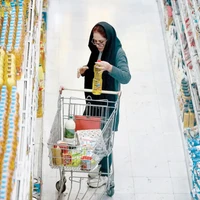
Some Iranians say the absence of severe shortages during the war reflects collapsing demand rather than stable or sufficient supply. With incomes sharply reduced, many households can no longer afford basic goods.

To cope, families are increasingly relying on savings, rental deposits, or loans from banks and relatives—placing them at risk of losing their homes. In some cases, household are selling personal belongings just to afford food.

Business owners are also under pressure. Many have begun selling equipment, with online marketplaces now flooded with listings for café and restaurant supplies and electronic devices—often with little or no buyer interest.

Meanwhile, the government faces mounting fiscal constraints. Even before the war, it struggled to meet budgetary obligations. Now, with millions feared to be unemployed, the government lacks the capacity to provide adequate unemployment benefits, and some workers report being unable to access them at all.

State media slam Araghchi's Hormuz tweet, say it let Trump claim victory

Apr 17, 2026, 17:40 GMT+1

Iran's state media issued rare and sharply worded criticism of Foreign Minister Abbas Araghchi and the negotiating team after he declared the reopening of Hormuz Strait on X, saying the move created confusion and gave Trump an opening to claim victory.

"In line with the ceasefire in Lebanon, the passage for all commercial vessels through Strait of Hormuz is declared completely open for the remaining period of ceasefire, on the coordinated route as already announced by Ports and Maritime Organisation of the Islamic Rep. of Iran," Araghchi announced in a post on X on Friday.

Minutes later, US President Donald Trump said "Iran has just announced that the Strait of Iran [sic] is fully open and ready for full passage."

Araghchi's post was widely criticized by hardliners and their outlets, including the state-run Mehr News which said Araghchi's tweet "provided the best opportunity for Trump to go beyond reality, declare himself the winner of the war and celebrate victory."

"It is clear that ceasefire-related negotiations are not being handled solely by the Foreign Ministry. Therefore, it is natural that under these circumstances the entire team should collectively explain the decisions that have been made," Mehr News said.

Tasnim News Agency described the post as a “bad and incomplete tweet that created misleading ambiguity about the reopening of the Strait of Hormuz."

The IRGC outlet said the announcement lacked “necessary and sufficient explanations” about the conditions, mechanisms and restrictions governing vessel transit, prompting widespread questions.

Fellow IRGC outlet Fars News Agency earlier quoted an informed source close to the Supreme National Security Council as saying that the Strait's reopening was subject to three conditions:

"Ships must be commercial. The passage of military vessels is prohibited, and neither the ships nor their cargo may be linked to hostile countries. Vessels must pass through routes designated by Iran, and transit must be coordinated with Iranian forces responsible for managing passage."

The source said Iran considers the continuation of a US naval blockade as a violation of the ceasefire and would close the Strait of Hormuz again if the blockade is not lifted.

Tasnim said Araghchi's post on X lacked "any verbal explanation or at least sufficient written clarification” which it said amounted to “complete poor judgment in communication."

The outlet urged either the Foreign Ministry to revise its approach or the Supreme National Security Council to step in and impose a more coherent messaging framework.

The criticism was echoed by Fars News Agency, which addressed authorities directly and questioned their silence.

“Officials, at least explain the reason for your ‘lack of explanation,’” Fars wrote, warning that the absence of clear communication had left the public in a “state of confusion.”

It added that "while citizens trust officials to uphold national red lines, they still expect transparency about why details are being withheld."

Fars also cautioned that without clear messaging, “the narrative of the enemy and hostile media” could fill the gap, adding that “this ‘lack of explanation’ itself needs explanation.”

How Tehran bends its own red lines to boost state rallies

Apr 17, 2026, 02:11 GMT+1
•
Maryam Sinaiee

The screening of a concert video by a Lebanese female singer at a pro-government rally in Iran has drawn unusual attention for appearing to cross two of the Islamic Republic’s long-standing cultural taboos: women’s solo singing and compulsory hijab.

The video featured Julia Boutros, a Christian artist widely known across the Arab world for songs supporting Lebanese and Palestinian “resistance” movements.

In the footage shown on a large screen before a mixed-gender audience, she appeared without a headscarf.

For nearly half a century, broadcasting a female singer’s solo voice to male audiences has been prohibited in Iran. Women who have challenged this restriction, even in private concerts or online, have often faced harsh repercussions.

The public screening of Boutros’s performance at an officially sanctioned gathering therefore represents a striking departure from established norms, even if it may have occurred unintentionally.

Events like the rally typically require official permits, suggesting at least tacit approval by local authorities. Yet judicial bodies, which have historically acted quickly against perceived breaches of cultural or religious codes, have so far issued no public criticism of the incident.

Rallies evolving after ceasefire

The episode comes as the character of pro-government gatherings has been changing since the ceasefire that ended weeks of fighting nearly two weeks ago.

Social media posts increasingly depict the rallies as taking on a festival-like atmosphere. Families attend together, and for some participants the events appear to function as social gatherings as much as political demonstrations.

Large banners, video screens and coordinated staging are now common, while mosques and local Basij militia bases often serve as assembly points before crowds move toward central gathering locations.

These developments have also generated complaints from residents about late-night noise and traffic congestion, concerns widely discussed on social media.

Incentives and organization

There are also claims—difficult to independently verify—that participants are being mobilized through local institutions and offered incentives such as food, snacks or other benefits.

Photographs circulating online show numerous tents distributing free food and drinks, a practice consistent with the Shia tradition of nazri, in which charitable offerings are made during religious gatherings.

Images from recent days also showed senior military figure General Habibollah Sayyari helping prepare and distribute food at one such tent, highlighting the visible presence of state institutions at the events.

Pro-government celebrities from the film and sports worlds have also attended, with state media giving extensive coverage to their participation.

Political messaging intensifies

Hardline political groups have used the rallies as platforms for speeches and mobilization, with invited speakers addressing contentious issues such as whether Iran should accept ceasefire terms or pursue negotiations with the United States.

Some speeches have targeted prominent political figures, including former President Hassan Rouhani, former foreign minister Mohammad-Javad Zarif and Parliament Speaker Mohammad-Bagher Ghalibaf, encouraging crowds to chant slogans against them.

In one instance, a live broadcast of a speech by a religious performer was abruptly cut by state television and replaced with pre-recorded programming, suggesting heightened sensitivity to the messages being aired.

The rallies themselves were initially encouraged by senior officials as a demonstration of wartime solidarity. Earlier in the conflict, Ghalibaf called on citizens to take to the streets in support of Iran’s armed forces.

Yet the appearance of Boutros’s unveiled image on a giant screen at a pro-government gathering has underscored the contradictions between Tehran’s cultural restrictions and the messaging it seeks to project.

Hope and anger in Iran as fragile ceasefire persists

Apr 16, 2026, 03:07 GMT+1

Messages from Iran International viewers inside the country reveal a society grappling with a mix of hope, anger and deep uncertainty as a fragile ceasefire with the United States persists.

Officials in Washington and Tehran are now considering extending the truce, raising new questions about whether the pause could evolve into a broader settlement or simply delay further confrontation.

The roughly 3,500 messages received and reviewed since April 8 show a wide array of emotions, with no single voice or issue dominating.

More than a quarter of the messages expressed hope about what might come next, often framing the ceasefire as a temporary pause rather than a turning point.

Some said they believed the truce was merely a tactical step that would ultimately weaken the Islamic Republic.

“Don’t lose hope. This ceasefire means another surprise is coming. Be patient,” one viewer from Rasht wrote.

Others expressed confidence that outside pressure on the government would continue.

“Trump knows what he’s doing. Don’t worry—there’s a plan behind this ceasefire,” a viewer from Tabriz wrote.

Many messages referred to Prince Reza Pahlavi as a potential focal point for opposition hopes, with some writers saying they were waiting for a “final call” to action.

About 18 percent of the messages focused less on politics and more on daily hardship.

Writers described worsening economic conditions, rising prices for food and medicine, job losses and the effects of the country’s internet shutdown.

A viewer from Karaj said he had paid the equivalent of nearly $20 for a single gigabyte of internet access through unofficial services.

“My business is destroyed,” he wrote.

Another viewer from Mashhad said cancer medicines had become scarce and far more expensive. “People are not well,” the message read.

Nearly 17 percent of the messages expressed deep despair, describing the ceasefire as the collapse of hopes that the conflict might bring fundamental political change.

“The world collapsed on my head,” one message from Tehran read. “We didn’t endure all this hardship just for a ceasefire.”

Others expressed anger at foreign leaders, accusing them of abandoning the Iranian people after raising expectations during the conflict.

Some messages directly criticized President Donald Trump and Israeli Prime Minister Benjamin Netanyahu, using words such as “betrayal” and “deception.”

“Mr. Trump, a ceasefire means betrayal of the blood of thousands of fallen heroes,” one viewer wrote.

Another message addressed the United States more broadly: “We asked you to help free Iran. Instead you left us with a worse situation.”

The messages, sent mainly from cities including Tehran, Mashhad, Karaj, Shiraz, Rasht, Isfahan, Tabriz, Ahvaz, Bandar Abbas and Kermanshah, offer a rare glimpse of public sentiment inside Iran at a time of near-total internet blackout.

Most messages were sent by users who managed to reach the global internet through workarounds. Some may have come from individuals with access to government-authorized “white SIM cards,” which allow limited connectivity.

Taken together, the messages portray a society that is exhausted yet resilient.

Many said they opposed any agreement that would leave the Islamic Republic in place. Some said they were prepared to endure further hardship rather than see what they called the “blood of the fallen” go unavenged.

The strongest refrain running through the messages echoed a familiar Persian expression: “Light will prevail over darkness.”