As anti-war protesters in Western capitals chant “no war with Iran,” some Iranians inside and outside the country are cheering the US-Israeli strikes and publicly thanking President Donald Trump.
That contrast, several Iran experts told Iran International, exposes a widening divide between Western progressive activism and the lived experience of many Iranians.
Analysts say the reaction among many Iranians is not about ideological loyalty but about seeing any weakening of the Islamic Republic as a rare opportunity to escape decades of repression.
“War is violent, it's terrible and it has started. The people of Iran didn't choose this war — the Islamic government, the Islamic Republic government, chose this war,” said Siavash Rokni, an Iran pop culture expert.
“Iranians will use any opportunity to bypass the Islamic Republic to assure the fall of the Islamic Republic and the institution of a democracy,” Rokni said.
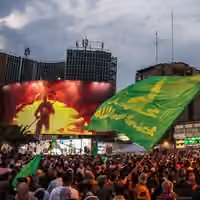
Anti-war protests taking shape in Western capitals have often featured placards supporting the very regime responsible for killing scores of Iranians, with demonstrators holding images of the now-former Supreme Leader, Ali Khamenei — the man ultimately responsible for the killings.
Rokni said one cannot claim to oppose war while supporting the regime responsible for such violence.
This week, clips of Iranians dancing to the Village People’s “Y.M.C.A.” in the exaggerated arm-pumping style popularized by Trump went viral following the confirmed death of Supreme Leader Ali Khamenei.
The cultural irony is striking. “Y.M.C.A.” was released in late 1978 and was charting in early 1979 — the same period Iran’s Islamic Revolution culminated in the fall of the Shah and the rise of the Islamic Republic.
Now, decades later, the disco anthem has resurfaced as a soundtrack for some celebrating what they see as the potential unraveling of that same regime.
Celebrations were reported not only inside Iran but also in diaspora hubs including Los Angeles and London, underscoring that the reaction extended beyond Iran’s borders but largely among Iranians themselves.
Iran International has reviewed footage received directly from inside Iran in the hours following the strikes.
In one clip, explosions can be seen in the background with plumes of smoke rising over Tehran as an Iranian man says: “Thank you Mr. President, thank President Trump, we love you.”
In another video, a woman shouts “Trump!” followed by cheers, clapping and the sound of what appears to be a vuvuzela-style horn as a group of Iranians celebrate.
In a separate clip filmed inside Iran, a woman says in Farsi: “Bibi, we are happy, Netanyahu, Israel, Trump...death to Terrorist, thank you for helping us Hooray.”
Another video, recorded after the bombing of Supreme Leader Ali Khamenei’s headquarters, shows a group of young people flashing peace signs as they welcome the joint US-Israel military strikes.
Khorso Isfahani, an Iran analyst with NUFDI, framed the reaction not as celebration of war itself but as the culmination of decades of struggle.
“Iranians have been on the front line of fighting against Islamist fascist occupation of Iran for the past five decades. We have sacrificed so many lives, but it has always been an uphill battle. Finally the moment has arrived and we are celebrating it.”
David Patrikarakos, a British journalist of part-Iranian origin, said many Western activists fail to grasp that context.
“A lot of people, generally not Iranian — generally unable to find Iran on the map — feel fit to pronounce upon this,” he said, describing much of the protest movement as “signaling your virtue” while “paying no attention to the suffering and the thoughts of people inside Iran.”
He added that for many Iranians, support for Trump or Netanyahu is not ideological devotion but circumstantial.
For those celebrating, analysts say, the moment is not about endorsing war itself but about the possibility that it may mark an inflection point in a decades-long fight for political change.
Israel’s military said it had completed a large-scale operation against a major military compound in Iran that it said housed headquarters of several branches of the country’s security apparatus.
In a statement on Wednesday, the Israeli military said the compound included headquarters linked to Iran’s Revolutionary Guards, the Basij, the Quds Force and units of the national police, as well as cyber command centers.
The military said the site also included units responsible for supporting and suppressing protests.
Germany’s defense minister said it is “illusory” to think that conflicts in the Middle East can be resolved “by military force and unilateral action alone.”
“We must emphasize this repeatedly to our American and Israeli friends, and we will continue to do so,” Boris Pistorius told the German parliament on Wednesday.
Iranian officials are sending a coordinated message to Arab nations surrounding the Persian Gulf as tensions escalate across the region, insisting Tehran’s military actions are directed at the United States and Israel rather than neighboring countries.
Foreign Minister Abbas Araghchi has been speaking with regional counterparts, including in a phone call with Qatar’s prime minister in which he said Iranian missile strikes were aimed at American interests and did not target Qatar.
At the same time, Iran’s top political figures have echoed similar messaging publicly. President Masoud Pezeshkian said in a post addressed to “friendly and neighboring countries” that Iran had tried to avoid war through diplomacy but that US and Israeli military attacks left Tehran with “no choice but to defend ourselves,” adding that Iran respects the sovereignty of regional states.
Parliament Speaker Mohammad-Bagher Ghalibaf also sought to reassure neighbors, saying Iran’s missile and drone capabilities were being used solely for “legitimate defense” against US and Israeli attacks and expressing hope that cooperation among regional countries would resume once the conflict ends.
Qatar’s prime minister has called for an immediate halt to Iranian attacks on countries in the region, accusing Tehran of striking civilian areas inside the Gulf state.
In a statement posted on X, Qatar’s foreign ministry said Prime Minister and Foreign Minister Sheikh Mohammed bin Abdulrahman Al Thani made the remarks during a phone call with Iran’s Foreign Minister Abbas Araghchi.
According to the statement, Araghchi said Iranian missile strikes were aimed at US interests and did not target Qatar. Al Thani rejected the claim, saying the attacks hit civilian and residential areas, including near Hamad International Airport and industrial zones that house liquefied natural gas production facilities.
The prime minister said such attacks violate Qatari sovereignty and warned that they “cannot go unanswered,” citing the country’s right to self-defense under Article 51 of the UN Charter.