Iran Guards say drones struck opposition sites in Iraqi Kurdistan
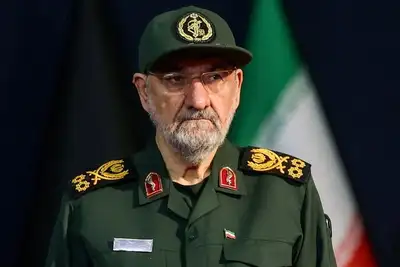
The Revolutionary Guards said they carried out a targeted intelligence operation against what they described as hostile anti-Islamic Republic groups in Iraq’s Kurdistan region, launching 30 drones at their positions.
In a statement, the Guards said the groups were planning infiltration and actions against the Islamic Republic. They added that “no leniency will be shown to hosts or perpetrators of actions against Iran’s national security.”

Iran’s foreign ministry spokesperson held a televised press conference on Tuesday from a Tehran classroom that state-linked media said had been damaged in recent strikes, as questions persist over the authorities’ use of civilian sites during wartime.
Images from the briefing showed spokesperson Esmail Baghaei speaking from a podium inside Mahalati School in Tehran. Iranian outlets said the school had been hit in recent attacks and presented the setting as evidence that educational facilities were being targeted.
Holding an official briefing in a classroom also prompted renewed speculation online that some officials may be seeking to operate from civilian buildings.
In recent days, social media users have circulated videos and photographs that appear to show security forces stationed inside schools in Tehran and Shiraz.
Iran International has also reported on security activity inside medical facilities. In one case, it cited a hospital employee who said military commanders held meetings inside a Tehran hospital.
Teachers’ unions have voiced alarm. The Coordinating Council of Iranian Teachers’ Trade Associations published an image a day before US-Israeli strikes began showing what it said was military equipment positioned inside a school, warning that classrooms were being turned into “shields for deadly equipment.”
Uniformed officers sit in a school courtyard beneath an Iranian flag in an image shared on social media on March 3, 2026.
Earlier this week, an image was released from a meeting of the interim leadership council, attended by President Masoud Pezeshkian, Judiciary Chief Gholamhossein Mohseni Ejei and cleric Alireza Arafi.
Hours later, social media posts suggested the meeting had taken place in a ward at Tehran’s Arman Hospital.
Members of Iran’s leadership council meet at an undisclosed location on March 1 with social media users saying the low ceiling and iron door behind them suggest the meeting was held inside Tehran’s Arman Hospital.
International humanitarian law requires parties to distinguish between civilians and combatants, and between civilian objects and military objectives.
Schools and hospitals are protected unless, and for such time as, they are used for military purposes, and the use of civilians to shield military objectives is prohibited.
Disputed strike in Minab
The controversy intensified after Iranian media reported that an elementary and preschool complex in Minab, Hormozgan province, adjacent to an IRGC compound, was struck on February 28, killing more than 160 people.
Asked about the incident, US Secretary of State Marco Rubio said the United States would not deliberately target a school and that its objectives were focused on missiles, related manufacturing and launch capabilities, and drones.
"We would have no interest and frankly no incentive to target civilian infrastructure.”
Security forces gather with motorcycles and armored vehicles inside a school courtyard in an image shared on social media in January ahead of a crackdown.
Israel’s ambassador to the United Nations, Danny Danon, said on Monday he had seen differing accounts of what happened in Minab, including claims that Iran’s Revolutionary Guards were responsible. He said Israel targets military assets and expressed regret for civilian casualties.
“We regret the loss of life of any civilian. And we pray for the people of Iran. But we have the intelligence and we target military assets. That’s what we do. The Iranians, they do exactly the opposite,” he said.
As the conflict deepens, any overlap between official or security activity and civilian sites could increase the risks for densely populated areas and raise further legal and humanitarian concerns.
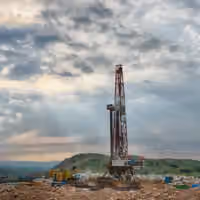
Oil production has been suspended at Iraq’s Rumaila oil field, the country’s largest, due to export disruptions linked to the military escalation in the Middle East, Shafaq News reported on Tuesday, citing local sources.
One source told Shafaq that production at all wells in the field had stopped completely after exports were disrupted, leading to rising storage levels and full tanks.
The halt is temporary until shipping resumes and conditions stabilize, the report said.
Iran’s foreign ministry spokesperson Esmail Baghaei said the international community is fully aware of the ongoing conflict in Iran and that the crisis will not remain confined to the region.
“The world is not blind; everyone sees this, and if it chooses to turn a blind eye or feign ignorance, it will face consequences,” Baghaei said, warning that the war in Iran could soon affect Europe and the wider world.
He said countries that believe they can stay on the sidelines while the conflict continues are “deeply mistaken,” adding that the conflict is “highly contagious” and will spread beyond its current borders.
Former Iranian President Mahmoud Ahmadinejad is alive following an assassination attempt, informed sources told Iran International on Tuesday.
The sources said Ahmadinejad was not harmed and had been moved to a safe place.
Over the weekend, during Israel’s attacks, Iranian media carried conflicting reports about Ahmadinejad’s fate, with some outlets saying he had been killed while others said they could not confirm the claim.
Exiled Prince Reza Pahlavi called on ethnic communities in Iran to remain united, saying they would no longer face discrimination in a future system based on separation of religion and state.
“We are on the verge of the fall of this regime,” Pahlavi said in a statement.
He urged vigilance against “opportunistic forces” seeking to exploit the situation and pledged that in a post-Islamic Republic Iran, all communities would live “under the rule of law and equal citizenship rights” and preserve their identities “without discrimination.”