For forty-seven years, the Islamic Republic has anchored Iran to an ideology that promised dignity and independence but delivered isolation, economic decay and recurring crisis. What began as a revolutionary project hardened into a theocratic system sustained by confrontation abroad and repression at home.
Today, that closed strategic loop appears to be under strain.
January marked what many observers describe as a point of rupture. Security forces killed, wounded and arrested thousands during a nationwide crackdown whose brutality shocked even a society long accustomed to state violence.
The state crossed a political and social threshold, relying more visibly than ever on coercion to maintain control. Whatever legitimacy the regime ever claimed has gone.
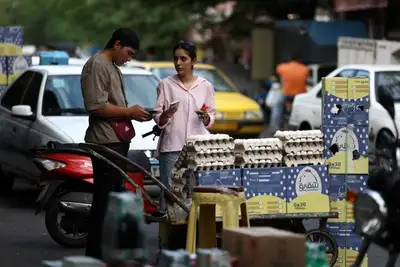
Iran now faces a convergence of pressures: economic exhaustion, widespread public frustration, continued international isolation and a credible threat of force from the United States. The familiar formula—delay and deflect diplomatically, escalate through regional partners and expand military capabilities—no longer guarantees stability.
At the center of this crisis lies ideological overreach that has become financially burdensome and strategically counterproductive.
Tens of billions of dollars (or over $100 billion if we consider the entire economic burden) have been invested in uranium enrichment to preserve what officials describe as a “nuclear option.” Rather than delivering security, this path has triggered successive rounds of sanctions and intensified isolation.
Billions more have gone into hardened missile infrastructure and underground facilities designed to project deterrence beyond Iran’s borders.
Supporters call these systems defensive; critics see them as instruments of coercion that have deepened confrontation without producing durable stability.
The same logic shaped Tehran’s network of allied militias across the Middle East. Built to extend influence and encircle adversaries, this proxy architecture was intended to provide strategic depth at relatively low cost. Instead, it has drawn Iran into repeated confrontations with militaries vastly more powerful than its own and entrenched a cycle of escalation.
At home, the Revolutionary Guard and Basij remain the state’s primary instruments of control. Their central mission has increasingly been the suppression of domestic unrest.
Each protest wave met with force further widens the gap between state and society.Continued reliance on coercion risks destabilizing Iranian society and the wider region.
Meanwhile, the United States has shifted into what appears to be a posture of sustained coercive pressure. Strike aircraft supported by aerial tankers; strategic bombers waiting at home to embark on global strike missions; intelligence, surveillance and reconnaissance (ISR) aircraft; layered air and missile defenses, and a reinforced naval presence including two carrier strike groups near critical waterways signal both capability and resolve.
Washington now possesses credible means to target Iran’s air defenses, command structures, missile forces, naval assets and military and nuclear industries for major effects without repeating the large-scale ground wars of the past.
The message, however, is not that war is inevitable. Rather, it is that Iran’s long-standing brinkmanship strategy may be reaching its limits. It is time for Tehran to decide. This does not necessarily mean surrender, but strategic realism.
In 1988, after eight devastating years of war with Iraq, the Islamic Republic’s founder and first supreme leader Ruhollah Khomeini accepted a ceasefire he described as “drinking from poisonous chalice.” The decision was politically humiliating for many within the revolutionary establishment, yet it prevented further destruction and preserved the state.
Iran may now confront a comparable moment of transformation. Accepting strategic capitulation would not necessarily mean dismantling the state or abandoning national defense. It would mean relinquishing powers and institutions, such as IRGC and Basij, that have contributed to oppression and prolonged isolation, halting uranium enrichment, placing missile programs under verifiable constraints, severing relations with proxy militias as instruments of foreign policy and ending existential rhetoric toward regional adversaries.
In return, Iran could pursue what many of its citizens have long sought: economic recovery, sanctions relief and diplomatic normalization.
Yet, after the events of January 2026, those gains alone may not satisfy public expectations. A growing segment of Iranian society is demanding fundamental political change and a credible path toward secular democracy and free elections in Iran.
The alternative is military attrition layered atop economic fragility and domestic unrest. Infrastructure would degrade further. Isolation would deepen. Public anger would intensify. Repression might temporarily contain dissent but would likely compound long-term instability.
History is ruthless with rulers who mistake ideological stubbornness for strength.
Those ruling Iran still have a narrowing window to prioritize real national interests over ideological expansion. Durable power rests not only in centrifuge halls and missile tunnels, but in legitimacy, prosperity and social cohesion.
For decades, the Islamic Republic framed confrontation as strength and resistance as destiny. Now the shadow of war hangs over Iran. Whether it chooses a peaceful concession of power or renewed escalation with unforeseen consequences may determine not only its own future, but the trajectory of the country and the nation it currently governs.
The path less treacherous for Iran appears clear: stepping back from confrontation and allowing Iranians to choose their future, even if that means the end of an era for those ruling the country.