Air superiority is a military condition; regime change is a political outcome. When it comes to discussing imminent American strikes on Iran, people often confuse the two, as if one automatically causes the other. It does not. If anything, Israel’s 2023-25 experiences in Iran, Lebanon and Syria have shown that modern air campaigns can be extraordinarily effective at damaging an adversary’s defensive structures, yet still leave an opponent intact but bloodied, paranoid, and still wielding the coercive machinery that matters.
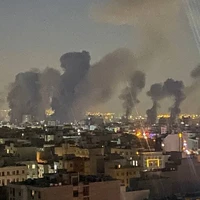
The Israeli campaign in last summer’s 12 Day War was bold precisely because it did not rely solely on aircraft. It combined waves of targeted strikes with covert sabotage, attacking radar, air defence systems, missile sites, and key individuals in rapid succession, aiming to undermine the regime’s sense of security and its capacity to coordinate a response. That brief conflict highlighted the hybrid nature of Israel’s actions: kinetic operations intertwined with cyber and information effects, intended to disorient command structures as much as to destroy hardware. That combination is exactly why people now discuss toppling the Islamic Republic as if it is merely a matter of scaling up what Israel already demonstrated. However, that conclusion overlooks the fact that Iran learns.
A regime that survives decapitation attempts does not remain unchanged. It adapts, strengthens, disperses, and develops redundancy and pre-planned succession. It modifies communication patterns and no longer appears as a neatly presented target on a staff officer’s PowerPoint slide. After the 2025 strikes, Iran’s senior military leaders publicly acknowledged damage to air defence assets and claimed they had been replaced with systems that were already stored and pre-positioned. On the one hand, this was an admission of vulnerability disguised as a sign of institutional resilience; on the other, it reveals how the regime perceives the next war: not as a single decisive encounter, but as multiple rounds of punishment, where merely surviving becomes a form of victory.
The United States can almost certainly achieve freedom of movement in Iranian airspace. America’s suppression and destruction of enemy air defences exemplify refined and developed capabilities. The question is what that freedom achieves politically, and how long the US can sustain its acquisition.
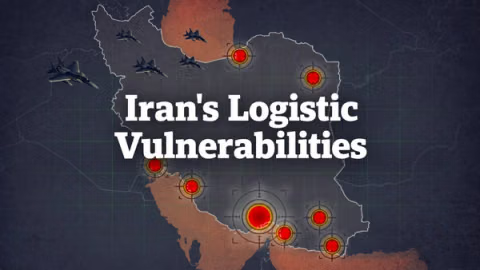
Begin with the straightforward aspect: the air defence challenge. Iran’s defences are not a single impenetrable dome. They comprise a mix of systems of Russian origin, such as the S-300, domestically developed systems like Bavar-373, and a patchwork of other sensors and missile systems, whose effectiveness relies on proper integration and resilient command and control. Israel’s advantage in 2025 was the capability to disrupt that integration from the start, including through covert operations targeting air defence infrastructure timed to coincide with strikes. As a consequence of Israel’s conflict, the regime will relocate launchers, expand radar coverage, reconfigure software, assume networks are compromised, and operate with that understanding.
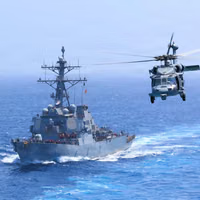
This adaptation will not be limited to air defence. The more important story is how Tehran might try to impose costs where US air superiority does not automatically guarantee control: at sea, through proxies, cyber means, and escalation politics. It was reported this week that Iran is approaching a deal to purchase Chinese CM302 supersonic anti-ship cruise missiles. These systems are explicitly designed to challenge naval defences by flying low and fast, and are difficult to intercept. Even if that agreement takes time to finalise, the overall trend is clear: Iran does not need to defeat US airpower to complicate an American campaign; it just needs to make the theatre more dangerous and costly.
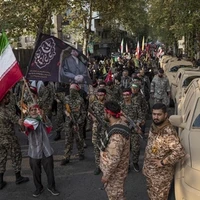
That leads me to the often-overlooked aspect: the regime is more than just a few visible leaders. It is a complex network of institutions designed to withstand leadership changes: security services, intelligence agencies, the IRGC’s economic backing, local enforcement bodies, and structures that uphold clerical legitimacy. The Israelis demonstrated they could penetrate deeply and eliminate senior figures, but that very success will drive the remaining cadre underground. For a targeted elite, “not being found” becomes the primary goal. Survival then becomes the measure of their success, and as a result, time becomes their greatest asset.
A fantasy of a rapid collapse clashes with the reality of authoritarian resilience. Authoritarian regimes often plan to outlast their opponents’ attention spans. The regime only needs to endure. The US system, by contrast, is highly sensitive to time: news cycles, polling, congressional chatter, and election schedules. AP-NORC polling this month illustrates this tension well: many Americans see Iran as an adversary and are worried about its nuclear programme, but confidence in President Trump’s judgment on the use of military force is low. That presents a political limitation. It indicates that if the regime does not fall quickly, Washington’s idea of “success” will likely shift from winning outright to “degrading capabilities” and declaring the mission complete.
There are also practical constraints. The Chairman of the Joint Chiefs has warned internally about munitions depletion and the complexities of any major Iran operation, highlighting strained stockpiles from other commitments and the difficulty of maintaining extended operations at scale. The US can strike what it wants,but “as long as it wants” is a different assertion, and one that depends on production lines, allied basing, and the willingness of partners to accept retaliation risks. Even if none of these constraints is decisive on its own, collectively they influence the one variable the regime cares about most: duration.
The most likely endgame is not necessarily a liberal revolution with a clear transition plan. A regime can change leadership while remaining deeply repressive. Venezuela serves as a clear warning, demonstrating how minimal leadership change can be when coercive forces and patronage networks remain in place. An Iranian version could simply be a reshuffle that removes some problematic figures, makes symbolic gestures towards de-escalation, and offers Washington a deal aligned with the US electoral cycle.
The alternative is just as troubling. A forced decapitation could result in fragmentation: competing power centres seeking legitimacy, security forces hedging their bets, commanders becoming warlords, and loyalists fighting a counter-revolution in the name of the old order. Civil conflict is not guaranteed, but it remains a risk we must take seriously. Even if a new governing coalition is formed, it might spend its first years fighting remnants of the Islamic Republic’s security forces or, more likely, integrating them in exchange for impunity. Either way, the Iranian people risk being caught between continuity and chaos, neither of which is the moral victory often implied by Western rhetoric.
Iran’s retaliation options are not limited to shooting down aircraft. Tehran can deploy asymmetric means: missile and drone strikes on regional infrastructure, harassment of shipping, blocking the Strait of Hormuz, cyber operations, and proxy violence. It is reported that Iranian military figures have warned of a shift away from “restrained retaliation” in response to any US attack, including the possibility of targeting US assets in the Persian Gulf region. The point is not that Iran can defeat the United States militarily (it cannot), but that it can force Washington to defend a broad perimeter while undertaking an air campaign, and that it can do so in ways that increase the risk of miscalculation and escalation.
There are even darker escalation pathways. If the regime believes it is facing extinction, it might choose options it would normally avoid because they could provoke catastrophic retaliation. We must seriously consider the logic of a cornered state: if the leadership believes the end is near, the temptation to shock, terrorise, or internationalise the conflict increases, or even deploy chemical or biological weapons. The best approach is through deterrence and risk management, but nonetheless, it remains a vital part of the strategic landscape that any serious planner must evaluate.
US military planning will expect sustained, weeks-long operations against Iran if the president orders an attack, on a scale far beyond a one-night “message strike”. Whether this becomes reality depends not only on military feasibility but also on how quickly the White House can turn bombing into a genuine political collapse inside Iran. If that collapse does not materialise, the Trump administration will be tempted to limit objectives: target nuclear and missile infrastructure, punish command nodes, then cease while claiming victory, leaving the regime bruised but still standing. This temptation grows with each week the regime survives, as every additional week of operations turns a war plan into a domestic political liability.
The military outcome of a strike campaign is never uncertain if the question is whether the United States can destroy what it can locate. The more difficult question is whether destroying what they find leads to the political results Washington desires. Airpower can coerce, degrade, terrify, and even trigger internal collapse if the regime is already decaying and an alternative power is ready to take advantage. However, decades of such operations show that air campaigns do not create legitimacy, govern territory, or shape the internal deals that determine who rules when the bombs cease. Aerial dominance does not equate to lasting political control, and “victory” defined solely in terms of target destruction often results in complex, long-term instability.
These are the risks. That said, it is entirely possible that the planned campaign will achieve great success and will lead to a smooth transition to a democratic and free Iran. This is not out of the question. However, the regime has learned that survival is the key to success, and it will now organise itself around staying alive rather than appearing strong. It can adapt tactically more quickly than Western publics can respond emotionally. It can raise costs without securing victory, and even if Washington can destroy the tools of Iranian power from the air, it cannot simply bomb its way to a clean succession.
The United States will be able to break Iranian capabilities. Whether it can break the regime’s grip, and what, exactly, replaces it if it does, is the part that should keep us skeptical of anyone guaranteeing a short war with a neat ending.