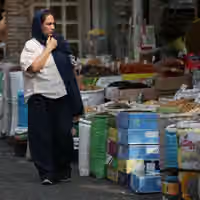
On Monday morning, the Foreign Ministry spokesman said foreign reporters visiting the country had described life as “normal.” Yet the indicators and daily experience suggest anything but.
That same day, Iranian media quoted bakers and grocers saying that wealthier customers now leave deposits so poorer families can take bread or meat without paying upfront.
Even newspapers aligned with Supreme Leader Ali Khamenei have begun issuing warnings.
Khorassan cautioned about the political consequences of rising bread prices. Days earlier, Kayhan warned that bread riots were likely if the government proceeds with plans to raise prices for a fourth time since President Massoud Pezeshkian took office in mid-2024.
Tabnak, the news site run by former IRGC commander Mohsen Rezaei, reported that a family of two or three now needs about twice the government’s worst-case estimate from last year to cover food costs.
Overall inflation is above 60 percent and expected to approach 70 percent this month. Donya-ye Eqtesad warned that food inflation could soon reach triple-digit levels. The Statistical Center of Iran reports inflation for agricultural goods above 85 percent and services above 45 percent.
Across the media spectrum, analysts point to three converging pressures: soaring food prices, wages that lag behind living costs and persistent instability in financial markets.
Specialized economic outlets report continued volatility in the foreign-exchange market. The dollar has fluctuated between 1,630,000 and 1,650,000 rials in recent days, with traders describing “high-tension anticipation” tied to uncertainty over negotiations with the United States and broader political risks.
Gold prices have surged alongside the currency, placing what has long been a traditional hedge against instability beyond the reach of most households.
The stock market has added to public unease. Shargh reported sharp index declines and heavy retail capital flight on Monday, with roughly 110 trillion rials ($680 million) exiting the market in 24 hours.
Analysts cite eroding confidence in government support policies and fears that regional tensions could spill into the domestic economy. Even those with no investments feel the consequences, as market instability feeds broader uncertainty.
Ramadan, traditionally marked by nightly gatherings and shared meals, has taken on a subdued tone. Many families can no longer afford customary foods, let alone host guests.
State television and pro-government social-media accounts now openly discuss the possibility of war. Online documentaries show Tehran’s pre–New Year shopping districts open but nearly empty. Instead of browsing, residents exchange advice on stockpiling food, fuel and clothing — precautions in case the capital comes under attack.
If this is normal, it is a fragile and increasingly costly version of it.