Amnesty says children among 30 at risk of death penalty in Iran
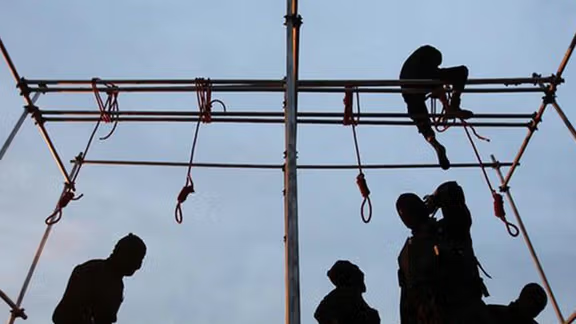
Amnesty International said at least 30 people, including two children, are at risk of the death penalty in Iran over alleged offences linked to the January uprising.
The rights group said eight people were sentenced to death in February following what it described as fast-tracked and grossly unfair trials, and warned that others face capital charges including “enmity against God.”
Amnesty said some of those at risk reported torture and forced confessions, and called on Iranian authorities to quash the death sentences and halt further executions.





Iran’s Foreign Minister Abbas Araghchi said on Friday that the United States has not asked Tehran to permanently stop uranium enrichment, pushing back on reports that Washington was demanding zero enrichment.
Speaking on MSNBC’s Morning Joe, Araghchi said recent talks in Geneva had been constructive and that both sides had agreed on guiding principles for a possible deal.
“The US side has not asked for zero enrichment,” he said, adding that Iran had not offered to suspend enrichment either.
“What we are now talking about is how to make sure that Iran’s nuclear program, including enrichment, is peaceful and would remain peaceful forever,” he said.
Araghchi said there was “no military solution” to Iran’s nuclear program and that the only path forward was diplomacy, adding that Iran was prepared for both negotiation and war.
He said technical measures were under discussion to ensure the program remains peaceful, and noted that International Atomic Energy Agency chief Rafael Grossi had played a constructive role in recent negotiations.
He also said the two sides had agreed to prepare a draft framework for a possible agreement and would begin negotiating its language at their next meeting, calling the process “a normal way of any international negotiations.”
Araghchi said Iran was ready for diplomacy but warned that if attacked again, it would defend itself, adding that after the previous 12-day conflict its “enemies had no way but to ask for an unconditional ceasefire.”
Prince Reza Pahlavi on Friday urged Shia Iranians to oppose the country’s ruling system, saying the authorities had committed crimes “in the name of Shia Islam.”
In a message addressed to “my devout Shia compatriots” and posted on X, Pahlavi said the Islamic Republic had brought “poverty, misery, and crimes against humanity” and accused Supreme Leader Ali Khamenei of overseeing repression during recent unrest.
He called on Shia Iranians who oppose clerical rule to “stand at the forefront of the struggle” and to reclaim their faith from political use by the state.
Pahlavi also urged unity among Shia, Sunni and other religious communities against what he described as an illegitimate regime.
President Donald Trump’s 10 to 15-day deadline for Iran to reach a nuclear deal could coincide with a meeting of the UN nuclear watchdog that may further censure Tehran, Bloomberg reported on Friday.
The International Atomic Energy Agency’s board is scheduled to meet on March 2 in Vienna and diplomats are expected to consider a new resolution that could refer Iran to the UN Security Council, the report said.
Bloomberg said the timing raises the possibility of military action if diplomacy fails, noting that Israel launched strikes within 24 hours of an IAEA censure in June.
“There is not much time but we are working on something concrete,” IAEA Director General Rafael Mariano Grossi told Bloomberg TV, according to the report.
Trump said on Thursday that Iran had 10 to 15 days to reach a deal or face consequences, as the United States builds up forces in the Middle East.
The cost of hiring oil supertankers could rise to the highest levels this decade on the growing risk of a major US attack on Iran, Bloomberg reported on Friday.
Citing data from the Baltic Exchange, Bloomberg said earnings for a very large crude carrier on the Middle East-to-China route have nearly tripled this year to about $151,208 a day, the highest since 2020.
The report said a major assault on Iran could disrupt traffic through the Strait of Hormuz and raise the risk premium for chartering ships.
“Military action in the Middle East will likely take VLCC rates to levels not seen since 2019,” Anoop Singh, global head of shipping research at Oil Brokerage Ltd, told Bloomberg.
Bloomberg also said tighter vessel supply and increased consolidation in the tanker market were adding to upward pressure on rates.
A sharp increase in US military deployments to the Middle East has intensified uncertainty in Tehran, where analysts and officials are debating whether the buildup signals imminent conflict or a bid to gain leverage in nuclear negotiations.
Multiple US outlets reported on Thursday that national security officials have informed President Donald Trump that the military has positioned the necessary air and naval assets in the region to carry out a strike “within days,” potentially even by the end of this week.
In Tehran, some analysts cautioned that the military moves could signal genuine escalation rather than routine pressure.
Political analyst Mohammad Soltaninejad told Entekhab: “If the negotiations fail or the US position changes—as happened before the 12-day war and in the middle of negotiations—it is possible that war could break out.”
Jalal Sadatian, a former Iranian ambassador to the United Kingdom, said in an interview with ILNA that war remains an unattractive option for regional states, particularly given the risk of US bases in those countries being targeted.
“The balance is still tilted somewhat more toward negotiation than toward war,” he said, arguing that Trump appears to be “more focused on threats and exercising pressure.”
‘Real’ prospect of war
The military buildup follows the second round of nuclear talks between Iran and the United States, which ended Tuesday in Geneva without tangible results. Cautious optimism expressed by Foreign Minister Abbas Araghchi has not translated into broad confidence in Tehran.
Financial markets have reacted nervously. Iran’s currency weakened nearly one percent in a single day, with the dollar rising toward 1,630,000 rials, reflecting broader concerns about the risk of escalation.
Prominent economic outlet Eco Iran ran an editorial on Thursday titled Diplomacy Under the Shadow of Military Movements, arguing that US deployments are not merely a show of power but “a sign of maintaining operational readiness in case tensions escalate.”
International relations professor Gholamreza Haddad told Eco Iran that talks proceeding to a third round is not necessarily a positive sign. He said the scale of US deployments suggests “real preparedness for military conflict,” rather than merely a threat intended to extract concessions from Tehran.
Agreement ‘a miracle’
Nour News, a site close to senior security official Ali Shamkhani, went further, suggesting that Washington might opt for a limited, symbolic action to demonstrate readiness without entering full-scale war.
“This scenario would symbolically test Iran’s deterrence and demonstrate America’s power,” the editorial said, warning that “the scene stands on the brink of crisis.”
Iran has also demonstrated heightened military activity. Over the past two days, it has conducted exercises in the Persian Gulf and the Sea of Oman, and a notice to airmen (NOTAM) was issued for a missile test in southern Iran scheduled for Thursday.
US affairs analyst Amir Abolfath delivered one of the more pointed warnings, calling a potential agreement “a miracle” and cautioning that sustaining any deal may prove even more difficult than reaching one.
“We may end up in war,” he told moderate outlet Khabar Online. “And even in the event of war, the problem may not be resolved.”