Oman says 'much work yet to be done' after US-Iran talks
Oman’s foreign minister said that more work remains to be done before a deal can be reached between Washington and Tehran after the second round of Iran-US talks in Geneva on Tuesday.
“Together we made serious efforts to define a number of guiding principles for a final deal. The contribution of the IAEA Director General Rafael Grossi was much appreciated,” Oman’s Foreign Minister Badr Albusaidi said on X.
“Much work is yet to be done, and the parties left with clear next steps before the next meeting,” he added.
A former senior US official on Iran told Iran International that prospects for a diplomatic breakthrough with Tehran were slim and argued that regime change in Iran would serve US interests, as Washington continues indirect talks with the Islamic Republic.
Elliott Abrams, a senior fellow for Middle East studies at the Council on Foreign Relations and a former US special envoy for Iran, said it was “very difficult” to see diplomacy succeeding if the United States maintained its current demands.
“The president has spoken of wanting an end to the nuclear weapons program, zero enrichment, and wants to do something about the ballistic missile program and the support for terrorist proxies in other countries,” Abrams said in an interview. “The regime is not going to accept that.”
“If the president sticks to what he has said he wants and Secretary Rubio has said the United States needs, there will be no deal,” he added.
Abrams said Iran’s leadership was in a weaker position than at any time in recent years, citing Israeli and US strikes on Iranian nuclear facilities and a deadly crackdown on protests.
“It is clearer today than ever that it remains in power only by murdering citizens,” he said. “The economy is in a kind of free fall. Look at the value of the currency. The ability of the regime to protect itself militarily has never been lower.”
He argued that Tehran’s domestic vulnerability could make compromise less likely rather than more.
“They will perhaps think, we cannot show weakness, so we cannot compromise,” he said. “So I think it’s hard to believe a reasonable agreement is possible.”
Access to the global internet has been cut in some Iranian cities, with users limited to the country’s national information network, digital rights advocacy account Filterbaan reported on Tuesday.
The group said disruptions were reported in Qazvin and Ahvaz, while users in Qom, Mashhad, Najafabad, Tabriz, Abdanan and Malekshahi also reported internet outages or slowdowns.
Filterbaan cited Cloudflare radar data showing internet traffic in Iran had dropped by about 45% since last Wednesday, with overall data exchange nearly halved compared with levels before Feb. 11.
Iran’s Foreign Minister Abbas Araghchi said talks with the United States had made “good progress” compared with the previous round, talking to state media.
“We agreed on a series of guiding principles based on which we will enter into a text of a possible agreement,” Araghchi said.
“This does not mean we will reach an agreement soon, but the path has begun. When it comes to drafting the text, the work becomes difficult,” he added.
A handout photo released by Iranian media shows a missile being fired from a vessel during Revolutionary Guards drills in the Strait of Hormuz on February 17, 2026.
Iran’s Revolutionary Guards carried out naval drills in and around the Strait of Hormuz on Tuesday and said parts of the strategic waterway were closed for several hours, as Iran and the United States held indirect nuclear talks in Geneva.
Iranian media said the temporary restriction was linked to the “Smart Control of the Strait of Hormuz” exercise and was aimed at ensuring safety and navigation principles during the drill.
Tehran has repeatedly warned in the past that it could close the strait if attacked, a step that would disrupt one of the world’s most vital oil export routes.
Guards navy commander Alireza Tangsiri said Iran’s forces were ready to shut the strait if ordered by the country’s leadership.
“The decision to close the Strait of Hormuz rests with the senior leaders, and as a soldier I say we are ready to carry it out whenever our leaders say,” Tangsiri was quoted as saying while overseeing the main phase of the exercise.
Tangsiri said the weapons used in wartime could differ from those displayed in drills. “The weapons that enter the field on the day of war are not necessarily the same as the equipment used in exercises,” he said, signaling that Iran’s operational capabilities extend beyond what is shown publicly.
Iranian outlets described the drills as a combined exercise involving Guards naval combat and rapid-reaction units, with a range of offensive and defensive systems deployed. They reported that missiles were fired toward designated targets and that drone units carried out reconnaissance and attack missions under conditions of signal jamming.
The exercise began from Iran’s Persian Gulf islands – including Abu Musa, Greater Tunb, Lesser Tunb and Sirri – which Iranian media described as key positions for overseeing shipping there and the western approaches to the Strait of Hormuz. The reports said the drill included elements of electronic warfare and simultaneous launches from land and sea.
Iran’s Supreme Leader Ali Khamenei, referring to US naval deployments, was quoted as saying that an American aircraft carrier was dangerous but that “more dangerous than it is the weapon that can send it to the bottom of the sea.”
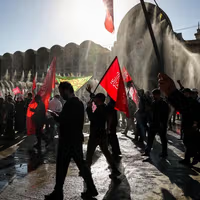
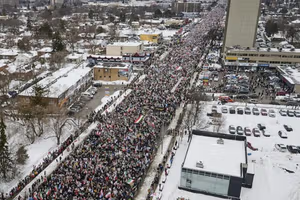
Protesters hold pre-1979 Iranian flags during a rally against Islamic Republic, in Munich, Germany on February 14, 2026.
Widespread rallies by Iranians abroad, held in response to a call by exiled Prince Reza Pahlavi, drew an outpouring of support from inside Iran, with many describing the gatherings as a renewed source of hope and unity.
German authorities said nearly 250,000 people attended the Munich rally, calling it the largest protest by Iranians in Europe to date. Organizers and local officials also reported large turnouts in Toronto and Los Angeles, each estimated at around 350,000, as well as 50,000 in London and 45,000 in Vancouver.
Speaking at the Munich event, Prince Reza Pahlavi addressed people inside Iran directly. “Know and see that you are not alone and that your voice has reached the world,” he said.
Messages sent to Iran International and widely shared on social media described what contributors called an unprecedented display of cohesion and discipline across continents.
Messages from inside Iran
One viewer wrote: “Salute to our honorable compatriots outside Iran. Seeing the beautiful images of unity, harmony, civility and order brought tears of joy to our eyes inside the country.”
Another message read: “We were tired and disappointed, but when we saw you in the gatherings abroad, we cried for all of us. Who can separate us from each other?”
A resident of Tehran wrote, “We bow our heads in respect to all our compatriots around the world. We saw your gatherings everywhere and wept.”
From Shiraz, a viewer addressed the authorities, writing: “Every bullet you fired at our young people united our hearts more. We are now united, aware and full of faith.”
Others described the rallies as a turning point after weeks of pressure at home. “Yesterday, after 37 days, for the first time we were not sad or hopeless. Everyone was talking about you, and there was excitement in their eyes,” one message said.
Several framed the demonstrations as evidence of a shared national purpose transcending borders. “It was proven that the power of love for Iran and Iranians does not fit within political and geographical boundaries,” one viewer wrote.
“With seeing you, every moment was tears and emotion. We hope to celebrate our freedom soon on our own soil,” another message said.
Support extended beyond messages sent directly to Iran International. Similar posts circulated widely across social media platforms, echoing themes of unity, perseverance and anticipation of political change.
The scale of the February 14 rallies prompted criticism from state media, officials and pro-government online activists, who questioned attendance figures and accused organizers of exaggeration.
Responses ranged from attempts to downplay the gatherings to verbal attacks on participants abroad. Supporters inside Iran, however, portrayed the demonstrations as a morale boost amid continuing domestic restrictions.
“Your presence is a bridge of hope and solidarity that lights many hearts inside the country,” another Tehran resident wrote.