Iran’s education ministry denied reports that security forces entered schools to arrest students during the recent unrest, saying no arrests took place on school grounds.
Ministry spokesman Ali Farhadi told Iranian news outlet ISNA that “no arrests happened,” and said that with follow-up by the education minister and coordination with other officials, no student remained in detention after the early days of the protests.
Farhadi said student safety and psychological well-being are the ministry’s “absolute priority,” and that schools should remain calm and free of tension.
He added that inquiries about detained students or teachers have been pursued through relevant bodies, but said details would be announced by judicial and law enforcement authorities.




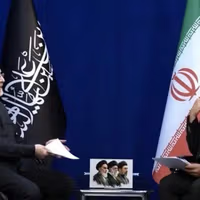
An Iranian lawmaker said upcoming nuclear talks in Geneva will not include Iran’s missile program or regional issues, and insisted Tehran will not discuss stopping uranium enrichment or sending its nuclear stockpile out of the country.
Ebrahim Rezaei, a member and spokesman of parliament’s National Security and Foreign Policy Committee, wrote on social media that “in this round of negotiations, there is no discussion of stopping or abandoning uranium enrichment,” and that Iran’s stockpiles will not be transferred abroad.
He added the United States has already accepted those points in earlier discussions, and said the Geneva talks are limited to the nuclear file.
Rezaei said Iran’s negotiating team has prepared a proposal package “to avoid wasting time,” but added that Tehran is not optimistic about a result given what he described as Washington’s track record.

Israeli Prime Minister Benjamin Netanyahu has ordered legal proceedings to begin to revoke the citizenship of Israelis convicted of serious espionage on behalf of Iran, officials said, in what they described as an unprecedented move.
The directive, issued with the backing of Attorney-General Gali Baharav-Miara, instructs authorities to pursue revocation only after a final, binding conviction for severe espionage offenses linked to the Islamic Republic.
Netanyahu told a closed-door meeting that spying against Israel constituted “a fundamental breach of trust,” according to officials familiar with the discussion, Israeli media reported.
Under Israel’s Citizenship Law, nationality can be revoked for a breach of loyalty, including espionage or treason. The provision has rarely been used and was previously considered mainly in terrorism-related cases.
Officials said that in practical terms, individuals stripped of citizenship who hold no other nationality would retain permanent residency and could continue living in Israel, though they would lose civil rights such as voting.
Over the past two years, around 40 indictments have been filed against about 60 suspects accused of being recruited by Iran, according to officials. Israel’s Shin Bet security service has warned of a rise in Iranian efforts to recruit Israeli citizens, describing it as a growing national security threat.
An Iranian lawmaker said a letter attributed to Tehran’s provincial security council seeking medical documents for people wounded in the January protests is authentic, and described a dispute between government bodies over whether patient information should be shared.
Homayoun Sameh-Yah Najafabadi, a member of parliament’s health committee, said there is disagreement between the health ministry and the interior ministry on transmitting patients’ information.
He said the health ministry, in a confidential correspondence, opposed the Tehran security council’s request for medical records of those injured in the protests.

Branch 15 of Iran’s Revolutionary Court, headed by Judge Abolghassem Salavati, has issued a death sentence for Mohammadamin Biglari, a 19-year-old detained during protests in Tehran, according to information shared with Iran International.
The case has been sent to Iran’s Supreme Court.
According to the information received, Biglari works at a men’s barbershop in Tehran and was arrested on January 8 while returning home from work.
The report said his mother has died and that authorities only informed his father of the arrest three weeks later, after he spent weeks searching for his son, including among bodies at Kahrizak morgue.

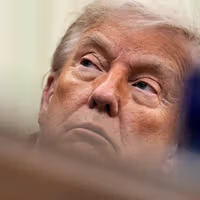
Iran’s armed forces chief Abdolrahim Mousavi warned US President Donald Trump that any conflict with Iran would be lesson for him, and questioned Washington’s stated interest in negotiations.
“He will enter a battle that will serve as a lesson, the outcome of which will ensure he no longer blusters on the world stage.”
He also challenged Trump’s approach, asking why the US president talks about negotiations if he intends to pursue war.