President Trump’s backing of Iranian protesters has revived debate in Washington over how far the US should go. As some advisers warn against another Iraq- or Afghanistan-style intervention, one can point to the 1991 Iraqi uprising as a cautionary lesson.


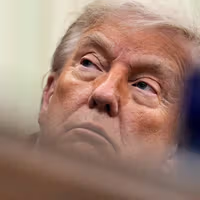
About a month ago, US President Donald Trump urged Iranians to keep protesting and take over institutions, saying that “help is on the way.”
Since then, the US military presence around Iran has expanded steadily, and many Iranians openly call for American military action against the Islamic Republic.
Yet some of Trump’s advisers draw cautionary parallels between a potential strike on Iran and the US invasions of Afghanistan in 2001 and Iraq in 2003, warning against another protracted and costly war.
There is, however, another Middle Eastern precedent—one that both Iran and the United States would be wise to examine closely: the 1991 Shia and Kurdish uprising in Iraq. It was a revolt sparked in part by American encouragement but crushed after the United States did not intervene on behalf of the protesters.
US call for uprising
On Feb. 15, 1991, President George H.W. Bush called on “the Iraqi military and the Iraqi people to take matters into their own hands and force Saddam Hussein, the dictator, to step aside.”
His message was broadcast into Iraq via television and radio. Coalition aircraft dropped leaflets urging Iraqi soldiers and civilians to “fill the streets and alleys and bring down Saddam Hussein and his aides.”
The call came weeks after the US-led coalition had launched its campaign to expel Iraqi forces from Kuwait. Shia communities in southern Iraq and Kurdish groups in the north rose up against Saddam.
The uprisings were fueled by deep public anger over Saddam’s military adventurism — from the long war with Iran to the invasion of Kuwait — which had imposed immense human and economic costs on Iraqi society.
Protests began in Basra and quickly spread to Najaf, Karbala and Nasiriyah. Shia rebels and defecting soldiers attacked security forces and government buildings. Baath Party offices were seized, officials were killed, prisoners were freed.
Within roughly two weeks, 14 of Iraq’s 18 provinces were effectively outside the central government’s control.
It was a dramatic advance — but it did not last.
The collapse of the uprising
The rebellion ended in one of the bloodiest crackdowns in modern Iraqi history. Its failure stemmed from a combination of factors: American hesitation to intervene, Saddam’s extensive use of force and deep divisions among the opposition — a combination that could, in a different form, reappear in Iran.
Despite overwhelming military superiority in the Persian Gulf, the Bush administration chose not to enter a new confrontation with Saddam. There were fears of “another Vietnam,” with American troops drawn into a prolonged deadly conflict.
Bush publicly called for Saddam’s removal but remained wary of what might follow. One concern was the “Lebanonization” of Iraq — the prospect of the rise of Iranian-backed Shia forces in Baghdad.
Meanwhile, opposition groups inside Iraq — Shia factions, Kurds, nationalists and others — failed to unify under a coherent command structure. The opportunity to conquer Baghdad slipped away.
The Gulf War ceasefire allowed Saddam breathing room. A regime many believed was on the brink of collapse recovered quickly. Relying on the Republican Guard — which had remained in the war largely intact — Saddam launched a counteroffensive.
Although parts of Iraq were placed under no-fly zones, Saddam exploited a loophole: helicopters were not barred. He used them to attack rebels, and coalition forces did not intervene to stop those assaults.
The Republican Guard shelled residential neighborhoods indiscriminately, conducted house-to-house arrests and carried out mass executions. Chemical weapons were used against some rebel-held areas. Even those who sought refuge in religious shrines in Najaf and Karbala were not spared.
Estimates suggest that between 30,000 and 60,000 Shia in the south and around 20,000 Kurds in the north were killed. Roughly 2 million people were displaced.
Lessons for the US and Iran
The Iraqi uprising offers several lessons for policymakers in Washington, and for Iranians.
First, the international community often underestimates a regime’s capacity for internal violence. Military weakness abroad does not necessarily translate into fragility at home.
A government that perceives its survival to be at stake may show restraint toward foreign adversaries while unleashing far harsher tactics domestically. Even an army battered in external war can regroup internally, close ranks and act with renewed intensity.
Saddam’s regime had been defeated by an international coalition, yet it retained loyal security structures, a functioning chain of command and the willingness to use extreme force against its own citizens.
At such moments, any external concession or diplomatic maneuver can be repurposed as an instrument of internal consolidation.
A deal with Iran could give the ruling elite a chance to regroup and unleash a new wave of repression against its own people.
For opposition movements, strategic cohesion matters. Agreement on minimum political goals, unity of command and preparation for a potential power vacuum can be decisive.
Victory does not arrive simply because a regime appears weakened. In Iraq, rebels went so far as to appoint local governors in areas they controlled — but the new order collapsed swiftly. Divisions within the opposition ultimately strengthened the existing power structure at a decisive moment.
At the same time, global leaders should recognize that threats alone are insufficient. If a foreign power seeks to alter the balance of power, it must understand that displays of force without the intention to use it can carry profound and unintended consequences.


Israel’s Prime Minister Benjamin Netanyahu believes only direct engagement with US President Donald Trump can prevent a limited nuclear deal with Iran—and turn this moment into a decisive blow against the Islamic Republic.
Netanyahu’s sudden trip to Washington on Tuesday is not routine diplomacy. It reflects his deep concern that renewed US–Iran talks in Oman could drift toward a narrow nuclear agreement that would stabilize Tehran rather than confront it.
Recent statements by President Trump have focused almost exclusively on the nuclear file. After the meeting on Wednesday, he said he told Netanyahu that he prefers a negotiated settlement with Iran and hopes Tehran is more reasonable than it was in 2025.
For Netanyahu, this signals a familtiar danger: pressure within the United States to settle for a deal that curbs uranium enrichment while leaving Iran’s missile arsenal, regional network of proxies, and broader strategic posture intact.
Netanyahu appears to believe this moment is unique—that Iran is weaker than it has been in years: economically strained, internally divided, and strategically exposed after recent regional confrontations. In his assessment, a limited agreement would squander a rare opportunity to alter the regime’s trajectory, particularly at a time of unprecedented US military presence in the region.
As in past confrontations with US administrations, Netanyahu is expected to arrive armed with intelligence briefings and a historical argument tailored to Trump himself. The message is likely to be direct: presidents are remembered for moments when they reshape history, not defer it. This, he will argue, is such a moment.
Netanyahu will also push for broadening negotiations to include Iran’s ballistic missile program—a threat not only to Israel but to US forces and regional allies.
Tehran is unlikely to accept such terms. Iranian officials have asserted this many times. Yet from Netanyahu’s perspective, that refusal would strengthen the case for a tougher American response. If Tehran accepts expanded terms, its capacity to project power would be significantly reduced.
There is also a domestic dimension.
Netanyahu seeks to reinforce his image as the leader most capable of confronting Iran while maintaining close ties with the US. That positioning carries particular weight after earlier claims that Israel had neutralized key Iranian threats—claims now tempered by recognition that deterrence alone may not suffice.
Underlying this approach is a broader strategic conclusion: Israel can manage Iran’s proxies, but it cannot indefinitely manage the regime itself. Only a fundamental shift in Tehran, whether through internal collapse or decisive US-led military pressure, would transform Israel’s long-term security equation.
Netanyahu’s decision to engage Trump directly also reflects skepticism toward the president’s diplomatic circle, particularly advisers who favor a pragmatic nuclear arrangement that stabilizes tensions in the short term while leaving the core challenge unresolved.
From Netanyahu’s standpoint, the risk of a narrow agreement is clear. Economic relief for Tehran could dilute international urgency and complicate future coalition-building against Iran while constraining Israel’s freedom of action.
Yet this strategy carries risks of its own.
Netanyahu may underestimate the resistance his approach could encounter within the United States, especially among segments of the MAGA movement increasingly skeptical of foreign entanglements. While Trump himself has shown openness to assertive uses of power, much of his political base is wary of being drawn into another Middle Eastern confrontation.
Historical memory also shapes the landscape. Netanyahu’s 2002 congressional testimony supporting military action in Iraq—and the subsequent costs of that war—still resonates in Washington. Advocacy framed as preventive or regime-targeting military action inevitably triggers those comparisons.
Israel could face heightened scrutiny and erosion of political goodwill should US–Iran tensions escalate in ways perceived domestically as externally driven or strategically avoidable.
In seeking to shape US policy at a pivotal moment, Netanyahu is pursuing what he sees as strategic necessity. But in doing so, he risks complicating Israel’s long-term standing within an increasingly divided American political landscape.

Israeli Prime Minister Benjamin Netanyahu’s hastily advanced trip to Washington this week underscores the rising stakes surrounding renewed diplomacy between Iran and the United States.
Originally scheduled for February 18, the visit was brought forward by a week following fresh indirect talks in Oman that both sides have indicated could resume in the coming days.
Netanyahu is expected to press President Donald Trump to impose firm constraints on Iran’s ballistic-missile program and its support for armed groups in the region. But the urgency of the meeting appears to reflect more than immediate tactical concerns, pointing to a blunter effort by Israel to shape US policy rather than simply align with it.
Trump has repeatedly signaled his preference for a "deal with Iran." But Netanyahu remains wary that negotiations might focus narrowly on the nuclear file and leave unaddressed what he sees as Tehran broader threat ecosystem.
That gap was evident during the previous round of US–Iran talks in the spring of 2025.
While Trump conveyed optimism about diplomatic openings and outlined prospective nuclear proposals, reporting suggested Netanyahu remained unconvinced, ultimately awaiting the expiration of Washington’s 60-day deadline before launching strikes that became the 12-Day War.
Even after US bombers joined strikes on Iran’s Natanz and Fordow nuclear sites, Washington reportedly urged Israel to scale back operations as Israeli forces moved closer to senior figures following the killing of top Revolutionary Guards commanders.
Israeli and Western officials say Iran has since moved to restore damaged ballistic-missile infrastructure, in some cases prioritising missile sites over nuclear facilities. Iranian officials have also publicly pointed to renewed—even enhanced—missile capabilities, reinforcing Israeli concerns about Tehran’s readiness to deploy them in a future confrontation.
It is against that backdrop that Israel has watched recent diplomatic signals from Tehran and Washington with growing unease.
Iran has reintroduced senior figures into the diplomatic arena, including Ali Larijani, a longtime adviser to Supreme Leader Ali Khamenei, who has held consultations alongside the Muscat talks. His reappearance has been read in Israel as a sign that Tehran is seeking to project flexibility while resisting constraints on missiles and regional networks.
Those moves have coincided with messaging from within Trump’s political orbit emphasizing diplomatic opportunity.
Remarks by J.D. Vance, cautioning against escalation and underscoring the potential for a negotiated outcome, have been noted closely in Jerusalem, where officials have long worried that talks could narrow toward the nuclear file alone.
Taken together, these developments appear to have heightened Israeli concern that its core security priorities could be sidelined as diplomatic momentum builds—helping explain Netanyahu’s decision to advance his Washington visit rather than wait.
Netanyahu’s publicly stated red lines, particularly Iran’s arsenal of more than 1,800 ballistic missiles, align not only with Israeli threat assessments but with those of key Arab states.
Saudi Arabia and the United Arab Emirates have borne the costs of Iran’s regional tactics firsthand. Iran-supplied Houthi drones and missiles struck Saudi Aramco’s Abqaiq processing facility in 2019 and later targeted infrastructure near Jeddah in 2022.
Israel’s September 2025 strike on Hamas leaders in Doha strained but did not sever quiet channels with Qatar.
Despite public friction, Persian Gulf states involved in the Abraham Accords and Qatar continued to participate in US-led security discussions in which Israeli intelligence on Iran was reportedly shared, underscoring the resilience of regional threat coordination.
At the same time, Iran’s Arab neighbors have actively sought to contain escalation and, in some cases, helped create the conditions for diplomacy.
While they share Israel’s assessment of the missile and proxy threat, they have often favored de-escalation and engagement as a means of managing it—highlighting a divergence not over the nature of the threat, but over how best to reduce it.
Netanyahu’s visit to Washington reflects an effort to push back against that regional pull toward accommodation, pressing for a harder line on Tehran that addresses Israel’s security concerns. He appears to view Iran’s nuclear latency, missile expansion and regional outreach as a single, interlocking challenge.
Israel’s objective, therefore, is not episodic deterrence but the steady erosion of the capabilities that allow Tehran to sustain an existential threat posture—a logic shaping Netanyahu’s diplomacy in Washington as much as Israel’s readiness to act alone.
Middle East analyst Elizabeth Tsurkov says people close to President Trump believe he is likely to strike Iran, arguing the Islamic Republic’s failure against Israel revealed a “paper tiger” abroad — even as it remains ruthlessly lethal toward its own citizens.
Speaking to Iran International in Washington, Tsurkov, a senior non-resident fellow at the New Lines Institute, said the recent US military buildup in the region is the largest since the 2003 invasion of Iraq and has raised expectations that force may ultimately be used.
“People who know the president personally have told me they believe he will attack,” she said, adding that talks are unlikely to succeed because “the maximum that the Iranian regime is willing to offer is less than what the US is willing to accept.”

Human rights activists are sounding the alarm over reports of secret and extrajudicial executions in Iran, warning that the authorities may be moving toward retaliating against detainees after the deadly crackdown on protests in January.
Domestic accounts—fragmentary and difficult to verify under heavy censorship—suggest that killings may be continuing beyond those reported during the nationwide unrest of January 8 and 9, when security forces opened fire on demonstrators in cities across the country.
One case frequently cited by rights activists involves Mohammad-Amin Aghilizadeh, a teenager detained in Fooladshahr in central Iran.
According to activists who followed the case, judicial authorities initially demanded bail for his release. Days later, his family was instead given his body, bearing signs of a gunshot wound to the head.
In another case, Javad Molaverdi was wounded by pellet fire during protests in Karaj, detained by security forces, and transferred to Ghezel Hesar Prison. His family later discovered his body in a cemetery, rights activists said.
Such cases have prompted warnings from international monitors. The United Nations special rapporteur on Iran, Mai Sato, has said she is closely following reports suggesting that executions and deaths in custody may be used to instill fear.
‘Doesn’t add up’
One of the most striking accounts received recently by Iran International comes from a journalist inside the country who described a conversation with a ritual washer working at a cemetery in Tehran province.
The journalist met the worker on January 27 and described him as visibly shaken, despite years of professional exposure to death. The washer told the journalist that the official reports “didn’t add up” for some bodies delivered to the cemetery.
“They bring a body that was clearly killed less than two days ago,” the worker said, “but say it has been in storage for 15 days because it was unidentified.”
“We have seen every kind of body for years—traffic accidents, heart attacks,” the worker added. “We can tell the difference. We know.”
Professionals working in forensic medicine and cemetery washing facilities often develop, over time, the ability to estimate time of death based on physical signs, even without laboratory tools.
Worrying precedents
The significance of the testimony lies not only in its emotional impact but in what it suggests about discrepancies between official explanations and physical evidence.
Such accounts cannot, on their own, establish a nationwide pattern. But taken together with reported cases of deaths in custody, they have intensified fears among activists that the authorities may be sending a broader message to protesters: that survival is no longer assured once dissent reaches detention centers.
Those fears are shaped in part by historical precedent.
Documented cases of extrajudicial killings in Iranian prisons—most notably in the early years after the 1979 revolution and during the 1988 mass executions—have heightened sensitivity to any signs that repression may again be moving out of public view.
The evidence gathered so far remains incomplete and uneven. But rights activists say it is sufficient to raise serious concern that deaths in custody and quiet executions may be occurring after protests have been suppressed.