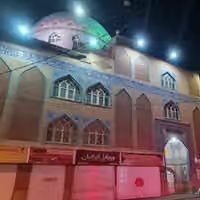
Iran cleric says enrichment will continue, rejects suspension calls


Ahmad Khatami, a senior Iranian cleric, said Iran would continue uranium enrichment and dismissed international calls to suspend the program as “irrelevant.”
Ahmad Khatami, a Tehran Friday prayer lmam, said Iran did not seek nuclear energy to build an atomic bomb and was not afraid of the United States.
“Iran does not want nuclear energy for an atomic bomb,” Khatami said, adding that calls for a voluntary suspension of enrichment were “an irrelevant statement.”
He said Iran’s opposition to nuclear weapons was based on religious principles, while insisting the country would not give up its nuclear program.
Iranian security forces ran armored vehicles over protesters in at least three areas of the northwestern city of Ardabil on Jan. 9, killing one woman and seriously injuring three others, according to information received by Iran International.
Earlier this week, Iran International published a video showing an armored vehicle driving over protesters in Yahyavi Square.
Iran’s delegation led by Foreign Minister Abbas Araghchi headed to talks with the United States to begin a second round of negotiations, Iran’s IRNA news agency reported.
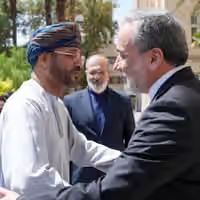
IRNA said Araghchi had presented Iran’s initial proposal to Omani Foreign Minister Sayyid Badr Albusaidi during the first round, which was then conveyed to US special envoy Steve Witkoff.
The agency said the US side had reviewed Iran’s views and the second round was starting as scheduled.

Iran’s Revolutionary Guards have deployed the Khorramshahr-4 ballistic missile in underground missile facilities, a move a senior Guards commander said carried a clear message even as Tehran entered talks with the United States.
Majid Mousavi, commander of the Guards’ aerospace force, attended an event unveiling a new underground “missile city” where the Khorramshahr-4 was displayed, Iranian media reported. The display took place hours before indirect Iran-US talks began in Muscat.
State-run Press TV said the Khorramshahr-4, described as one of Iran’s most advanced long-range ballistic missiles, has a range of about 2,000 km and can carry a 1,500-kg warhead. It said the missile has been deployed at one of the aerospace force’s underground facilities.
Iranian state media said the deployment coincided with what they described as a shift in Iran’s military doctrine from defensive to offensive and was intended to send a message to regional and extra-regional adversaries.
In a separate interview carried by state-linked media, Guards political deputy Yadollah Javani said the missile display showed Iran would not give up its military strength while pursuing diplomacy.
“We are not seeking war, but if the other side makes a mistake, we will respond decisively,” Javani was quoted as saying.
The display came as the Trump administration has moved additional military assets to the Middle East in recent weeks.
Oman’s foreign minister held separate meetings with Iranian and US delegations as Muscat hosted indirect talks on Iran’s nuclear file, Oman’s foreign ministry said.
Sayyid Badr Albusaidi met the Iranian delegation led by Abbas Araghchi and the US delegation headed by US special envoy Steve Witkoff, accompanied by Jared Kushner, the ministry said.
The consultations focused on creating conditions to resume diplomatic and technical negotiations and on supporting dialogue to promote security and stability, the ministry added, reaffirming Oman’s role as a mediator.


Australian Senator Raff Ciccone said the Australian Senate was standing firmly with the people of Iran after lawmakers passed a bipartisan motion condemning Tehran’s crackdown on nationwide protests.
The Australian Senate on Thursday approved the motion, which cited killings, mass arrests and internet blackouts imposed on civilians during protests that began in late December. It also acknowledged the distress of Iranian-Australians unable to contact relatives in Iran.
In an interview with Iran International, Ciccone said the vote sent a clear message of unity across Australia’s political spectrum.
“Earlier today in the Australian Senate, myself and a number of other senators across the political spectrum came together in a sign of unity and national bipartisanship to send a very strong message that Australia and the Australian Senate stands very closely with the people of Iran,” he said.
The motion called on the Albanese government to work with international partners, including the United Nations, to support independent investigations into human rights violations, press for accountability, expand targeted sanctions and push for an end to violence and communications restrictions.
Ciccone’s comments followed new Australian sanctions imposed earlier this week on 20 individuals and three entities linked to Iran’s security apparatus.
“Since 28 December last year, the Iranian regime has responded to peaceful protests with extraordinary and horrifying violence against its own people,” Ciccone said, adding that authorities had tried to conceal the crackdown through internet and telecommunications blackouts.
He said his office had received hundreds of calls and emails from members of the Iranian-Australian community worried about family and friends.
“Members of the Australian Iranian community have watched these events unfold with profound anguish,” he said.
Ciccone urged Iranian authorities to halt attacks on civilians and said Australia would not stay silent.
“The attacks that are occurring on citizens has to stop, has to stop immediately,” he said. “Australia is very much by your side.”