Iran-US talks in Istanbul may include regional ministers and Kushner – WaPo


Foreign ministers from Turkey, Qatar and Egypt, as well as counterparts from Saudi Arabia, Oman and Pakistan, could attend possible Iran-US talks in Istanbul, regional officials told the Washington Post.
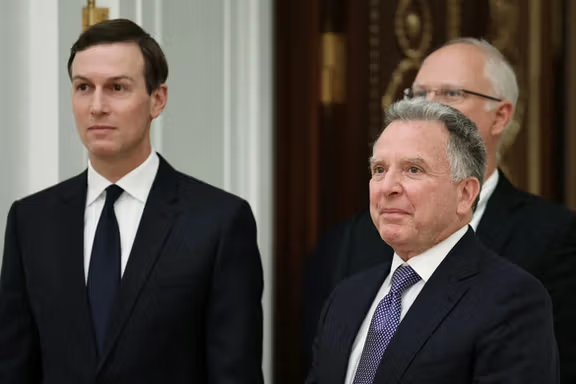
One regional official, speaking on condition of anonymity, said President Donald Trump’s son-in-law Jared Kushner will also attend alongside US Special Envoy Steve Witkoff if the meeting goes ahead.
The officials said plans for the meeting were still under discussion and there was no final confirmation that talks would take place.
A senior aide to Iran’s president said on Tuesday that pursuing peace did not amount to surrender, after President Masoud Pezeshkian ordered the foreign minister to restart talks with the United States.
“Not every peace means surrender,” Mohammad Jafar Ghaempanah, the president’s executive deputy, wrote on X. “No war is good, and not every peace is surrender.”
Earlier, Pezeshkian said on X that he had instructed Foreign Minister Abbas Araghchi to restart talks with the US in response to a proposal from President Donald Trump and requests from what he called “friendly governments.”
The comments came as reports said Araghchi and US Special Envoy Steve Witkoff were expected to meet in Istanbul on Friday.

President Donald Trump on Thursday delivered a characteristically ambiguous message on Iran, pairing talk of overwhelming military force with renewed signals that he may still favor a negotiated deal.
“I can’t tell you what I’m going to do right now,” Trump told reporters in the Oval Office when asked about Iran. “We have a tremendous force going in there, just like we did in Venezuela — even bigger.”
Still, he stressed that the administration was already in contact with Tehran.
“Right now, we’re talking to them. We’re talking to Iran,” he said. “If we could work something out, that’d be great. And if we can’t, probably bad things would happen.”
The remarks underscored a familiar dual-track approach: escalating deterrence while keeping the door open to diplomacy.
That uncertainty comes as US and Iranian officials prepare for what could be their first face-to-face engagement in the current crisis, with US envoy Steve Witkoff and Iran’s Foreign Minister Abbas Araghchi set to meet in Istanbul on Friday.
The meeting, if it goes ahead as expected, would mark a significant step after weeks of indirect messaging, military posturing and sharply escalatory rhetoric.
Conflicting reports
Various reports emerged on Friday about the details and potential format of the planned negotiations.
Reuters cited an unnamed Iranian official as saying Tehran was “ready to show flexibility on uranium enrichment,” including the possible transfer of 400 kilograms of highly enriched uranium and acceptance of zero enrichment under a consortium arrangement.
The report was swiftly denied by Ali Shamkhani, a senior adviser to Iran’s Supreme Leader Ali Khamenei, who stressed that any transfer of enriched uranium abroad was off the table.
“We are prepared for a possible war,” Shamkhani said in an interview with Hezbollah-affiliated broadcaster Al Mayadeen. “If the US attacks, we will certainly strike Israel.”
Separately, the Financial Times cited unnamed diplomats as saying the initial talks in Turkey are expected to focus primarily on Iran’s nuclear program, rather than its missile arsenal or support for regional militant groups.
US President Donald Trump says talks with Iran are ongoing amid high tensions.
"We have ships heading to Iran right now, big ones ... and we have talks going on with Iran," Trump told reporters at the White House on Monday.
"We'll see how it works out," he added. "If we could work something out, that'd be great. And we can't, probably bad things would happen.
Ali Shamkhani, a senior adviser to Iran’s Supreme Leader Ali Khamenei, said transferring Iran’s enriched uranium abroad is off the table, warning that Tehran is prepared for a potential war and would strike Israel if the United States attacks.
“We are prepared for a possible war,” Shamkhani told Hezbollah-affiliated broadcaster Al Mayadeen. “If the US attacks, we will certainly strike Israel.”
Shamkhani added that transferring Iran’s enriched uranium to another country was “definitely off the table.”
Commenting on talks expected on Friday between US special envoy Steve Witkoff and Iran’s foreign minister Abbas Araghchi in Turkey, Shamkhani said negotiations would initially be indirect but could quickly move to direct talks if there was an atmosphere of mutual understanding.

Reza Bahmani Alijanvand, a 34-year-old Iranian protester, disappeared after attending protests in the central Iranian city of Shahin Shahr on January 8, and was later found dead in the cold storage of a cemetery, people familiar with the matter told Iran International.
The sources said Alijanvand was shot by security forces with two live rounds, one striking his lower back and another his abdomen. His family spent five days searching hospitals, police stations and prisons across Isfahan province before identifying his body in the cold storage at Bagh-e Rezvan cemetery on January 13, the sources said.
According to the sources, Alijanvand's body was transferred later that night, on January 13, to Shahin Shahr's morgue.
Authorities initially refused to hand over the body and sought to have Alijanvand declared a “martyr,” a condition the family rejected, which would have required them to accept the state’s official account of the death rather than acknowledge that he was killed by state security forces.
Alijanvand was eventually buried under heavy security at around 4 a.m. on January 15, in a tightly controlled ceremony at Behesht-e Zahra Chaharbisheh cemetery in his hometown of Masjed Soleyman in southwestern Iran, with only five family members present and several plainclothes agents in attendance, the sources said.
Alijanvand was married and worked as a forklift driver at a brick factory, according to the people familiar with the matter.
“Reza worked from morning until night. He was deeply patriotic and hopeful for Iran’s freedom,” the source said, adding that Alijanvand believed Iran’s exiled prince Reza Pahlavi would return to the country.
Last month, Iran International reported that more than 36,500 Iranians were killed by security forces during the January 8-9 crackdown on nationwide protests, making it the deadliest two-day protest massacre in history.