US President Donald Trump says talks with Iran are ongoing amid high tensions.
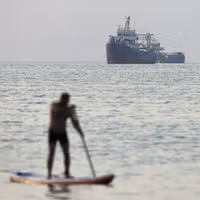
"We have ships heading to Iran right now, big ones ... and we have talks going on with Iran," Trump told reporters at the White House on Monday.
"We'll see how it works out," he added. "If we could work something out, that'd be great. And we can't, probably bad things would happen.
Ali Shamkhani, a senior adviser to Iran’s Supreme Leader Ali Khamenei, said transferring Iran’s enriched uranium abroad is off the table, warning that Tehran is prepared for a potential war and would strike Israel if the United States attacks.
“We are prepared for a possible war,” Shamkhani told Hezbollah-affiliated broadcaster Al Mayadeen. “If the US attacks, we will certainly strike Israel.”
Shamkhani added that transferring Iran’s enriched uranium to another country was “definitely off the table.”
Commenting on talks expected on Friday between US special envoy Steve Witkoff and Iran’s foreign minister Abbas Araghchi in Turkey, Shamkhani said negotiations would initially be indirect but could quickly move to direct talks if there was an atmosphere of mutual understanding.

Reza Bahmani Alijanvand, a 34-year-old Iranian protester, disappeared after attending protests in the central Iranian city of Shahin Shahr on January 8, and was later found dead in the cold storage of a cemetery, people familiar with the matter told Iran International.
The sources said Alijanvand was shot by security forces with two live rounds, one striking his lower back and another his abdomen. His family spent five days searching hospitals, police stations and prisons across Isfahan province before identifying his body in the cold storage at Bagh-e Rezvan cemetery on January 13, the sources said.
According to the sources, Alijanvand's body was transferred later that night, on January 13, to Shahin Shahr's morgue.
Authorities initially refused to hand over the body and sought to have Alijanvand declared a “martyr,” a condition the family rejected, which would have required them to accept the state’s official account of the death rather than acknowledge that he was killed by state security forces.
Alijanvand was eventually buried under heavy security at around 4 a.m. on January 15, in a tightly controlled ceremony at Behesht-e Zahra Chaharbisheh cemetery in his hometown of Masjed Soleyman in southwestern Iran, with only five family members present and several plainclothes agents in attendance, the sources said.
Alijanvand was married and worked as a forklift driver at a brick factory, according to the people familiar with the matter.
“Reza worked from morning until night. He was deeply patriotic and hopeful for Iran’s freedom,” the source said, adding that Alijanvand believed Iran’s exiled prince Reza Pahlavi would return to the country.
Last month, Iran International reported that more than 36,500 Iranians were killed by security forces during the January 8-9 crackdown on nationwide protests, making it the deadliest two-day protest massacre in history.

Israel will call for Iran to have no nuclear program, no ballistic missile program and no support for armed regional allied groups at a meeting on Tuesday with US special envoy Steve Witkoff, ahead of his talks later this week with Iran’s foreign minister Abbas Araghchi, Channel 12 reported.
Prime Minister Benjamin Netanyahu, Mossad chief David Barnea and Israel Defense Forces Chief of Staff Eyal Zamir are expected to attend the meeting, the report said.

Rights groups and activists are sounding the alarm over what they describe as a widening campaign of pressure, arrests and intimidation against Iranian doctors and nurses who treated injured protesters.
Iran International has reviewed information from multiple sources inside Iran suggesting that at least 32 members of the country’s medical staff have been detained, with no public information available about the status of their cases.
Doctors who treated wounded protesters in cities including Qazvin, Rasht, Tabriz, Mashhad and Gorgan have been arrested or have gone missing, according to the reports.
Most of the reported arrests are said to have taken place after January 8, following the escalation of protests and the ensuing security crackdown.
‘Normalization of arrests’
Iran Medical Council chief Mohammad Raiszadeh confirmed that 17 of its members had faced judicial or security cases linked to the recent unrest, but insisted that none had been prosecuted for providing medical treatment and that no verdicts had been issued.
The Medical Council is formally a civil body but operates under heavy state oversight.
Raiszadeh, who is close to conservative political circles and previously led the establishment-aligned Basij Doctors Organization, said the council had followed up the cases with security and judicial authorities and had been told that none of the individuals were arrested solely for treating patients.
His remarks prompted criticism within the medical community.
Mahdiar Saeedian, editor-in-chief of a medical science magazine in Iran, wrote on X that the council’s position amounted to normalizing state pressure on healthcare workers.
“More unpleasant than silence is the normalization of arrests and pressure on medical staff by the Medical Council,” he wrote. “This is the result of fully turning a professional organization into a state-controlled body.”
Reported cases
UK-based outlet Kayhan London reported that doctors Masoud Ebadi-Fard Azari and his wife, Parisa Porkar, were arrested in Qazvin for allegedly treating injured protesters, adding that their whereabouts remain unknown.
Another reported case involves Golnaz Naraqi, a 41-year-old emergency medicine specialist at Hasheminejad and Shohada-ye Tajrish hospitals in Tehran, who was reportedly arrested at her home more than ten days ago.
Social media users have also reported growing pressure on medical staff accused of helping protesters anonymously.
In one account, a viewer message sent to Iran International said Farshid Pourreza, head of Golsar Hospital in Rasht, was dismissed and expelled from the hospital for supporting protesters and treating the wounded.
Health Minister Mohammad Reza Zafarghandi wrote on X that providing “the best possible medical services to every patient in a safe healthcare environment,” regardless of “any external factors,” was the health system’s top priority.
The remarks drew swift criticism online.
“As a colleague, I am waiting to see whether you remain loyal to your oath, or whether an ‘external factor’ stands in the way of it,” Nakisa Serafinincho, an Iranian doctor based in Romania, wrote on X.
Another user responded: “You can’t even protect medical staff. How can you talk about patient safety?”
“Diplomacy is ongoing. For talks to resume, Iran says there should not be preconditions and that it is ready to show flexibility on uranium enrichment, including handing over 400 kg of highly enriched uranium, accepting zero enrichment under a consortium arrangement as a solution,” Reuters quoted an unnamed Iranian official as saying.
However, the official added that for talks to begin, Tehran wanted US military assets moved away from Iran.
“Now the ball is in Donald Trump’s court,” the official said, according to the report.