Iran official says no plan to transfer enriched uranium abroad


Iran has no plans to transfer its enriched nuclear material to any country and talks are not focused on such an option, a senior Iranian official said, pushing back against earlier reports.
Ali Bagheri, deputy for foreign policy at Iran’s Supreme National Security Council secretariat, said Iranian officials had no intention of moving enriched nuclear materials out of the country.
“Iranian officials have no plan to transfer enriched nuclear materials to any country, and negotiations are not about such an issue,” he was quoted as saying by state media.
His comments came after Reuters reported on Monday that an unnamed Iranian official said diplomacy was ongoing and that Iran was ready to show flexibility on uranium enrichment, including possibly handing over 400 kg of highly enriched uranium under certain arrangements.

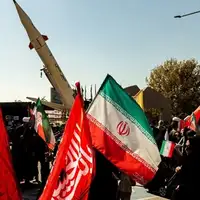
The European Union said on Monday it rejected Iran’s decision to consider the armies of EU countries as “terrorist groups” after the bloc designated Iran’s Islamic Revolutionary Guard Corps as a terrorist organization.
“We reject the announcement of the listing of EU armies and the accusation of terrorism,” European Commission spokesman Anouar El Anouni said.
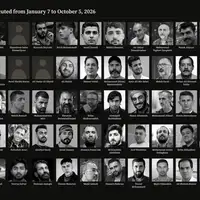
Iran’s move followed an EU decision last Thursday to list the Revolutionary Guards, a step that marked a shift in the bloc’s approach toward Iran’s leadership after a deadly crackdown on protests.

A senior Iranian military commander warned on Monday that Iran would respond forcefully if its security was threatened, saying the region could not remain safe if Iran was unsafe.
“We will never accept that Iran is unsafe while the region is secure,” Kioumars Heidari, deputy commander of Iran’s central Khatam al-Anbiya headquarters, was quoted as saying by Iranian media.
He said that if the United States endangered Iran’s security, “neither the Zionist regime nor other countries that help the US will have security,” adding they would be defeated and forced to leave the region.
Heidari also warned Washington to act "wisely" toward Iran. “It is in the Americans’ interest to behave rationally,” he said, adding that otherwise they would face a “harsh and regret-inducing” response.

Iran’s foreign minister said on Monday that Tehran remained committed to diplomacy while standing alongside its armed forces, stressing that the two tracks were not in conflict.
“We are in the same trench as the armed forces,” Foreign Minister Abbas Araghchi said at a ceremony in Tehran, according to state media.
He said Iran had never abandoned diplomacy and was always ready for talks “on equal footing and with mutual respect,” adding that “diplomacy is not compatible with threats, intimidation or pressure.”

Iran’s Foreign Minister Abbas Araghchi said on Monday that Tehran was ready for diplomacy and said he hoped there would be results soon, as Iran weighs possible talks with the United States.
Araghchi said Iran had never abandoned diplomacy based on mutual respect and mutual interests.
“The people of Iran must be spoken to with respect,” Araghchi said, adding that Iran would respond respectfully to anyone who did so.
Iran’s President Masoud Pezeshkian, meanwhile, ordered the start of negotiations with the United States, Fars news agency quoted a source in the administration as saying, adding that negotiations would take place within the framework of the nuclear issue.
Fars later changed the wording of the report and said nothing is final about the status of the negotiations.
The report followed remarks earlier in the day by foreign ministry spokesperson Esmaeil Baghaei, who said talks between Iran and the US would probably be held in Turkey in the coming days.
At his weekly news conference, Baghaei said any Tehran-Washington negotiations would proceed step by step.
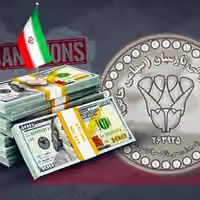
He said alongside “the issue of threats,” the priority for the Islamic Republic would be sanctions relief, which he called “a fundamental and non-negotiable priority.” He also thanked Turkey for its role in helping reduce regional tensions.
Tasnim news agency, which is affiliated with the Revolutionary Guard, confirmed the possibility of talks but said the time and place were not final. It said talks would likely be held between the Iranian foreign minister, and Steve Witkoff, the US special envoy.
A senior Iranian official and a Western diplomat told Reuters on Monday that Witkoff and Araghchi could meet in Turkey in the coming days.
A Turkish ruling party official told Reuters that Tehran and Washington had agreed that talks would focus on diplomacy, seen as a possible reprieve from potential US strikes.
Qatar and Egypt were also being considered as possible hosts for talks, Iran’s ISNA news agency reported.
US Special Envoy Steve Witkoff and Iranian Foreign Minister Abbas Araghchi could meet in Turkey in the coming days, a senior Iranian official and a Western diplomat told Reuters.
A Turkish ruling party official told Reuters that Tehran and Washington had agreed talks this week would focus on diplomacy, seen as a possible reprieve from potential US strikes.
The Iranian official told Reuters that "diplomacy is ongoing. For talks to resume, Iran says there should not be preconditions and that it is ready to show flexibility on uranium enrichment, including handing over 400 kg of highly enriched uranium (HEU), accepting zero enrichment under a consortium arrangement as a solution".