Pezeshkian says protests aimed to fracture society
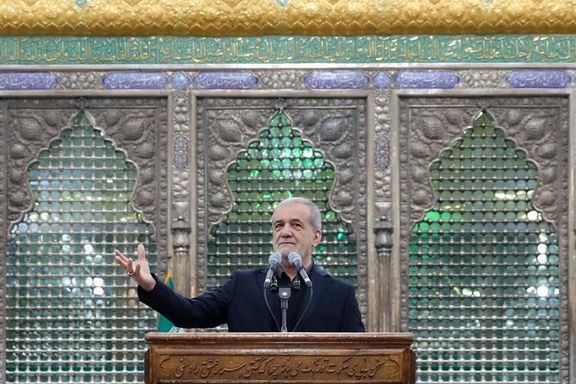
Iran's President Masoud Pezeshkian said at a ceremony at the burial site of Ruhollah Khomeini that in ordinary social protests people do not take up guns, kill security forces, or set ambulances and markets on fire, adding that the issue went beyond social protest and was aimed at tearing society apart.
"In these events Donald Trump, Benjamin Netanyahu and Europeans all sought to incite unrest, create division and provide support, drawing some innocent people into the streets," he said on Saturday.




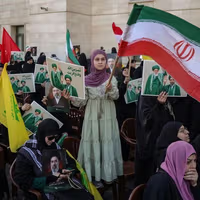

In response to designating the Islamic Revolutionary Guards Corps as a terrorist organization, Iran could move through parliament to place European armies on its terrorist list, Abbas Araghchi, Iran’s foreign minister, told CNN Turk.
Europe’s actions, he said, would not reduce regional tensions, adding that countries working for the region’s welfare and stability are regional states, not European ones, and that Europe is only fueling the fire.
Araghchi said Europeans have lost something significant by acting against the Guards and that the European Union’s role in the region is steadily diminishing, adding that he regrets they are not even considering their own interests.
Tehran appears to have taken the US military buildup near Iran seriously, but shows no sign of softening its rhetoric or accepting Washington’s terms while it explores limited diplomatic channels.
Speaking in Istanbul on Friday, Foreign Minister Abbas Araghchi said Iran would consider US proposals for negotiations only if the military threat was removed first. Araghchi was in the Turkish city to explore a possible mediation initiative, though he made clear that Tehran would not negotiate under pressure.
Hours later, US President Donald Trump said he had directly communicated a deadline to Iran for reaching an agreement with Washington. “Only they know about the deadline for sure,” Trump told reporters, without elaborating on the terms or consequences.
The exchange reflects a familiar standoff: Washington is attempting to force rapid movement at a moment when Iran is politically and economically weakened, while Tehran is signaling defiance even as it quietly probes diplomatic off-ramps.
Ahmad Bakhshayesh Ardestani, a member of parliament’s Foreign Policy Committee, said on Thursday that internal debates were under way in Tehran over how far Trump might go.
“Trump’s confrontation with Iran during his first term was a failure,” he told news website Didban Iran, setting out his assessment that the US president’s long-term aim was to end the Islamic Republic.
“He knows there is no third term, and this is his only chance.”
Ardestani also argued that regional powers including the United Arab Emirates, Qatar, and Turkey oppose the collapse of the Islamic Republic, which he said they view as destabilizing and economically disruptive.
Former Iranian diplomat Kourosh Ahmadi offered a more cautious assessment.
Speaking to Entekhab on January 29, he said Trump’s deployment of military forces was intended primarily to intensify diplomatic and economic pressure on Tehran rather than signal a settled decision to strike.
“Trump does not want to be remembered as a president who failed to deliver on his promises,” Ahmadi said, adding that the show of force was designed to deepen Iran’s economic crisis and force concessions.
Araghchi has denied that talks are planned with US envoy and Trump aide Steve Witkoff, even as he travels regionally to discuss mediation proposals.
Ahmadi said US military action remained possible but warned that Trump would face difficulties justifying an attack both internationally and to his domestic political base.
He also dismissed speculation that Washington might attempt to block Iran’s oil exports, arguing that such a move would almost certainly trigger military confrontation in the Persian Gulf and affect China and Arab nations in the region.
Ironically, Iran’s hardline daily Kayhan—close to the office of Supreme Leader Ali Khamenei—has suggested that Tehran itself should consider closing the strategic waterway.
Rahman Gharemanpour, an international relations expert, told Donya-ye Eghtesad that preparations for a major operation would require significantly more time and should not be read as evidence of an imminent attack.
In the same newspaper, Mashhad University academic Rouhollah Eslami said regional states are increasingly guided by cost-benefit calculations rather than ideological alignment—a shift that helps explain their reluctance to support military action against Iran.
For now, Iran’s position remains deliberately unresolved. Araghchi insists Tehran is prepared both for negotiations and for war—and given the balance of fear and defiance now shaping decision-making in Tehran, he may not be spinning for once.
The United States said Iran’s recent internet shutdown has devastated more than one million online businesses, with sales dropping by up to 80 percent and small enterprises hardest hit.
“The recent internet shutdown is not just an effort to silence the people; it has also devastated over one million online businesses, with their sales dropping by up to 80 percent and small businesses suffering the most damage. As a result of the Islamic Republic regime’s reckless policies, nearly half of all jobs are now at risk,” State Department Persian account on X posted on Friday.
“As US Secretary of State Marco Rubio said, “The reason for the collapse of [Iran’s] economy is that they spend all their money and resources on building weapons and supporting terrorist groups around the world, instead of reinvesting those resources in their own society,” the post added.
With US military assets building up across the Middle East and Washington warning Tehran that “time is running out,” a former Israeli military spokesperson says US strikes on Iran now appear increasingly likely.
“I think it’s only a matter of time before the US will conduct strikes against the Islamic Republic,” Lt Col Jonathan Conricus said in an interview with Iran International's English podcast Eye for Iran.
President Donald Trump said this week that the United States was prepared to act with “speed and violence, if necessary,” while Iranian officials have threatened immediate retaliation.
Trump also suggested Friday that Tehran may ultimately seek negotiations rather than face American military action.
“I can say this, they do want to make a deal,” confirming that he had given Iran a deadline to enter talks without specifying what it was. “We have a large armada, flotilla, call it whatever you want, heading toward Iran right now,” he added.
'Almost everything is in place'
Conricus, a senior fellow at the Foundation for Defense of Democracies (FDD), argued that the military tools required for meaningful action are already positioned.
“I think most of those capabilities and assets are in place and are ready to be deployed,” he said, adding: “Judging by the way things look now, almost everything is in place.”
He said the remaining question is timing—“the tactical operational opportunity” and political considerations around when to strike.
Secretary of State Marco Rubio also told lawmakers this week that the Islamic Republic is “probably weaker than it’s ever been."
Iran’s Foreign Minister Abbas Araghchi said Friday that Tehran was ready for talks only “on an equal footing,” but stressed that Iran’s missile and defence capabilities would “never be subject to negotiation.”
What would strikes target?
Conricus told Iran International any US strikes would likely prioritize crippling the regime’s internal control and ability to sustain repression.
He suggested an initial focus on “command and control” and the Islamic Republic's capacity “to exercise power domestically,” including “specifically targeting IRGC and Basij, but not limited to that.”
He also flagged cyber and communications disruption, saying he would “assume cyber and communications warfare against the networks and the communications infrastructure of the regime.”
In addition, he said missile infrastructure would be central—“related to Iran’s ballistic missiles,” including launch sites, silos and supply chains.
Nuclear-related facilities could also be targeted if the conflict escalates, particularly amid renewed American demands that Iran halt uranium enrichment and curb its missile program.
Israel watching, bracing and waiting
The Trump administration is also hosting senior Israeli and Saudi defense and intelligence officials in Washington this week amid discussions of possible strike scenarios and regional fallout.
From an Israeli perspective, Conricus described a mood focused less on whether action will happen, and more on when—and what retaliation might follow.
“People are waiting for when will it happen? What will the consequences be for Israel?” he said, adding that Israeli forces remain at “elevated readiness.”
He argued that a weakened Islamic Republic would also undercut Tehran’s regional proxy network, including Hamas, Hezbollah, and the Houthis.
“Getting rid of this horrible, terror-supporting, destabilizing regime would be very beneficial,” Conricus said.
You can watch the full episode on Eye for Iran on YouTube or listen on any podcast platform of your choosing.
Saudi Defense Minister Prince Khalid bin Salman warned in a private briefing in Washington that Iran would emerge stronger if President Donald Trump does not follow through on his threats against Tehran, according to four sources present at the meeting cited by Axios.
Khalid bin Salman also held a lengthy meeting at the White House on Thursday with Secretary of State Marco Rubio, Secretary of Defense Pete Hegseth, White House envoy Steve Witkoff, and Chairman of the Joint Chiefs of Staff General Dan Caine.