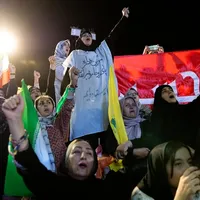
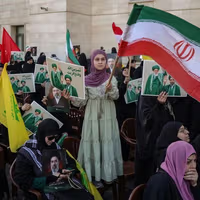
A senior official at Iran’s Medical Council confirmed on Friday that some doctors were arrested during recent protests, though no official figures were available.
“During the recent protests, regardless of the reasons or the number, there are some doctors who have been detained,” Mohammad Mirkhani, the council’s social and parliamentary deputy, was quoted as saying.
He said reliable and official data on detained doctors was difficult to obtain. “Most of this information comes from conversations with other colleagues who say a certain doctor has been arrested, and we are required to verify these reports,” he said.
Iranian Foreign Minister Abbas Araghchi arrived in Istanbul on Friday and said Tehran was holding close consultations with Turkey as regional tensions rise.
“There are serious challenges in the region, and the goals stated by the United States and others require closer consultations,” Araghchi said on arrival, according to state media.
He said he would meet his Turkish counterpart and President Tayyip Erdogan during the visit.
Araghchi also criticized Europe, saying its approach toward Iran was weakening. “Europe is in decline, and its action against the Islamic Revolutionary Guard Corps was a strategic mistake,” he said.
“They will soon realize that they made a mistake,” he added.
Britain is unlikely to take part in a US attack on Iran but could help protect allies in the Persian Gulf if Tehran retaliates, British sources told the Guardian, pointing to a recent deployment of RAF Typhoon jets to Qatar.
The Typhoon squadron was deployed at Qatar’s request to help defend the country against possible drone or missile attacks, the sources said. Qatar hosts the largest US air base in the region.
A first strike on Iran would be unlikely to align with Britain’s view of international law, but British forces could become involved if allies such as Qatar faced attacks in self-defense, the sources said.
Prime Minister Keir Starmer said on Thursday the priority was preventing Iran from obtaining nuclear weapons and working with allies toward that goal, declining to speculate on possible US military action.

Iranian-American Assistant Secretary of State for Consular Affairs Mora Namdar said on Thursday that Washington stood with the Iranian people and supported blocking Iranian regime members and their immediate relatives from benefiting from the US immigration system.
“The United States stands with the brave Iranian people,” Namdar said in a social media post. “We will not allow Iranian regime members and their immediate relatives to take advantage of America’s immigration and visa systems while brutally repressing their own people’s quest for basic rights.”
The US State Department said earlier on Thursday that Secretary of State Marco Rubio had taken action this week to revoke the privilege of Iranian senior officials and their family members to be in the United States, adding that those who profit from what it called the Iranian regime’s brutal oppression were not welcome to benefit from the US immigration system.

Two brothers based in the UK are behind a messaging app accused by digital rights groups of sharing user data with Iranian authorities, the Guardian reported on Friday.
Hadi and Mahdi Anjidani are co-founders of TS Information Technology, a UK-registered branch of Iranian software firm Towse’e Saman Information Technology (TSIT), which develops Gap Messenger — a domestic Iranian alternative to Telegram. The company is registered at an address in West Sussex.
While Gap Messenger claims its service is encrypted and does not share data with third parties, Iranian digital rights researchers dispute this. FilterWatch, which monitors internet censorship in Iran, has accused the app of being among entities involved in the state’s online surveillance and suppression efforts, citing leaked emails from Iran’s attorney general’s office in 2022.
Mahdi Anjidani, TSIT’s chief executive, has publicly expressed pro-government views in Iranian media and has called for tighter controls on foreign messaging apps and VPNs. The Guardian said neither brother responded to requests for comment.
Gap Messenger operates within Iran’s state-controlled “national internet”, which authorities have promoted during repeated internet shutdowns amid crackdowns on protests, according to digital rights experts.
In Iran, Mahdi Anjidani has appeared in state and tech media, describing himself as a “child of the Islamic Revolution” and praising Iran’s leadership for overcoming sanctions. His social media accounts show meetings with senior figures, including former president Mahmoud Ahmadinejad. Iranian digital rights researchers cited by the Guardian said the scale and scope of the brothers’ business interests suggest close ties to the authorities, adding that permission to operate domestic messaging platforms in Iran is limited to a small circle with strong political backing.


Iranian security forces have vandalized the gravestone of slain protester Sajad Valamanesh and continued pressuring his family to portray him as a Basij member, a source familiar with the matter told Iran International.
The source said intelligence and IRGC officials had repeatedly threatened the family over the wording on the headstone, warning they would destroy it if it was not changed. “Yesterday, several people went and covered the inscriptions with glue and plaster,” the source said, adding that the family had earlier been forced into coerced confessions and is now being pressured to say Valamanesh was a Basij member killed by “rioters.”
Valamanesh, from Lordegan in Chaharmahal and Bakhtiari province, was shot dead by security forces during protests on January 1.