Israeli military intelligence chief Maj. Gen. Shlomi Binder met senior officials at the Pentagon, the CIA and the White House on Tuesday and Wednesday, according to US officials and other sources familiar with the discussions, as Israel shared intelligence it says could inform potential targets inside Iran, Axios reported on Thursday.
Saudi Defense Minister Prince Khalid bin Salman was expected in Washington on Thursday and Friday for meetings at the Pentagon, the State Department and the White House, including with Secretary of State Marco Rubio and US special envoy Steve Witkoff, sources said.
Saudi officials have been urging de-escalation and have passed messages between Washington and Tehran in recent days, according to the same accounts.
The visits came as Reuters reported on Thursday that President Donald Trump is considering military options against Iran that range from targeted strikes on commanders and security forces blamed by Washington for a violent crackdown on protests, to broader attacks against Iran’s missile and nuclear infrastructure.
Trump has not made a final decision, Reuters reported, citing multiple sources, including US officials familiar with the deliberations.
Trump on Wednesday again warned Iran about possible strikes while also urging Tehran to “come to the table” on a nuclear deal, saying any future attack would be “far worse” than a June bombing campaign against Iranian nuclear sites.
He described US naval forces in the region as an “armada,” language he has used repeatedly in recent days.
Washington’s military posture has been shifting at the same time.
The arrival of the USS Abraham Lincoln aircraft carrier and supporting warships in the region this week broadened Trump’s options.
Open-source tracking and public statements over the past two weeks have pointed to a wider buildup of air, sea and air-defense assets, including deployments designed to support sustained air operations and defend US forces and regional partners against retaliation.
The question of whether a second major naval force could follow has added to the sense of escalation.
A separate carrier strike group, the USS George H.W. Bush, departed Norfolk on January 13, though its destination has not been publicly confirmed.
Analysts tracking force movements have said the Bush’s movements could determine whether the United States intends to maintain one carrier in the region as a deterrent, or assemble a larger package capable of prolonged operations.
Behind the high-level diplomacy and military deployments is a rapidly deteriorating crisis inside Iran that has reshaped Washington’s calculations over the past month.
Protests erupted on December 28 after strikes and demonstrations began in Tehran’s bazaars and spread nationwide, driven initially by economic pressures and rapidly escalating into wider political demands.
Iran’s authorities responded with mass killings and arrests as well as communications restrictions, while the Trump administration warned Tehran against lethal repression.
Trump publicly threatened military action if Iran carried out large-scale executions of protesters, and in mid-January said – without providing evidence – that killings had paused.
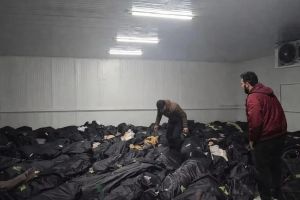
The situation then worsened sharply. More than 36,500 Iranians were killed by security forces during the January 8-9 crackdown on nationwide protests, making it the deadliest two-day protest massacre in history, according to documents reviewed by Iran International
Iranian authorities have not released a comprehensive breakdown of protest-related deaths. They have, however, acknowledged several thousand fatalities.
In Tehran, Iranian officials have warned the United States and regional states against military action. Ali Shamkhani, a senior adviser to Iran’s top leadership, said on X that any US military action would be treated as an act of war and would prompt immediate retaliation, including against Israel and what he called those supporting an attack. Iranian officials have also said US bases in the region could be targeted in response.
At the same time, Iranian officials have signaled that indirect diplomacy remains possible even as they reject Washington’s terms.
Trump has not publicly laid out his terms. Past U.S. negotiating demands have included a ban on Iran enriching uranium, limits on long-range ballistic missiles and curbs on Tehran’s network of allied armed groups in the region. Iran has rejected preconditions and says it will negotiate only on equal footing.
A senior Iranian official told Reuters that Iran was preparing for a potential military confrontation while also using diplomatic channels, but said Washington was not showing openness to diplomacy.
Regional reactions
Regional governments are split between fear of Iranian retaliation and concern about Iran’s internal trajectory.
Persian Gulf states that host US forces have pressed Washington against strikes, wary that they would be the first targets in any escalation, according to Reuters.
Saudi Crown Prince Mohammed bin Salman told Iran’s President Masoud Pezeshkian that Riyadh would not allow its airspace to be used for an attack, according to state news agency SPA. Qatar, Oman and Egypt have also lobbied for restraint, Reuters reported.
Israeli officials, while sharing intelligence and planning closely with Washington, have also cautioned that air power alone is unlikely to produce political change in Iran, Reuters reported, and that any transition would depend on internal fractures and organized domestic forces.
“If you're going to topple the regime, you have to put boots on the ground,” a senior Israeli official told Reuters, adding that even if the United States killed Supreme Leader Ali Khamenei, Iran would "have a new leader that will replace him."
For now, US officials say the military buildup is nearing completion and Trump has not closed the door to diplomacy.
But the convergence of high-level visits, an expanded US force posture and the White House’s increasingly explicit linkage between military options and Iran’s internal crackdown has turned a once-remote contingency into an imminent choice for Washington.