Exiled prince Pahlavi invokes ‘never again’ for Iran
Exiled Prince Reza Pahlavi marked International Holocaust Remembrance Day on Tuesday by urging world leaders to turn the post‑war vow of “never again” into concrete action over the mass killing of protesters in Iran.
“Today, as we mark International Holocaust Remembrance Day, the promise of ‘Never Again’ is being tested in Iran,” Pahlavi wrote on X. “The world has a moral imperative to put this concept into practice by standing with the brave people of Iran against the pure evil they face."
US President Donald Trump said a US naval force is currently moving toward Iran, renewing pressure on Tehran to reach an agreement with Washington.
“There’s another beautiful armada floating beautifully toward Iran right now,” Trump said on Tuesday in Iowa, adding that he hoped Iranian leaders would “make a deal.”
Trump said Iran should have agreed earlier, adding it would still “have a country” had it done so.
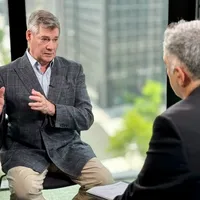
Special conversation between Masih Alinejad and María Machado, leader of the Venezuelan opposition and Nobel Peace Prize winner
Iranian and Venezuelan opposition figures in a meeting in Washington DC urged the United States and its allies to act against what they described as an axis of repression between their two countries.
Iranian activist Masih Alinejad met with Venezuelan opposition leader and Nobel Peace Prize laureate Maria Corina Machado in Washington, where the two discussed the situation in Iran and Venezuela and called for stronger international action.
“Today I am in Washington, DC. The capital of the free world,” Alinejad said. “I am here with one of the most courageous woman who is leading the democratic opposition movement in Venezuela, Maria Corina Machado.”
The meeting comes amid one of the deadliest periods of deadly violence in Iran's history. Iranian authorities have responded to nationwide protests with a massacre, with at least 36,500 people killed by security forces from Jan 8-9.
Alinejad said the Venezuelan and Iranian struggles are linked, arguing that the governments of Nicolás Maduro and Iran’s Supreme Leader Ali Khamenei support one another.
“Maduro is not alone. Ali Khamenei is his ally,” Alinejad said. “Ali Khamenei and Revolutionary Guards invaded Venezuela.”
Machado said that cooperation between the heavily sanctioned authoritarian governments has been underway for years.
“The tyrannies we’re facing have been cooperating for many years, exchanging resources, information technology agents, weapons, weapons, certainly,” Machado said. “And now at the same time, we see our people getting up and committing themselves in an unprecedented citizen movement for freedom.”
Machado’s remarks come weeks after US forces captured Maduro in Caracas and flew him to New York, where he has pleaded not guilty to drug trafficking charges.
She rejected criticism of such actions as foreign intervention.
The meeting also follows repeated warnings by US President Donald Trump that Washington would respond if Iranian authorities escalated violence against protesters — statements that activists say raised expectations among Iranians seeking international backing.
Alinejad said Iran is currently facing mass violence by state forces.
“Right now, Iranians are facing massacre,” she said. “Up to 20,000 people have been killed ... with empty hands, unarmed people cannot win."
Machado welcomed the US military intervention which captured Maduro this month, calling it a turning point. The attack killed 83 people, according to Venezuela's defense ministry.
“Finally, in Venezuela, we’re seeing President Trump making a tremendous important decision,” she said. “January 3rd, when President Trump brought Nicolas Maduro to justice.”
“Venezuela will be free and Iran will be free as well,” she added.
Mojtaba (Shahmorad) Shahpari, a protester from the southwestern Iranian city of Izeh who was injured during the nationwide protests and later found dead in a cold storage warehouse in Isfahan, was laid to rest wrapped in the lion and sun flag, fulfilling his final wish.
Shahpari was shot by security forces on January 8, 2026, during protests in Baharestan, Isfahan province, people familiar with the matter told Iran International.
The sources, who asked not to be named for fear of retaliation, said security forces opened fire indiscriminately on protesters that night.
“They opened fire on everyone that night, men and women, young and old,” the source said.
Videos sent to Iran International show gunshots being heard as protesters chant “long live the King” in Baharestan on January 8.
Security forces shot Shahpari in the leg on Isar Street in Baharestan sometime between 8:30 p.m. and 9 p.m. local time, causing him to fall to the ground, a source said.
Wounded but alive, he was taken by ambulance to Al-Zahra Hospital in Isfahan.
“He was not dead when he was taken to hospital,” the source added.
For days afterward, Shahpari’s family searched hospitals across Isfahan. Authorities repeatedly told them he was wounded and alive but refused to say where he was, the source said.
“Then there was nothing. No answers.”
Three days later, the family’s search ended near Bagh-e Rezvan cemetery, Isfahan’s main burial ground.
With the cemetery morgue full, bodies were being kept in a storage warehouse used for fruit and vegetables near Bagh-e Rezvan cemetery, the source said.
“There was no space ... They had put the bodies in a warehouse. As far as the eye could see, there were bodies,” putting the total at a minimum of 500.
When the body was found, a gunshot wound was visible on the side of his head, which the source said was not present when he was taken to hospital.
The source said they believed it was a gunshot to execute him and that he had been operated upon on his abdomen without his family's knowledge and later stitched back up.
About 18 miles southeast of Baharestan, also in Isfahan province, in the provincial capital, another source told Iran International that at the height of protests, “several containers of bodies” were brought to Bagh-e Rezvan in the middle of the night and unloaded into warehouses.
According to the source, some of the bodies were still alive and semi-conscious.
Shahpari, 32, was originally from Izeh in Khuzestan province in southwestern Iran, but had moved to Baharestan in search of work.
To support himself, he worked nights as a building security guard and spent his days unloading cargo as a laborer.
“He was a freedom-seeker,” a source said. “He opposed religion and supported the monarchy.”
Shahpari was buried on January 18, 2026, in the village of Nashil-e Do near Izeh.
“He was buried wrapped in the lion and sun flag, just as he wished...just as we all do.”
"We should be arming the protesters in Iran. NOW," US Senator Ted Cruz wrote on X on Tuesday.
"For the Iranian people to overthrow the Ayatollah—a tyrant who routinely chants “death to America”—would make America much, much safer," the Texas Republican added.
Iranian families are turning funerals of youths killed in a deadly protest crackdown this month into celebrations of life, with dancing and wedding music aimed at defying their heartbreak and state repression.
The transformation of funerals into celebrations is a deliberate act of resistance, said Siavash Rokni, an expert on Iranian popular culture.
“If you, the Islamic regime, are telling me that I need to cry at the deathbed of my child, I will laugh just to defy your existence," Rokni told Iran International
Rokni said the funerals-turned-celebrations strike at one of the clerical establishment's defining pillars, overturning the Islamic Republic’s long-standing use of grief and martyrdom as a galvanizing force.
With the internet crackdown still in place, footage from these funerals is only now beginning to surface.
Traditionally in Iran, funerals are defined by grief: mournful music, Islamic sermons and Quranic recitations. But what is unfolding now looks completely different.
The songs being played are the kind usually reserved for weddings. People clap. They dance.
Across Iran, families are transforming burials into acts of resistance.
The relatives and close friends of slain protesters Mohammad-Hossein Jamshidi and Ali Faraji honored their memory with music and applause as they were laid to rest at Hesar Cemetery in Karaj, west of Tehran, according to a video obtained by Iran International.
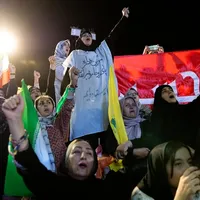
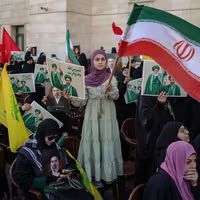
In Lordegan, mourners chanted “Death to Khamenei” and “This is the final battle — Pahlavi will return” during the funeral of Ali Khaledi, with the pre-1979 Lion and Sun flag raised above the crowd.
Sina Haghshenas, a young florist from northern Iran, was also killed during the nationwide uprisings by the Islamic Republic. At his funeral, mourners celebrated his life even in death — refusing silence, and turning grief into a final act of pride and defiance.
It is not customary in Iran to hold funerals with dancing and clapping, but this has become a form of protest among families who have lost loved ones.
Holly Dagres, a senior fellow at the Washington Institute, said the scenes reflect a profound shift in Iranian society.
"For the Islamic Republic, that is a very worrying thing, that instead of these people mourning and being traumatized by what has happened, which they are to an extent, they're celebrating. And that means to me and signifies that this is a people that's no longer afraid of the Islamic Republic.”
By rejecting religious rituals and replacing them with wedding music, families are sending a clear and defiant message.
“Whether you're simply looking at the fact that Iranians are calling their martyrs, not martyrs but Javid Nam, or 'long-lived name,'" said Behnam Ben Taleblu, director of the Foundation for Defense of Democracies’ Iran Program.
"There are many, many signs that the Iranian population, even as they grieve are trying to push past the discourse imposed on them by the Islamic Republic," he said.
For many Iranians, the celebrations are not a denial of loss but a declaration that fear has broken.
In the face of mass killings, families are reclaiming the meaning of death from a theocratic system that has long weaponized mourning and turned funerals into acts of national resistance, where even in grief, their message of defiance is clear.