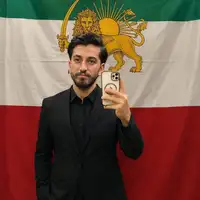
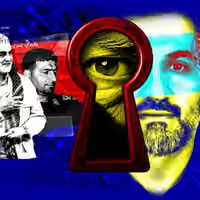
Mojtaba (Shahmorad) Shahpari, a protester from the southwestern Iranian city of Izeh who was injured during the nationwide protests and later found dead in a cold storage warehouse in Isfahan, was laid to rest wrapped in the lion and sun flag, fulfilling his final wish.
Shahpari was shot by security forces on January 8, 2026, during protests in Baharestan, Isfahan province, people familiar with the matter told Iran International.
The sources, who asked not to be named for fear of retaliation, said security forces opened fire indiscriminately on protesters that night.
“They opened fire on everyone that night, men and women, young and old,” the source said.
Videos sent to Iran International show gunshots being heard as protesters chant “long live the King” in Baharestan on January 8.
Security forces shot Shahpari in the leg on Isar Street in Baharestan sometime between 8:30 p.m. and 9 p.m. local time, causing him to fall to the ground, a source said.
Wounded but alive, he was taken by ambulance to Al-Zahra Hospital in Isfahan.
“He was not dead when he was taken to hospital,” the source added.
For days afterward, Shahpari’s family searched hospitals across Isfahan. Authorities repeatedly told them he was wounded and alive but refused to say where he was, the source said.
“Then there was nothing. No answers.”
Three days later, the family’s search ended near Bagh-e Rezvan cemetery, Isfahan’s main burial ground.
With the cemetery morgue full, bodies were being kept in a storage warehouse used for fruit and vegetables near Bagh-e Rezvan cemetery, the source said.
“There was no space ... They had put the bodies in a warehouse. As far as the eye could see, there were bodies,” putting the total at a minimum of 500.
When the body was found, a gunshot wound was visible on the side of his head, which the source said was not present when he was taken to hospital.
The source said they believed it was a gunshot to execute him and that he had been operated upon on his abdomen without his family's knowledge and later stitched back up.
About 18 miles southeast of Baharestan, also in Isfahan province, in the provincial capital, another source told Iran International that at the height of protests, “several containers of bodies” were brought to Bagh-e Rezvan in the middle of the night and unloaded into warehouses.
According to the source, some of the bodies were still alive and semi-conscious.
Shahpari, 32, was originally from Izeh in Khuzestan province in southwestern Iran, but had moved to Baharestan in search of work.
To support himself, he worked nights as a building security guard and spent his days unloading cargo as a laborer.
“He was a freedom-seeker,” a source said. “He opposed religion and supported the monarchy.”
Shahpari was buried on January 18, 2026, in the village of Nashil-e Do near Izeh.
“He was buried wrapped in the lion and sun flag, just as he wished...just as we all do.”