Emory University sacks daughter of Iran’s top security official Larijani
A protest gathering outside Emory University's Winship Cancer Institute held on January 19, 2026
Emory University has dismissed Fatemeh Ardeshir Larijani, the daughter of the US-sanctioned security chief of the Islamic Republic, the university confirmed to Iran International on Saturday, following growing calls for her removal.
"A physician who is the daughter of a senior Iranian government official is no longer an employee of Emory," the university’s Winship Cancer Institute, where Larijani worked, said in response to Iran International’s inquiry.
"Because this is a personnel matter, we are unable to provide additional information," the university said.
The US Treasury last week sanctioned Ali Larijani, the secretary of Iran's Supreme National Security Council, for “coordinating” the Islamic Republic's response to nationwide protests on behalf of Supreme Leader Ali Khamenei and for publicly calling on security forces to use force to repress peaceful demonstrators.
It sanctioned him alongside other alleged "architects" of the deadliest crackdown on protests in Iran's history earlier this month.
Emory University did not specify whether her dismissal was related to the US sanctions, but said its "employees are hired in full compliance with state and federal laws and other applicable requirements."
Ardeshir-Larijani was an assistant professor in the department of hematology and medical oncology at Emory medical school, whose official website described her research as focusing on "new target discovery and defining an immune resistance mechanism in lung cancer."
Her biography page at the university's website is no longer available following the Saturday dismissal.
US Representative Buddy Carter of Georgia earlier this week called for her removal from Emory and the revocation of her Georgia medical license.
Carter wrote in a letter to the university and the Georgia Composite Medical Board that Larijani had “recently and publicly advocated violence against Americans and US allies” while holding a senior national security position, and argued that his daughter’s continued role treating patients in the United States was unacceptable.
Iran’s near-total internet blackout since January 8 did not only shut down social media but collapsed the country’s last channels to the outside world, isolating families and sharply limiting what evidence of the crackdown could escape.
The shutdown, imposed on January 8 as protests spread nationwide, follows a familiar pattern in the Islamic Republic’s response to unrest. But its scale and duration have once again exposed a critical vulnerability for both Iranians and the outside world: when domestic networks go dark, how does information still get out?
The answer lies in a narrow and increasingly contested ecosystem of satellite-based and offline technologies that operate beyond Iran’s communications infrastructure.
Among the actors working in that space is NetFreedom Pioneers (NFP), a US-based nonprofit that has spent more than a decade developing tools for societies living under digital repression.
“People in Iran are asking for basic freedoms and basic livelihoods, and they are facing live fire,” said Evan Firoozi, NFP’s executive director. “The question is whether the outside world can still see what is happening.”
Founded in Los Angeles in 2012, NFP initially focused on countering Iran’s expanding censorship regime.
Its best-known technology, Toosheh, is a one-way satellite file-casting system that delivers information using widely available household equipment: free-to-air satellite dishes, receivers and USB drives. Because it does not rely on internet connectivity, Toosheh can continue operating even during nationwide shutdowns.
Over the years, the system has been used to distribute global news, digital security guidance and educational material inside Iran. During periods of unrest, NFP says it adjusts the content it sends, prioritizing personal safety information and verified reporting.
After a five-month pause linked to US funding disruptions, Toosheh resumed broadcasts in January as the blackout took hold.
Two-way communication is far harder to sustain. That gap has increasingly been filled by Starlink, the satellite internet service operated by SpaceX.
NFP is supporting Starlink access for Iranians, delivering terminals and covering subscription costs–that is, until Elon Musk lifted subscription fees for users in Iran–thanks to public's donations.
During the 2022 Women, Life, Freedom protests, NFP began helping deliver Starlink terminals into Iran, enabling limited but crucial connectivity for activists, journalists and civil-society networks.
“Without satellite internet, much of what the world sees from Iran simply wouldn’t exist,” said Mehdi Yahyanejad, an NFP co-founder and board member. “Most of the photos and videos that do emerge during shutdowns are transmitted through Starlink.”
The number of Starlink terminals inside Iran is impossible to verify. Activists estimate that tens of thousands may be scattered across the country, smuggled in via third countries and used not only by political groups but also by businesses, students and households seeking uncensored access.
Countermeasures
Iranian authorities have acknowledged the threat posed by such systems, and users report intermittent jamming, reportedly using Russian-supplied technology.
This week, monitoring groups including NetBlocks and Access Now reported brief, inconsistent openings in Iran’s shutdown, allowing limited messaging and data access.
The restrictions, however, remain largely in place, leaving satellite systems, one-way tools like Toosheh and trusted circumvention software as the primary lifelines for both Iranians and those trying to document events from abroad.
Groups working in this space have relied in part on public fundraising to finance satellite terminals and subscriptions, drawing support from the Iranian diaspora and technology donors.
For now, Iranians are forced to rely on a fragile patchwork: shared Starlink terminals switched on briefly to avoid detection, one-way satellite systems like Toosheh, and circumvention tools that work only intermittently.
It is enough to let fragments escape, but not enough to guarantee sustained, safe communication for millions living under blackout conditions.
New satellite technologies, including Direct-to-Cell services that allow ordinary mobile phones to connect directly to satellites without ground infrastructure, could fundamentally alter the balance.
Yet for Iranians, these services remain out of reach, constrained by sanctions, licensing barriers and political hesitation, even as the blackout model becomes an increasingly central tool of repression.
Until that changes, the outside world’s view into Iran will continue to depend on a narrow group of actors willing to take extraordinary risks to keep information moving.
Their work does not end repression, but it prevents it from disappearing entirely into darkness—and in moments like this, that distinction matters.
After unprecedented mass killings of protestors whose full scope lies concealed behind Iran's internet iron curtain, the Washington-based pro-Israel think tank JINSA urges Donald Trump to seize the moment to destroy the mutual foe of Israel and the United States.
The non-profit Jewish Institute for National Security of America, founded in 1976, advocates for a strong US military relationship with Israel and researches conflict in the Middle East.
JINSA president and CEO Michael Makovsky and the group’s vice president for policy Blaise Misztal told Iran International’s English-language podcast Eye for Iran that decades of containment, deterrence and nuclear diplomacy have failed because the Islamic Republic itself should be destroyed.
“It should be US policy to seek the collapse of this regime,” Makovsky said.
They said hesitation now — after mass killings of protesters across Iran — risks emboldening Tehran at the theocracy's weakest moment.
“We don’t say regime change,” Makovsky said. “The regime will fall … only when the Iranian people bring it down. But it should be US policy … to seek the collapse of this regime.”
The last months, Misztal said, have created a rare strategic opening: Iran’s nuclear clock has been set back, its regional proxies weakened and Iranians themselves have returned to the streets demanding freedom.
“This is a moment like no other,” he said. “I don’t know when the stars will align like this again… why not make it now? When is a better time than now?”
The duo urged the Trump administration to abandon negotiations, intensify pressure on the Revolutionary Guards and build the infrastructure needed to help Iranians defeat the Islamic Republic.
Misztal said previous administrations focused on Iran’s nuclear program, terrorism sponsorship and ballistic missile development as separate threats without tying them back to what he called the ideological nature of the theocracy.
“Yes, it’s a problem that Iran is the world’s greatest state sponsor of terrorism. Yes, it is a problem that it’s pursuing nuclear weapons,” he said. “But all of that stems from it being the Islamic Republic of Iran.”
Trump’s Promises and a Moment of Decision
Their warnings come as President Donald Trump faces rising scrutiny over his own rhetoric. Earlier this month, Trump vowed support for protesters and issued a direct warning to Tehran.
“I tell the Iranian leaders: You better not start shooting, because we’ll start shooting, too,” he said.
But Makovsky warned that after mass killings and widespread arrests, the absence of immediate consequences risks damaging US credibility.
“The Iranians have called his bluff for now,” he said. “If he doesn’t do it, it will go down as a tragic mistake.”
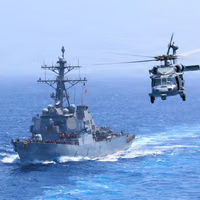
In recent days, Trump has said a US "armada" is heading toward the Middle East, with the aircraft carrier USS Abraham Lincoln and several guided-missile destroyers expected to arrive in the region soon as Washington signals it is positioning military assets amid escalating uncertainty.
The growing tensions are now rippling far beyond Iran itself.
Major European airlines have begun suspending flights across parts of the Middle East, citing security concerns. Air France has canceled flights to Tel Aviv and Dubai, British Airways has halted evening service to Dubai and KLM has suspended routes to Israel, Saudi Arabia and the UAE.
Industry officials say cancellations are expected to increase gradually as carriers reassess airspace restrictions and passenger safety in a rapidly deteriorating regional environment.
A Cold War–Style Pressure Campaign
Misztal framed the strategy as a modern version of what the United States pursued against Soviet communism: strengthening civil resistance while weakening the ruling system from within.
“The strategy of regime collapse has been precisely what the United States pursued throughout the Cold War,” he said.
He argued that Washington should encourage defections, isolate elites in authority, cut off funding streams and expand opposition communications.
“One of the things we recommended is a quarantine of Iran’s oil exports,” Misztal said, “so that it doesn’t keep getting the money to rebuild its forces to pay the Basij or the IRGC.”
Both analysts warned that Iran’s leadership is entering what they described as its most dangerous phase, amid mass violence at home and the potential for war abraod.
“A showdown of some kind” is coming, Misztal said, and “the next showdown will be the last one."
Iran's Supreme Leader Ali Khamenei has moved into a special underground shelter in Tehran after senior military and security officials assessed an increased risk of a potential US attack, two sources close to the government told Iran International.
The facility was described as a fortified site with interconnected tunnels.
The sources indicated that Masoud Khamenei, the supreme leader’s third son, has taken over day-to-day management of the leader’s office and serves as the main channel for communication with executive branches of the government.
Iran’s Supreme Leader Ali Khamenei ordered state media and security bodies to adopt a militarized approach toward controlling information, according to a new report by media freedom advocacy group DeFFI.
The Defending Free Flow of Information Organization (DeFFI) said its 2025 annual report documented 264 cases of intensified judicial and security pressure against journalists and media outlets, including arrests, interrogations, trials and operational disruptions.
The report says Iranian authorities now treat independent journalism as a security issue, framing the flow of information as a threat that requires a coordinated response by judicial, intelligence and media bodies.
According to DeFFI, 225 journalists and media outlets faced judicial or security measures last year, with 148 new judicial cases filed against media workers. At least 14 journalists were detained or had prison sentences enforced, while 8 media outlets were shut down or banned.
The report found that 34 female journalists were among those targeted and that judicial and security institutions violated legal rights in at least 396 documented instances.
The most frequently used charge against journalists was “spreading falsehoods,” applied in 106 cases, DeFFI added.
Sentences issued to 25 journalists and media managers collectively exceeded 30 years in prison, alongside nearly 293 million tomans (more than $2,000) in fines and five years of internal exile, according to the report.
The findings come as Iran has been under a near-total internet blackout since January 8, imposed amid nationwide anti-government protests.
The shutdown has severely restricted public access to global online platforms while allowing state-linked media and select institutions to remain connected.
Internet monitoring and human rights groups say the blackout, which has lasted for hundreds of hours, is among the longest and most comprehensive imposed by government in Iran.
Iranian security forces deployed unknown chemical substances amid deadly crackdowns on protestors in several cities earlier this month, eyewitnesses told Iran International, causing severe breathing problems and burning pain.
They described symptoms that they said went beyond those caused by conventional tear gas, including severe breathing difficulties, sudden weakness and loss of movement.
“What was fired was not tear gas,” one protester said.
"People collapsed," another eyewitness said.
Iranian authorities crushed unrest earlier this month in the deadliest crackdown on protestors in the Islamic Republic's nearly 50-year history.
According to accounts, the gases caused intense burning of the eyes, skin and lungs, along with acute respiratory distress, repeated coughing, dizziness, loss of balance and, in some cases, vomiting or coughing up blood.
Witnesses said the severity and persistence of the symptoms differed from their past experiences with tear gas, although they said they could not identify the substances used.
Gas fired into crowds and escape routes
Witnesses said gas canisters were fired into crowds and along escape routes, including narrow streets and alleys.
According to the accounts, in some cases gunfire began at the same time, or immediately after, protesters lost the ability to walk or run and fell to the ground.
Several witnesses said that moments of immobilization became points at which shooting intensified, particularly when protesters collapsed in alleys or while trying to flee.
Reports came from multiple cities, including Tehran, Isfahan and Sabzevar.
Sabzevar footage
Videos received from Sabzevar, a city in Razavi Khorasan province in northeastern Iran, and reviewed by Iran International showed security personnel wearing special protective clothing and masks designed for hazardous chemical materials, positioned on military-style vehicles in city streets.
Warning symbols associated with hazardous substances were visible on vehicles in the footage. Sounds consistent with gunfire could be heard in separate videos.
Iranian forces are seen wearing chemical-hazard protective gear on military-style vehicles in the streets of Sabzevar, northeast Iran.
A yellow triangular hazardous-materials warning sign is visible in the footage, while gunfire can be heard in a separate video.
Isfahan accounts
In central province of Isfahan, witnesses said tear gas with chemical characteristics was fired directly into crowds of protesters, including teenagers, young people and older individuals.
They said attempts to reduce the effects of the gas using common methods such as wet cloths quickly proved ineffective.
Witnesses described scenes in which people fleeing into alleys developed severe breathing difficulties and collapsed after running short distances. They said shooting began while protesters were in that condition, with scenes they described as “like war movies.”
Other witnesses described the smell of the gases as a mixture of pepper, swimming-pool chlorine, bleach and vinegar, and said the sky filled with smoke in red, yellow and white colors.
Several women and a 17-year-old girl described seeing an unknown device that, they said, “without the sound of gunfire, fired something like flames in red and yellow.”
“Seconds later, the street was full of smoke and vapor,” they said, adding that the smell resembled ammonia, drain cleaner and, in some areas, mustard.
One woman said two plainclothes agents put on protective masks before throwing gas canisters toward nearby crowds. She said young people closest to the impact “quickly developed coughing, intense burning and inability to move” and shouted: “I’m burned.”
Tehran accounts
In Tehran, witnesses from several neighborhoods said gas was fired repeatedly, producing thick smoke and severe irritation.
Protesters said the gases caused intense burning of the eyes and lungs and numbness in the lips, with smoke described as green, yellow and black.
Witnesses said protesters who felt suffocation sought refuge inside nearby homes, but said security agents were positioned near some of those locations.
In addition to tear gas, witnesses spoke of “unknown gases with more severe effects,” saying those exposed experienced sudden weakness, inability to walk and loss of breath.
Fear of hospitals
In a number of accounts, witnesses said fear of the presence of security agents at hospitals and the risk of arrest led many wounded protesters to avoid medical centers.
They said some treatment was instead carried out at private homes with the help of volunteer doctors.
Some witnesses said people they knew continued to suffer severe coughing, nausea and skin blistering days after exposure.
Medical assessment
Alan Fotouhi, a physician and professor of clinical pharmacology based in Sweden, told Iran International that the symptoms described by witnesses did not match those typically associated with standard tear gas.
He said the pattern of symptoms, severity of harm and persistence of effects differed from what is normally observed with conventional tear gas exposure.
Fotouhi said the reported effects could result from a combination of high-dose tear gas and other highly irritating chemical substances, but said identifying the exact materials would require laboratory analysis.
Iranian authorities have not commented on the witness accounts.
Iran is a signatory to the Chemical Weapons Convention, which restricts the use of chemical agents against civilians.
Human rights groups have condemned the use of force against protesters in Iran, including the use of tear gas and live ammunition.
“Physicians are entrusted with intimate access to patients, sensitive personal information, and critical medical decision-making,” Carter wrote, adding that allowing someone with close family ties to a senior Iranian security official to hold such a position posed risks to patient trust, institutional integrity and national security.
The dismissal comes a few days after a protest gathering by a group of Iranians outside the Winship Cancer Institute, where protestors demanded her removal over her father's role in the brutal crackdown on Iranian protesters.