Witnesses report gunfire aimed at heads, faces in Dezful protests
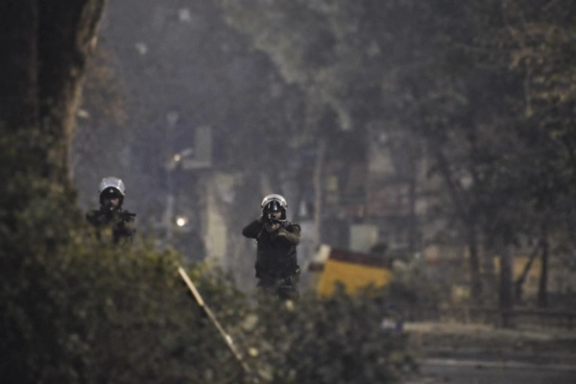

Eyewitnesses from protests in the city of Dezful said security forces carried out widespread repression on January 8 and 9, firing directly at protesters’ heads and faces.
Local accounts described the clashes escalating into open street war, with anyone seen outside coming under fire.
Security forces, according to residents, used motorcycles to surround demonstrators and fired pellet guns, wounding large numbers of people.
Witnesses also reported the use of finishing shots and simultaneous aerial and direct gunfire to spread fear. One resident present in the city estimated the death toll at around 400, with thousands detained.
Images and messages received by Iran International indicate that protesters in Karaj were killed by sniper fire during demonstrations, followed by the nighttime burial of victims, including a 16-year-old boy identified as Reza.
According to witness accounts on January 8 and at around 9:00 at night, Reza was shot dead in an alley in the Shahin Villa neighborhood. Witnesses said the shot was fired by a sniper positioned on the rooftop of a fruit shop.
Witnesses said Reza was moved after being shot into a nearby home’s parking area, where he died. After the situation calmed, his body was taken to a local clinic.
The following day, people close to the family were told that Islamic Revolutionary Guard Corps forces had buried the teenager’s body overnight and informed the family of the grave’s location.
According to residents, armed forces were deployed at Shahin Villa’s Eighth and Ninth bases and prevented people from approaching by firing live ammunition. Witnesses said at least six people were killed by gunfire on Shahin Villa Street alone, adding that the shooting appeared targeted, particularly against younger protesters.

A witness to protests in Fardis, Alborz province, said the “main killing” occurred on Friday, January 9, when security forces intensified their crackdown and opened fire with live ammunition on protesters after initially allowing the gathering to proceed.
The witness told Iran International that on January 8, the first day of protests, security forces were caught off guard by the size of the crowd and that the number of fatalities that night was limited.
According to the witness, the situation escalated sharply the following day when Islamic Revolutionary Guard Corps forces and special police units, after permitting the protest to take place, opened fire from multiple directions using military-grade weapons.
“In some areas of Fardis there was widespread gunfire, and a large number of people were killed on Ahari Street,” the witness said.
The witness also reported seeing direct shootings, including what they described as execution-style “final shots” fired at elderly protesters.
According to the account, in several cases families of those killed by direct fire were later forced to sign commitments identifying the victims as members of the Basij militia. The witness said this was done because families were unable to afford the high costs demanded for the release of the bodies.


Iranian security forces shot at people trying to help the wounded during protests in the northern city of Rasht, according to eyewitness accounts shared with Iran International.
The witnesses said security forces surrounded injured protesters to block assistance and fired directly at anyone who tried to help.
“In some cases they formed a circle around the wounded so no one could get close, and if anyone tried to help, they opened fire,” one witness said in a message from Rasht.
The witness described an incident on Takhti Street in which a wounded person lay bleeding in the street. When a resident tried to help, security forces hiding in an alley opposite shot both individuals, killing them, the witness said, adding that the rescuer was shot in the head.
The witness said security forces hid in alleys and fired at people passing through.
Witnesses told Iran International that a 30-year-old woman and mother of a 7-year-old girl was killed after being shot by security forces during protests in Nurabad Mamasani, a city in southwest Iran, earlier this month.
According to the accounts, Parisa Lashkari was shot on Jan. 10 during demonstrations in the city. Witnesses said she was wounded and called her husband and brother for help, telling them to come and take her away, before being hit by additional gunfire minutes later.
The accounts said Revolutionary Guards forces later transported both the wounded and the dead together, and that Lashkari was among those taken away.
Her family was contacted several days later to collect her body, which was handed over under security restrictions, the witnesses said.
Witnesses told Iran International that security forces used heavy force against protesters in the city of Borujerd, in Iran’s western Lorestan province, including what they described as live ammunition and high-pressure water cannons.
According to the accounts, large crowds gathered on the first night of recent protest calls, with people of all ages taking part.
One witness said security forces fired live rounds and pellet guns at demonstrators, who had little means of defense.
The witness also said authorities used water cannon trucks, drones and aerial surveillance to disperse the crowd.
The account said several civilians were killed that night and many others wounded, though the claims could not be independently verified.
Witnesses said an internet shutdown made it difficult to share images or videos of the events.