Iran lawmaker opposes lifting internet restrictions
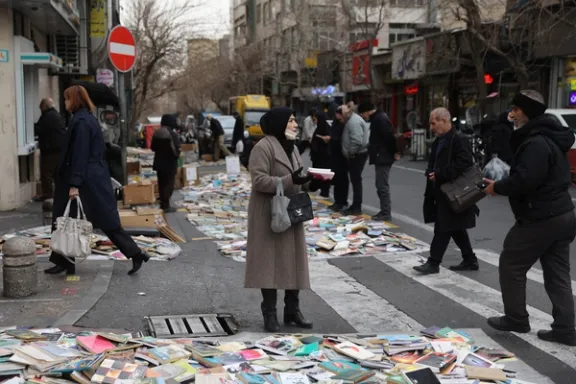
An Iranian lawmaker said lifting restrictions on social media platforms would be a major mistake, warning it could harm the country internationally.
Abolfazl Aboutorabi, a member of parliament from Najafabad, said restoring access to restricted networks would allow government opponents to spread violent images.
“Lifting social media restrictions again is a big mistake,” Aboutorabi was quoted as saying. He added that opposition groups were ready to act once limits were removed, which he said could bring international consequences for Iran.





Venezuelan opposition leader Maria Corina Machado said democratic governments must raise the cost for Iran’s rulers to stay in power in an interview with Iranian activist Masih Alinejad.
Machado said Iran and Venezuela were bound by deep cooperation between their rulers, even as people in both countries rise up against repression.
“The Iranian people, the Venezuelan people, we are fighting the same struggle,” she said. “These regimes have been cooperating for many years, exchanging resources, information, technology, agents and weapons.”
She said authoritarian governments help each other bypass pressure and maintain control, while democracies often stop at statements.
“Dictators help each other, they exchange technology, resources, they help each other bypass sanctions and they support each other in international forums,” Machado said. “Democratic governments stay at statements and declarations that at the end do not serve the people.”
Machado said people in Iran had reached a breaking point and were calling on the world to respond.
“We reach a point where the people start asking the world to react and to support,” she said. “What we are asking for is to stop the killings and to save lives.”
She criticized what she described as double standards among democratic governments that condemn repression while maintaining economic ties.
“You sign declarations talking about freedom and equality and respect for human rights, then you do business with these regimes,” Machado said. “You buy oil from these regimes and you keep their assets and resources in your own financial systems.”
Praise for Trump action
Machado praised Donald Trump for taking decisive action against Venezuelan President Nicolas Maduro and said it showed what firm leadership could achieve.
“Finally in Venezuela we’re seeing President Trump making a tremendous important decision,” she said. “Bringing a criminal to justice is precisely what the world needs.”
She said the move sent a signal beyond Venezuela.
“It has brought a lot of hope,” Machado said. “This is a milestone.”
Machado said repression continues when dictators see little cost in using force.
“When you’re dealing with criminals, the only way they will leave is when the cost of staying in power is higher than the cost of leaving,” she said.
She said opposition movements cannot succeed alone without coordinated international pressure.
“We have done everything that any civic movement can do and they are killing us,” Machado said. “What we are asking for is applying law enforcement and cutting the resources they use to fund repression.”
Machado said the fall of Iran’s ruling system would have consequences far beyond the country.
“Imagine how the world will look once the Iranian criminal regime falls,” she said. “This is a unique moment in history.”
She said cooperation among opposition groups and diasporas was essential.
“These regimes help each other, and we the people need to connect and coordinate,” Machado said. “Regardless of how far away we are, we are united in this aspiration.”
Venezuelan opposition leader Maria Corina Machado said democratic governments must raise the cost for Iran’s rulers to stay in power in an interview with Iranian activist Masih Alinejad.
Machado said Iran and Venezuela were bound by deep cooperation between their rulers, even as people in both countries rise up against repression.
“The Iranian people, the Venezuelan people, we are fighting the same struggle,” she said. “These regimes have been cooperating for many years, exchanging resources, information, technology, agents and weapons.”
She said authoritarian governments help each other bypass pressure and maintain control, while democracies often stop at statements.
Machado praised Donald Trump for taking decisive action against Venezuelan President Nicolas Maduro and said it showed what firm leadership could achieve.
“Finally in Venezuela we’re seeing President Trump making a tremendous important decision,” she said. “Bringing a criminal to justice is precisely what the world needs.”
She said the move sent a signal beyond Venezuela.
“It has brought a lot of hope,” Machado said. “This is a milestone.”
Witnesses told Iran International that a 30-year-old woman and mother of a 7-year-old girl was killed after being shot by security forces during protests in Nurabad Mamasani, a city in southwest Iran, earlier this month.
According to the accounts, Parisa Lashkari was shot on Jan. 10 during demonstrations in the city. Witnesses said she was wounded and called her husband and brother for help, telling them to come and take her away, before being hit by additional gunfire minutes later.
The accounts said Revolutionary Guards forces later transported both the wounded and the dead together, and that Lashkari was among those taken away.
Her family was contacted several days later to collect her body, which was handed over under security restrictions, the witnesses said.
One year after US President Donald Trump returned to the White House and revived the "maximum pressure" sanctions on Iran from his first term, available data show the country’s energy exports remain largely intact.
Data from the commodity intelligence firm Kpler, seen by Iran International, show that in 2025 Iran delivered an average of 1.38 million barrels per day (bpd) of crude oil and gas condensate to China—a decline of just 7 percent compared with 2024.
After Iranian oil exports to Syria halted in December 2024, China effectively remained Tehran’s sole buyer of crude oil over the past year.
Unlike crude oil, Iran’s petroleum product exports—fuel oil (mazut), naphtha and liquefied petroleum gas (LPG)—are relatively diversified, with shipments mainly destined for China, the United Arab Emirates, Malaysia and Singapore.
According to Kpler, Iran exported an average of 190,000 bpd of naphtha and 256,000 bpd of fuel oil last year, a combined decline of about 13 percent compared with 2024.
The drop, however, was driven not by tighter US sanctions but by Iran’s worsening domestic gas shortages, which forced power plants and industrial facilities to burn more fuel oil, reducing volumes available for export.
Data from tanker-tracking firms Kpler and Vortexa show that the modest decline in crude oil exports was offset by increased shipments of natural gas and LPG.
Iran has also continued exporting natural gas to Turkey and Iraq.
Tehran and Baghdad don’t publish official figures, but data from Turkey’s energy ministry indicate that natural gas imports from Iran increased about 9 percent during the first 11 months of last year compared with the same period in 2024.
One reason US sanctions have struggled to significantly curb Iran’s energy exports has been the continued operation of the so-called shadow fleet—a network of oil tankers that transport sanctioned crude through flag changes, disabled tracking systems, ship-to-ship transfers, and opaque ownership structures.
According to estimates by TankerTrackers, roughly 1,500 oil tankers worldwide were involved in shadow fleet activity last year, with nearly 40 percent linked to Iranian oil shipments.
Although the United States stepped up sanctions on such tankers in 2025, existing data suggests that hundreds of non-sanctioned vessels remain active in transporting Iranian oil through opaque trading routes and intermediary networks, undermining the enforcement capacity of US measures.
Further data from Kpler indicate that widespread domestic protests in Iran in recent weeks have had no noticeable impact on the country’s oil and petroleum product export volumes.
While China has remained the sole buyer of Iranian crude oil and condensate, the United Arab Emirates—one of Washington’s closest regional allies—has emerged as the largest importer of Iranian fuel oil, accounting for nearly 70 percent of those exports.
Estimates by Iran International put the total value of Iran’s exports of crude oil, petroleum products, and natural gas last year—excluding discounts and the costs of sanctions evasion—at roughly $60 billion.
The figure highlights the gap between early US projections that Iran’s oil exports would collapse by as much as 90 percent and the far more limited impact visible in the data so far.
Iran’s deputy foreign minister accused the United States of undermining global security and international law.
“The US move toward an international order based on force and intimidation has undermined security and international law,” Saeed Khatibzadeh said, offering no evidence for the claim.
“The US has shown that it is not loyal to the path of diplomacy and, in practice, sacrifices dialogue and engagement for pressure, threats and destabilization,” he added.
The United States has repeatedly said its policies toward Iran are aimed at curbing Tehran’s nuclear program and regional activities.