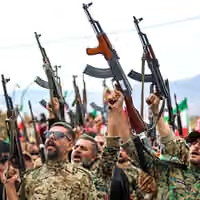
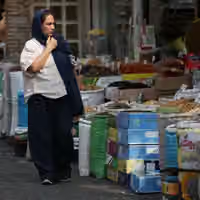
A United Nations fact-finding mission said credible information suggested the number of protesters killed in Iran’s crackdown was “much higher” than official figures that already cite thousands of deaths.
The mission also said the violence marked the deadliest crackdown since Iran’s 1979 Islamic Revolution.
“Violence against protesters is the deadliest crackdown since the 1979 Iranian revolution,” the UN fact-finding mission on Iran said, citing information gathered during its investigation.
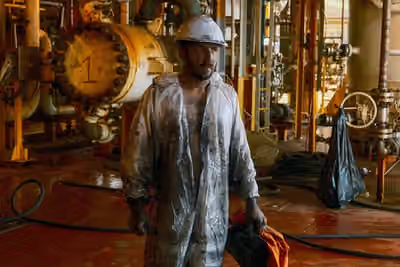
The United Nations human rights chief said there were indications that Iranian security forces carried out mass arrests during the crackdown on protests, including pursuing wounded protesters into hospitals.
“We have indications that the security forces made mass arrests, even pursuing injured people into hospitals,” Volker Turk told the UN Human Rights Council at an emergency session on Iran.
Turk said thousands of people were killed during the crackdown.
“Thousands were killed in Iran’s crackdown on protests, including children,” he said.
The emergency session was convened to discuss what the council described as “alarming violence” used against protesters and to consider documenting alleged abuses for possible future legal proceedings.
Iran has sharply reduced operations at its consulate in central London, Iran International reported, following protests that took place outside the building during the recent unrest in Iran.
According to information received by Iran International, the consulate’s first floor has been fully evacuated and locked, and staff numbers at the site have been significantly reduced. Consular services are now being provided at a much more limited level than before.
Images obtained by Iran International in recent days showed office equipment and administrative materials being removed from the building, with vehicles seen transferring staff and items to another location earlier this week.
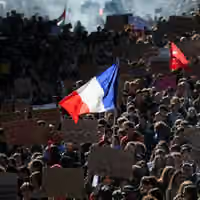
The changes follow demonstrations held outside Iran’s embassy and consulate in London during the nationwide protests in Iran.
British police previously deployed metal barriers and vehicles to secure the area during the demonstrations.
A senior commander of Iran’s Revolutionary Guards said adversaries would fail in any attempt to damage the Islamic Republic, repeating defiant rhetoric from Tehran amid heightened tensions.
Ahmad Vahidi said the Guards were created to protect Iran’s Islamic system and remained prepared to confront what he described as external threats.
“Enemies should know they cannot inflict any harm on the Islamic Republic of Iran,” Vahidi said, according to state media.
EU lawmaker Hannah Neumann said she will host a public meeting next week on the violent repression of protests in Iran.
“Next Monday, 26 January, I will host a public meeting on the violent repression of protests in Iran, with a focus on minority groups,” Neumann wrote on X.
The session will be publicly livestreamed, she added.
Iran’s Supreme National Security Council instructed newspaper editors and online media managers to stop publishing independent reporting on protest deaths and to avoid interviewing bereaved families, according to information shared with Iran International.
The instruction, according to the information received by Iran International, was conveyed during a meeting with managers of domestic media outlets and explicitly required them to refer only to figures released by state bodies, while avoiding any independent accounting of deaths.
The same directive, the sources said, also prohibited interviews or conversations with families of those killed.