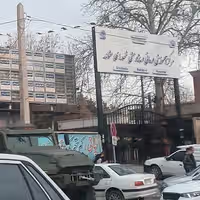
Iran has sharply reduced operations at its consulate in central London, Iran International reported, following protests that took place outside the building during the recent unrest in Iran.
According to information received by Iran International, the consulate’s first floor has been fully evacuated and locked, and staff numbers at the site have been significantly reduced. Consular services are now being provided at a much more limited level than before.
Images obtained by Iran International in recent days showed office equipment and administrative materials being removed from the building, with vehicles seen transferring staff and items to another location earlier this week.
The changes follow demonstrations held outside Iran’s embassy and consulate in London during the nationwide protests in Iran.
British police previously deployed metal barriers and vehicles to secure the area during the demonstrations.
Iran’s Supreme National Security Council instructed newspaper editors and online media managers to stop publishing independent reporting on protest deaths and to avoid interviewing bereaved families, according to information shared with Iran International.
The instruction, according to the information received by Iran International, was conveyed during a meeting with managers of domestic media outlets and explicitly required them to refer only to figures released by state bodies, while avoiding any independent accounting of deaths.
The same directive, the sources said, also prohibited interviews or conversations with families of those killed.

Iran’s Supreme National Security Council instructed newspaper editors and online media managers to stop publishing independent reporting on protest deaths and to avoid interviewing bereaved families, according to information shared with Iran International.
The instruction, according to the information received by Iran International, was conveyed during a meeting with managers of domestic media outlets and explicitly required them to refer only to figures released by state bodies, while avoiding any independent accounting of deaths.
The same directive, the sources said, also prohibited interviews or conversations with families of those killed.
Sources described as familiar with the decision said the measure was aimed at preventing broader disclosure of the scale of the killings of protesters, which they said occurred under direct orders from Supreme Leader Ali Khamenei.
Media managers question the order
The directive was delivered, the report said, as some domestic media managers challenged the government’s line during the same session, pointing to internal information suggesting a death toll in the thousands and questioning instructions issued under President Masoud Pezeshkian and the Supreme National Security Council.
Those participants, according to the account, argued there is a wide gap between official numbers and information circulating inside the country.
Iran’s National Security Council, a body operating under the Interior Minister, on Wednesday published figures for the first time covering deaths on January 8 and 9.
The statement put the number of killed protesters at 690. It also listed a total death toll of 3,117 across the two days, but described 2,427 of those as “martyrs” drawn from “innocent people and guardians of order and security,” a designation in the Islamic Republic’s official language generally used for those aligned with state institutions.
The Islamic Republic’s Martyrs Foundation also announced on Wednesday that military and security forces had taken the lives of only 690 protesters, while another 2,427 people were said to have been killed by protesters. The institution had initially reported 3,317 deaths, but hours later revised the figure down to 3,117.
Iran International said the official numbers differ sharply from information it has received, eyewitness accounts, and reporting by international media.
The outlet’s editorial board has previously put the number of protesters killed by state forces at at least 12,000, according to its published statement.
The number of civilians killed in Iran’s crackdown on protests may be more than 20,000, the UN special rapporteur on human rights in Iran said, citing reports from doctors inside the country, Bloomberg reported.
Mai Sato said earlier this week that civilian deaths were estimated at 5,000 or more, adding that medical reports suggested the toll could be far higher, at about 20,000 or more.
Iran International’s statement described the killings on January 8 and 9 as unprecedented in modern Iranian history in geographic spread, intensity of violence, and number of deaths.
A 37-year-old physiotherapist and clinic founder was shot dead during protests in Iran earlier this month, and his family was later forced to pay money to retrieve his body, a source familiar with the matter told Iran International.
The source identified him as Masoud Bolourchi, a Tehran-based physiotherapist and founder of Rush Physiotherapy Clinic, and said he was shot from behind on Jan. 8.
According to the source, his family later located his body in Kahrizak, south of Tehran, and were pressured by security officials into paying what was described as a “bullet fee” before it was released.
Bolourchi had studied in Budapest, Hungary, and had returned to Iran several years ago, the source said.

A serving official at Iran’s Interior Ministry has defected from his post and joined the protests, urging US President Donald Trump to intervene against the Islamic Republic, he said in a message to Iran International.
The official said in an audio message recorded on Sunday that he stayed away from work after a call by exiled Crown Prince Reza Pahlavi.
Iran International is withholding the official’s identity for security reasons.
The official said he took part in recent demonstrations and witnessed the Islamic Republic’s use of live fire against protesters.
He said protesters were facing armed forces with no means to defend themselves. “People have done everything they can and made their demands clear,” he said, adding that security forces were deliberately targeting demonstrators with live ammunition.
The official appealed directly to Trump to act, saying many Iranians were waiting for US intervention. “People are waiting for Trump, and if he does nothing, widespread hatred toward him will emerge among Iranians,” he said.
He accused security forces of using G3 rifles against civilians and warned that patience inside Iran was running out.
The official also described what he called de facto martial law in several provinces, with traffic tightly controlled, motorcycle units deployed, and armored vehicles patrolling streets to prevent gatherings.
According to the official, the scale of protests on January 8 and 9 was unprecedented in the history of the Islamic Republic, prompting authorities to restrict internet access and block the flow of images and videos.
“The Islamic Republic is ruthless and will do anything,” he said, adding that agents were operating openly with weapons in the streets.
The Interior Ministry official said he believed Trump would ultimately act but stressed that expectations among protesters were growing as violence continued.
Trump has previously warned Tehran that if Iranian authorities fired on protesters, the United States would respond in kind. Days later, he said he had been told executions in Iran were halted following his warning.
In his most recent comments to Politico, Trump spoke openly about the need for leadership change in Iran, calling Supreme Leader Ali Khamenei “a sick man.”
A serving official at Iran’s Interior Ministry has defected from his post and joined the protests, urging US President Donald Trump to intervene against the Islamic Republic, he said in a message to Iran International.
The official said in an audio message recorded on Sunday that he stayed away from work after a call by exiled Crown Prince Reza Pahlavi.
Iran International is withholding the official’s identity for security reasons.
The official said he took part in recent demonstrations and witnessed the Islamic Republic’s use of live fire against protesters.
The official appealed directly to Trump to act, saying many Iranians were waiting for US intervention. “People are waiting for Trump, and if he does nothing, widespread hatred toward him will emerge among Iranians,” he said.